Table of Contents
The Generative AI in DevOps market is projected to reach USD 22.1 billion by 2032, up from USD 942.5 million in 2022. Individual developers write code 21% faster with AI tools for DevOps, and pull request volume has jumped 98% in AI-augmented teams. Yet deployment queues are longer, alert fatigue is worse, and mean time to recovery (MTTR) has barely moved.
Ninety percent of software professionals now use AI at work, according to the DORA 2025 State of AI-Assisted Software Development Report. Despite this, the selection criteria for AI tools for DevOps remain poorly defined at the C-suite level. Dev velocity is rising, but everything downstream, including deployment pipelines, incident response, and infrastructure provisioning, stays manual in most enterprises.
This guide is for CTOs and VPs of Engineering evaluating how modern engineering teams solve DevOps challenges based on cost, scalability, and measurable business impact. It covers the top 10 DevOps automation tools, a pricing tier comparison, ROI benchmarks, and a vendor checklist to help you select the right AI tools for DevOps.
AI tools for DevOps are software platforms using machine learning to automate and optimize tasks across the full DevOps lifecycle. They cluster into four capability groups: code generation, CI/CD AI tools optimization, observability platform intelligence, and incident response automation, delivered through AIOPS platforms and DevOps AI automation workflows.
These DevOps automation tools amplify what works. AI tools for DevOps do not fix broken processes.
Teams running manual, ticket-based deployment approvals will not see faster deployment frequency after adopting CI/CD AI tools. The DevOps automation tools simply generate more code waiting in the same queue.
DORA 2025 confirms this: adoption of AI tools for DevOps increases deployment instability in teams lacking strong continuous integration pipeline foundations. Only 16.2% of teams deploy on demand, and 9.4% achieve sub-one-hour lead time. Results come from workflow maturity, not from smarter AI powered DevOps tooling.
AI powered DevOps investment is accelerating because the cost of inaction is now measurable at the board level.
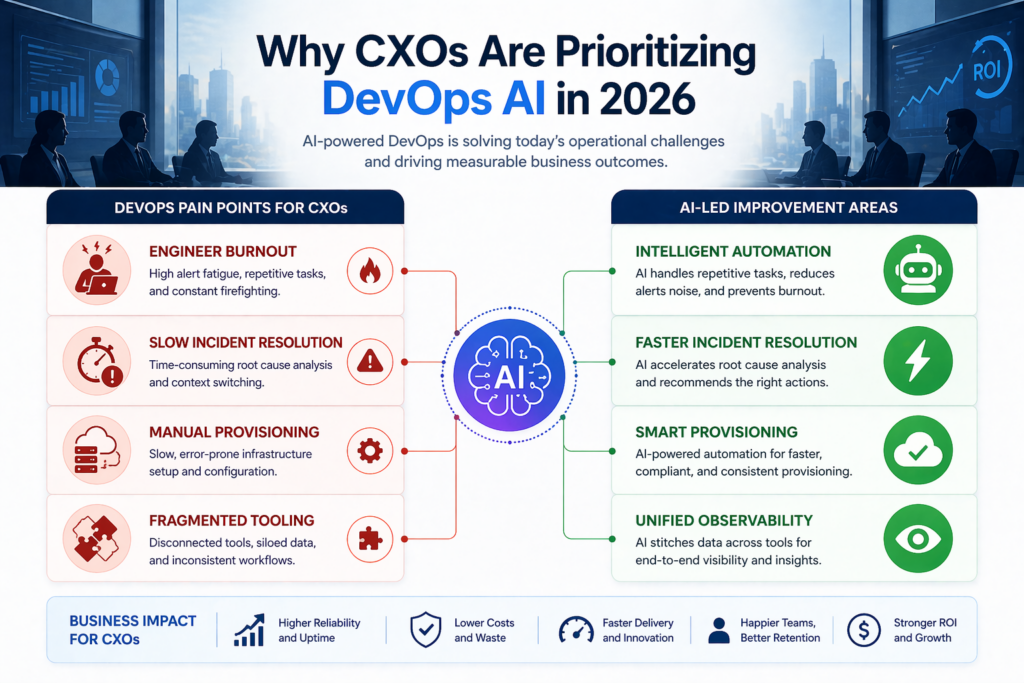
Code generation is faster than ever with AI tools for DevOps. The problem is everything downstream. Deployment queues, ticket-based infrastructure provisioning, and platform team throughput remain manual in most enterprises. Engineers spend the first 90 minutes of a P1 incident on Slack coordination before anyone starts actual diagnosis.
That is a process failure. AIOps platforms address it directly through automated event correlation and predictive anomaly detection. These capabilities of AI powered DevOps sit at the core of modern DevOps AI automation and are exactly why CXOs are accelerating investment in AI tools for DevOps.
Alert fatigue and constant context-switching across fragmented toolchains increase burnout risk for senior engineers for AI tools for DevOps. Losing a principal SRE costs more than a year of investment in DevOps automation tools.
Sixty percent of organizations using AI in development deliver projects faster and with fewer defects, per Spacelift's 2026 DevOps Statistics research. The AI powered DevOps ROI case is no longer theoretical. Teams without DORA metrics baselines cannot determine which tools match their building scalable software systems.
Most organizations run three to five of these AI tools for DevOps together. No single platform covers the full DevOps lifecycle well.
GitHub Copilot is the entry point for teams adopting AI tools for DevOps, used by over 20 million developers. It delivers in-editor code completion, multi-file edits, and PR summaries with native GitHub Actions integration.
Pricing: Individual at $10/month, Business at $19/seat, Enterprise at $39/seat.
Best for teams seeking DevOps AI automation with native CI feedback loops.
Rating: 4.3/5
Harness is the most complete AI powered DevOps platform for mid-to-large organizations. Its AI Development Assistant (AIDA) analyzes pipeline failures, suggests fixes, and triggers automated rollbacks when health degrades. DORA metrics dashboards span CI/CD AI tools and cloud cost modules.
Pricing: CD Team tier runs $100 to $300 per service per month.
Best for teams standardizing on a delivery platform using AI tools for DevOps.
Rating: 4.2/5
Dynatrace Davis AI engine is the most mature observability platform intelligence among AI tools for DevOps. OneAgent auto-instruments entire hosts without manual configuration with the help of DevOps automation tools. Davis DevOps AI automation identifies root causes and triggers remediation across your full topology. MCP server integration with GitHub Copilot enables prioritized vulnerability remediation inside developer workflows.
Pricing: host-based subscription with custom enterprise contracts.
Best for Kubernetes-heavy and multi-cloud architectures with the help of AI tools for DevOps.
Rating: 4.5/5
Datadog is the broadest full-stack monitoring platform with embedded AIOPS platforms capabilities, covering infrastructure, APM, logs, security, and AI-driven anomaly detection. Its Bits DevOps AI automation agents for SRE, Development, and Security were introduced at DASH 2025. These AI tools for DevOps enable proactive recommendations and automated incident investigation.
Pricing: usage-based per host, log volume, and APM trace.
Best for cloud-native teams needing unified observability using AI tools for DevOps.
Snyk is the standard for developer-first security in DevOps automation tools stacks, shifting security left without requiring developers to become security engineers. These CI/CD AI tools for DevOps scan code, open-source packages, containers, and IaC files. AI-assisted risk prioritization with AI powered DevOps uses predictive anomaly detection to rank vulnerabilities by exploitability.
Pricing: free tier; paid plans from $25/month.
Best for the go-to AI tools for DevOps choice for CI/CD AI tools security.
Rating: 4.5/5
PagerDuty AIOps platforms layer handles event correlation, alert grouping, and automated escalation, directly reducing mean time to recovery (MTTR). AI-driven correlation groups related alerts into single incidents, cutting on-call noise significantly.
Automated runbook automation as a part of AIOps platforms reduces first-response coordination time for most P1 incidents. Integrates with Jira, Slack, and ServiceNow. A leading choice among AI tools for DevOps for DevOps AI automation at scale.
Rating: 4.3/5
AWS CodeGuru is the most accessible code review automation among AI tools for DevOps for AWS-native teams. CodeGuru Reviewer analyzes pull requests for concurrency bugs, resource leaks, and inefficient patterns. CodeGuru Profiler surfaces CPU-intensive methods in production.
CodeGuru Security reached the end of support on November 20, 2025.
Pricing: monthly fixed rate per line of code; 90-day free tier included.
Rating: 3.9/5
Ansible Lightspeed, built on IBM WatsonX Code Assistant, brings generative AI into Ansible playbook authoring, a core part of infrastructure as code (IaC) workflows. AI tools for DevOps generate task suggestions in natural language from Ansible documentation and best practices. DevOps automation tools integrate with Red Hat Ansible Automation Platform for governance.
Pricing: via IBM WatsonX enterprise contracts.
Best for the most practical AI tools for DevOps for hybrid cloud DevOps AI automation.
Rating: 4.1/5
Metoro targets site reliability engineering (SRE) teams running Kubernetes at scale through kernel-level observability via eBPF. eBPF-based telemetry captures system calls without requiring instrumentation changes. AI powered DevOps root cause analysis generates pull requests with suggested fixes. Among AI tools for DevOps, Metoro stands out for Kubernetes-heavy site reliability engineering use cases.
Pricing: enterprise custom. Contact Metoro directly.
Rating: 4.3/5
Spacelift supports Terraform, OpenTofu, CloudFormation, Ansible, and Pulumi in one IaC management engine. Drift detection identifies unauthorized infrastructure changes. OPA-based policy as code enforces governance across all stacks through DevOps automation tools.
Pricing: free tier available; Business and Enterprise tiers add SSO. Among AI tools for DevOps, Spacelift leads for kubernetes automation and IaC governance as a core AI powered DevOps investment.
Rating: 4.5/5
| Tool | Primary Category | CI/CD Integration | AI Capability | Cloud Native | Pricing Model | Best For |
| GitHub Copilot | Code Generation | GitHub Actions native | Code completion, agentic mode | Yes | Per seat | Dev teams on GitHub |
| Harness | Continuous Delivery | Multi-cloud, Jenkins, GitHub | AIDA pipeline analysis, auto-rollback | Yes | Modular usage-based | Full platform standardization |
| Dynatrace | Observability | Jenkins, GitHub, GitLab | Davis AI root cause | Yes | Host-based subscription | Enterprise Kubernetes environments |
| Datadog AIOps platforms | Monitoring and AIOps | GitHub Actions, Jenkins, GitLab | Anomaly detection, Bits AI agents | Yes | Usage-based | Full-stack cloud monitoring |
| Snyk | Security Scanning | All major CI/CD platforms | ML risk prioritization, auto-PR | Yes | Freemium and enterprise | Developer-first security |
| PagerDuty AIOps platforms | Incident Management | Jira, Slack, ServiceNow | Event correlation, escalation automation | Yes | Tiered subscription | Complex multi-service incidents |
| AWS CodeGuru | Code Review | AWS CodePipeline, GitHub | ML code analysis, profiling | AWS-native | Lines of code | AWS-native code quality |
| Ansible Lightspeed | IaC Automation | Ansible Automation Platform | NLP playbook generation | Hybrid | IBM Watsonx pricing | Linux and hybrid IaC teams |
| Metoro | Kubernetes SRE | Kubernetes-native | eBPF telemetry, AI fix PRs | Kubernetes | Enterprise custom | High-scale SRE teams |
| Spacelift | IaC Workflow | Terraform, OpenTofu, Pulumi | Drift detection, policy-as-code | Multi-cloud | Tiered (freely available) | Multi-framework IaC teams |
These DevOps automation tools and CI/CD AI tools are not mutually exclusive. Most engineering organizations run three to five complementary AI tools for DevOps across code, delivery, observability, and security layers.
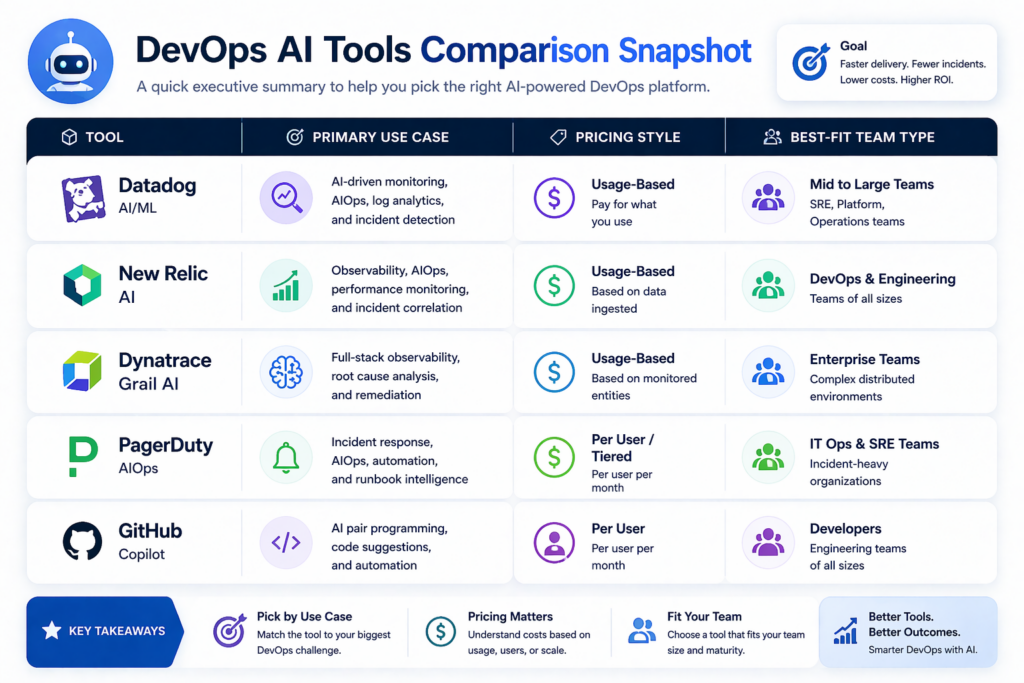
The base subscription is never your real number in DevOps automation tools. That is the most important principle before any procurement conversation around AI tools for DevOps.
Flat per-seat pricing like GitHub Copilot Enterprise at $39 per seat looks predictable until you add premium request overages. Hybrid usage-based models, which dominate AIOps platforms like Datadog and Harness, use subscription as a floor with compute overages as the real cost driver. Enterprise bundling through Dynatrace or Harness involves custom contracts where actual spend runs two to five times above list pricing for teams with heavy DevOps AI automation workloads.
The shift toward agentic AI is the most significant pricing risk in 2026 for teams evaluating AI tools for DevOps. Most pricing tiers predate agentic mode becoming standard for CI/CD AI tools.
Small teams (5 to 20 engineers): $500 to $3,000 per month across two to three AI powered devops tools. GitHub Copilot Business plus Snyk covers code and security without enterprise complexity.
Mid-size (20 to 100 engineers): $5,000 to $20,000 per month. Harness or Datadog as the core platform, plus Snyk, PagerDuty, and Spacelift for IaC governance.
Enterprise (100+ engineers): $50,000 or more per year. Full AI tools for DevOps stacks run $200,000 to $500,000 annually.
Hidden cost flag: Integration, model retraining, and compliance overhead add 20 to 40% to base licensing in regulated sectors, particularly for teams with a continuous integration pipeline in fintech or healthcare.
ROI from AI tools for DevOps does not arrive uniformly. DevOps AI automation concentrates on three specific areas, and teams that track the right metrics see payback significantly faster.
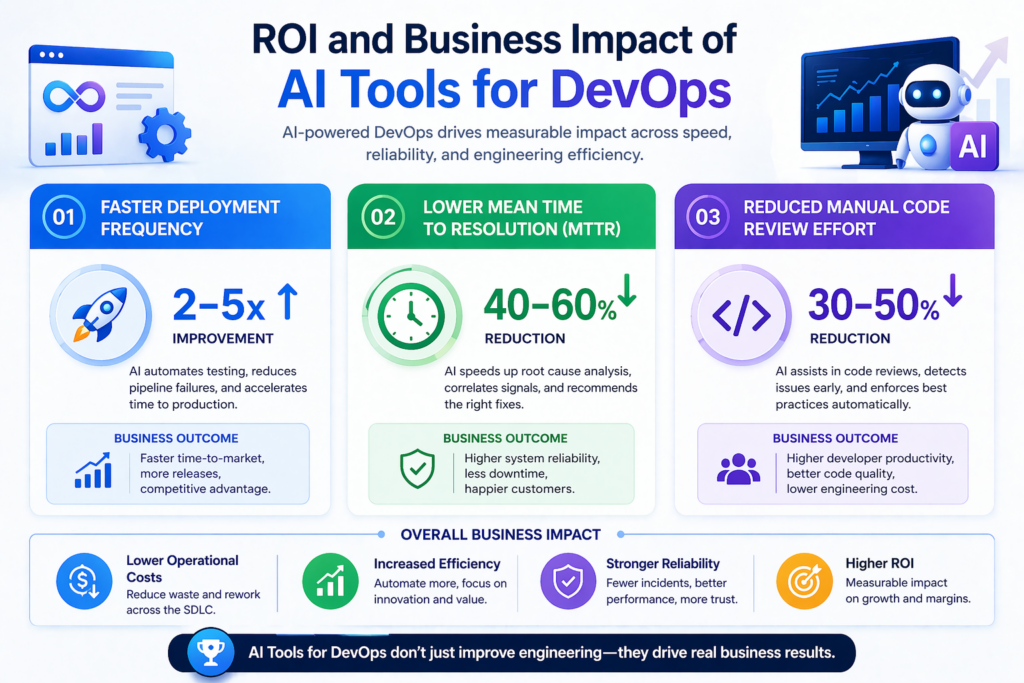
Deployment frequency improvement is the fastest measurable win after adopting CI/CD AI tools with AI verification. Teams using AI-assisted pipelines report 30 to 50% improvement in deployment frequency and deployment speed.
MTTR reduction through automated incident response automation cuts P1 incident cost at the point where it hurts most: the first 90 minutes of coordination. Automated event correlation and escalation, core features of modern AIOPS platforms, remove most of that overhead for teams that configure their AI tools for DevOps correctly.
Code review automation reduces engineering hours spent on manual QA cycles. This is the subtler ROI driver of DevOps AI automation, compounding over time as teams deploy more frequently without a proportional increase in review workload.
Engineering organizations using AI powered DevOps stacks report 62% improvement in deployment frequency and 48% reduction in change failure rates, per Global Growth Insights 2026 research. Teams tracking DORA metrics baselines typically see payback within 6 to 12 months.
AI tools for DevOps in immature workflows do not self-correct process gaps. Teams without baseline DORA metrics cannot track improvement accurately. Poorly configured DevOps automation tools amplify alert noise instead of reducing it.
Every risk in this category is predictable and preventable. Most stem from purchasing AI tools for DevOps before answering the process questions.
Shadow AI risk: Individual adoption without IT governance inflates spend and creates security gaps in AI tools for DevOps environments. When engineers independently adopt unapproved AI coding assistants, the compliance team inherits the audit problem.
Toolchain fragmentation: Teams with fewer than five DevOps automation tools are five times more likely to deploy within an hour than teams with over 20, per Programs.com's 2026 DevOps Statistics. Fragmentation is the leading barrier to ROI from AI tools for DevOps.
Model drift: AI systems require retraining as codebases evolve. Budget 15 to 20% of initial licensing annually when using AI powered DevOps with fast-moving codebases.
Vendor lock-in: Deep integrations with AWS or GCP-native CI/CD AI tools limit portability. Evaluate exit costs before signing contracts for bundled AIOPS platforms.
Compliance cost: Regulated industries add 20 to 40% to the total implementation cost of DevOps AI automation, where audit trails are legally required for AI tools for DevOps.
Use this before any procurement meeting. It structures your evaluation of AI tools for DevOps and AIops platforms, so price comparisons happen after fit is confirmed.
Not sure which AI tools for DevOps fit your current maturity? Audit your DevOps stack with our team, identify integration gaps, and implement AI-native workflows.
Getting the DevOps AI automation right is only half the work. Most failed deployments fail at implementation.
Patoliya Infotech deploys AI enhanced CI/CD AI tools, pipelines, Kubernetes automation environments, and observability stacks for mid-size to enterprise engineering teams:
Ideal for SaaS and product engineering teams at the 20 to 200 engineer scale. Patoliya Infotech helps you scope, integrate, and measure your AI powered DevOps investment across the right AI tools for DevOps.
The right AI tools for devops decision starts with your biggest operational constraint. If deployment queues are the bottleneck, prioritize Harness or GitHub Copilot with strong DevOps AI automation. If alert fatigue is destroying SRE retention, Dynatrace or Datadog AIOps platforms solve that directly. If security debt is slowing releases, Snyk addresses it without a separate team.
Best returns from AI powered DevOps come from teams with clear DORA metrics baselines and mature pipeline foundations. Base subscriptions are not your actual cost. Model for usage overages and integration overhead before committing to enterprise-scale DevOps automation tools or AIOPS platforms.
Need a second opinion on your DevOps stack? Identify gaps, remove unnecessary tools, and move forward with a clear implementation roadmap built for your engineering team.