Table of Contents
TLDR: AI in software testing replaces brittle manual scripts with self-healing, self-generating test pipelines that adapt to UI changes automatically. QA teams adopting AI test automation report up to 60% reduction in test maintenance time and faster release cycles. This guide covers every capability, tool, pricing tier, and implementation decision you need to make the right call for your team.
Your QA team is not slow because they lack effort. They are slow because 40% of every sprint gets consumed by maintaining tests that break every time a developer changes a button label. AI in software testing directly attacks that problem. It generates tests, heals broken locators, and runs regression coverage without a human writing a single line of script. The teams shipping daily are already running AI in software testing pipelines. The teams shipping weekly are still manually updating Selenium selectors. This guide explains every capability, tool, cost, and implementation decision so you can close that gap for AI driven QA.
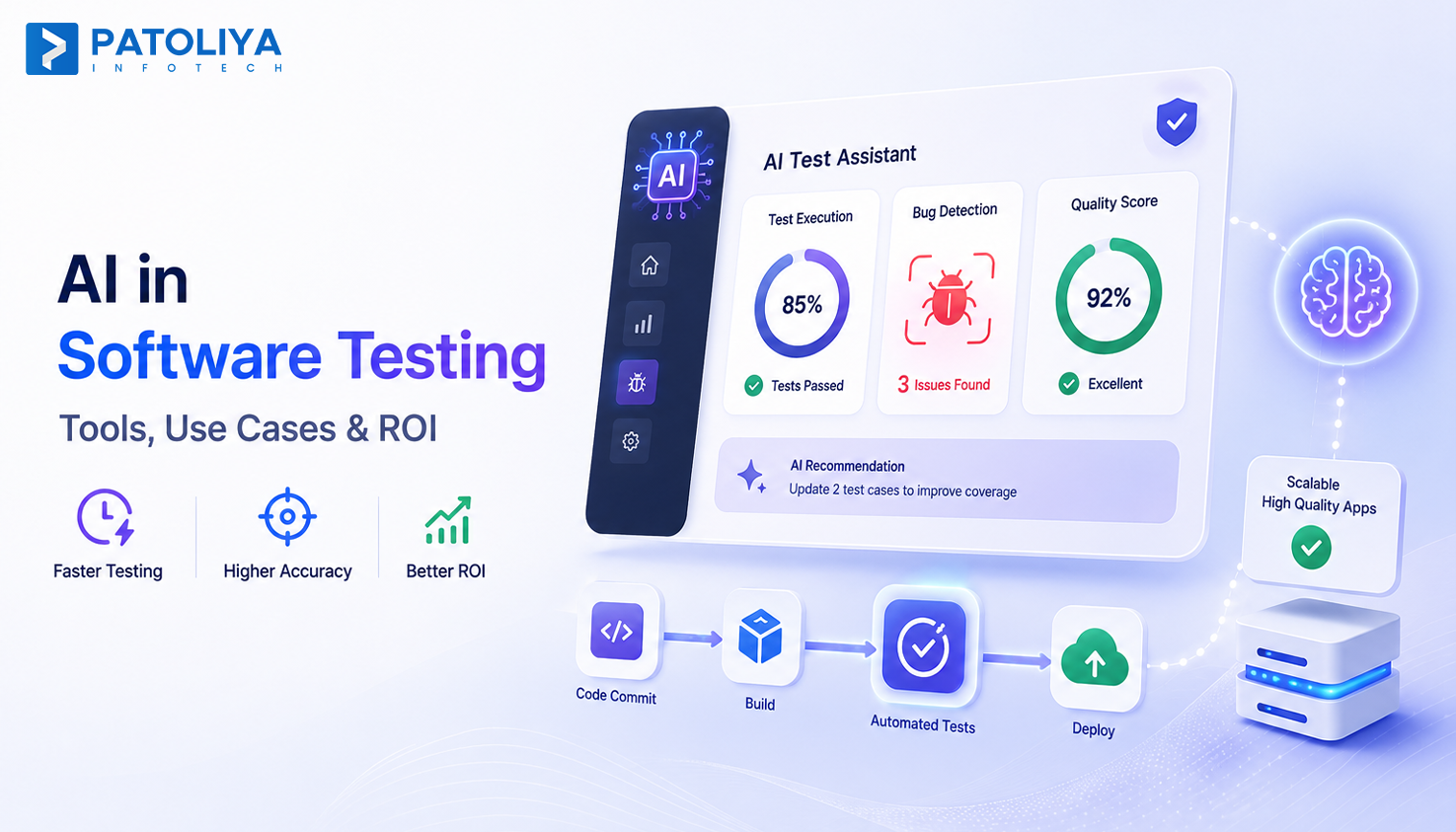
AI in software testing is the application of machine learning and computer vision to automate test creation, execution, maintenance, and analysis without constant human intervention.
Traditional automation requires engineers to write and update every test script manually. AI in software testing removes that dependency. Machine learning testing tools observe application behavior, generate test cases from user flows, detect UI changes, and repair broken tests automatically.
AI driven QA operates across three layers:
| Layer | What AI Does |
| Test Generation | Creates test cases from recorded sessions or specs |
| Test Execution | Runs cross-browser and cross-device coverage at scale |
| Test Maintenance | Heals broken locators without manual intervention |
AI driven QA is not a replacement for QA engineers. It removes the work that prevents QA engineers from doing high-value testing. That distinction matters when building the business case internally.
AI in software testing delivers five capabilities that traditional frameworks cannot match without significant manual overhead.
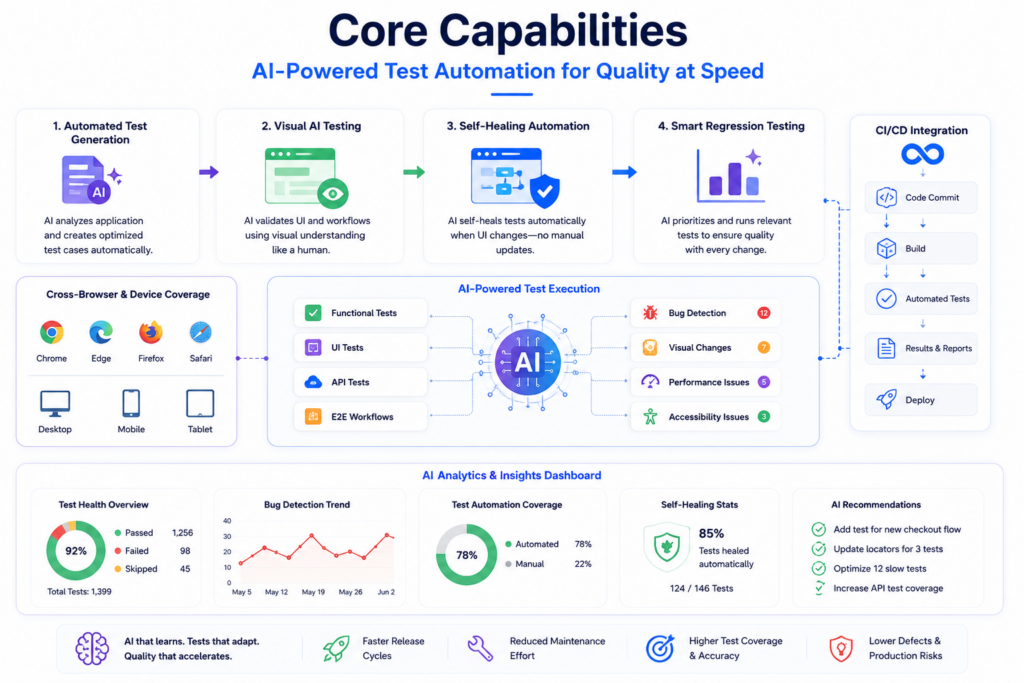
Self-healing test automation detects when a UI element changes and updates the locator automatically. A button that moves from one div to another no longer breaks your entire suite overnight in AI in software testing. Teams running AI test automation with self-healing report a 60 to 70% reduction in maintenance hours per sprint.
Visual AI testing compares screenshots pixel-by-pixel across browsers and devices, flagging visual regressions that functional tests miss entirely. In AI in software testing, A layout that breaks only on Safari mobile gets caught before it reaches production.
Test generation AI creates test cases from user session recordings, API specs, or requirement documents. New features get baseline coverage without a QA engineer writing scripts from scratch for AI driven QA. Enterprise Custom Software Development projects benefit from AI-generated baseline testing during rapid feature expansion.
AI-powered regression testing prioritizes which tests to run based on code change impact analysis. Instead of running 4,000 tests on every commit, the AI driven QA runs the 400 most likely to catch a regression. Release pipelines move faster without sacrificing coverage confidence in AI in software testing. Mature continuous testing practices help teams reduce regression delays and improve deployment frequency.
Autonomous testing takes this further by continuously exploring the application for untested paths without human direction. It is early-stage but already in production use at several enterprise QA teams. Automated QA pipelines should follow software security best practices to reduce security risks during continuous testing and deployment.
AI in software testing solves four engineering problems that compound in cost as your release velocity increases.
The average QA team spends 30 to 40% of sprint time maintaining existing tests rather than building new coverage. Machine learning testing tools with self-healing locators cut that overhead directly. Engineers reallocate that time to exploratory testing and coverage expansion for AI in software testing.
Manual cross-browser testing is always incomplete because time runs out before coverage does for AI in software testing. AI driven QA platforms execute full cross-browser runs in parallel, covering Chrome, Firefox, Safari, and Edge simultaneously in the same time a manual tester covers one browser. Modern web application development services increasingly require automated cross-browser validation before deployment.
Full regression suites take 4 to 8 hours in traditional pipelines. AI in software testing with impact-based test selection runs targeted regression in 20 to 40 minutes. That difference is the gap between daily releases and weekly ones in AI driven QA. Mature CI/CD pipelines often depend on structured DevOps consulting for automated testing and deployment orchestration.
When QA is the last gate before release, every sprint ends with a queue. Machine learning testing tools that generate and execute tests autonomously remove QA as a sequential challenge. In AI in software testing, this makes it a parallel function inside the CI/CD pipeline. Fast-growing engineering teams often use resource augmentation to scale QA and automation expertise quickly.
AI in software testing tools falls into distinct categories. Matching tool type to use case is more important than picking the most popular platform.
| Tool Category | Best Use Case | Examples |
| Visual AI platforms | Cross-browser visual regression | Applitools, Percy |
| AI test automation platforms | Full suite generation and healing | Testim, Mabl, Functionize |
| Machine learning testing tools | Predictive test selection, risk scoring | Launchable, Diffblue |
| Codeless AI recorders | Rapid test creation without scripting | Katalon, Leapwork |
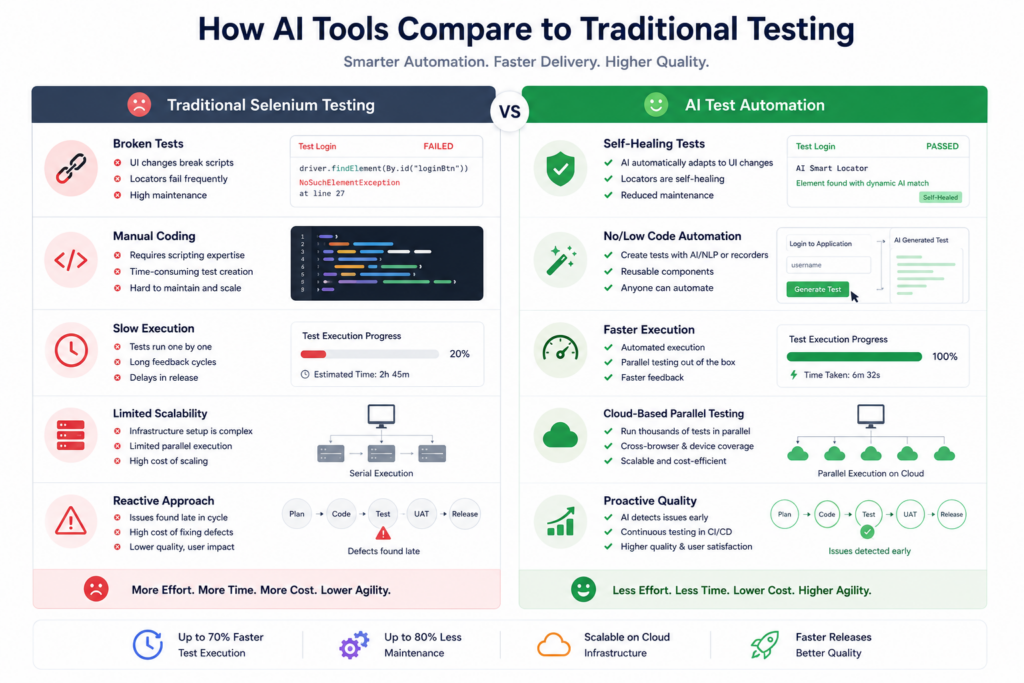
| Dimension | Traditional Selenium | AI test automation |
| Locator maintenance | Manual, breaks on UI change | Self-healing, automatic |
| Test creation speed | Hours per test case | Minutes via recording |
| Cross-browser execution | Manual grid setup | Cloud-native parallel runs |
| Regression intelligence | Run everything | Run what matters |
| Onboarding time | Weeks | Days |
The Selenium AI gap is real for AI in software testing. Selenium requires infrastructure, scripting expertise, and constant maintenance. AI test automation platforms abstract all three. The trade-off is vendor dependency, a risk worth planning for explicitly.
AI in software testing pricing varies significantly by team size, execution volume, and platform depth.
Typical annual investment ranges from $600 to $3,000 for basic AI-driven QA coverage.
Entry-level AI driven QA tools at this tier cover basic visual regression and limited test generation. Suitable for teams under five engineers with fewer than 500 test cases. Applitools Eyes Starter and Mabl's entry plan fall here.
Most mid-market teams spend between $5,000 and $25,000 per year for scalable AI test automation.
This tier covers full AI test automation with self-healing, parallel execution, and CI/CD integration for AI in software testing. Suitable for teams of 10 to 25 engineers running daily releases. Testim Growth and Mabl Professional sit in this range.
Enterprise AI-driven QA programs typically range from $30,000 to $150,000+ annually, depending on scale and compliance needs.
Enterprise AI driven QA platforms add advanced analytics, custom AI model training, SSO, and dedicated support SLAs. Functionize Enterprise and Applitools Ultrafast Grid operate here at scale with machine learning testing tools.
Patoliya Infotech delivers AI in software testing as a managed service with fixed monthly billing, removing per-seat and per-execution pricing exposure entirely.
The ROI of AI in software testing is measurable across four specific outcomes. Each one compounds as your engineering team scales.
AI in software testing with self-healing locators reduces maintenance hours by 60 to 70% per sprint. On a team of five QA engineers at an $80,000 average salary, that is $48,000 to $56,000 in recovered engineering capacity annually.
Machine learning testing tools with impact-based regression selection compress release cycles from weekly to daily for most mid-market engineering teams. Faster releases mean faster revenue realization on every feature shipped of AI in software testing.
AI in software testing with visual regression and cross-browser coverage catches defect categories that manual and traditional automation miss entirely. In AI driven QA, Fewer production defects mean lower incident response cost and better user retention.
Traditional QA scales linearly: more features require more testers. AI in software testing scales horizontally. You add execution capacity, not headcount. Machine learning testing tools handle 10x test volume without 10x team cost. That is the economic argument that wins the budget conversation at the C-level.
Every AI in software testing implementation carries four risks that are manageable with the right design decisions upfront.
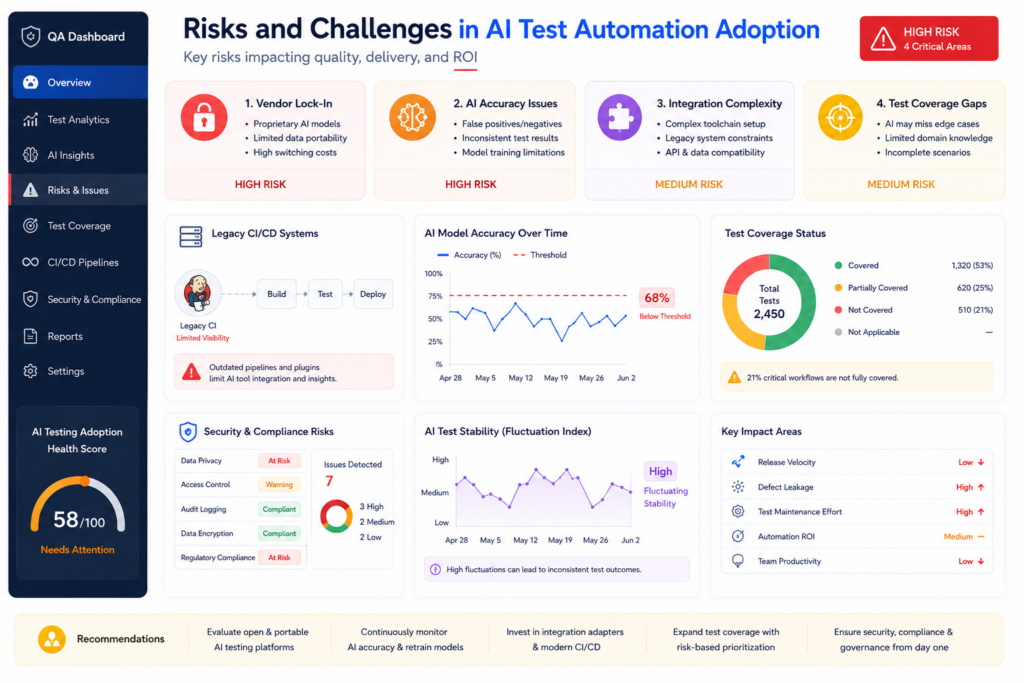
AI in software testing generates tests based on observed behavior. Edge cases that never appear in recorded sessions do not get covered automatically. Human QA engineers remain responsible for exploratory testing and requirements-based test design.
AI test automation platforms use proprietary test formats for AI in software testing. Migrating 2,000 tests from one platform to another is a significant engineering project. For machine learning testing tools, design your test strategy to abstract business logic from platform-specific syntax where possible.
Older Jenkins pipelines and monolithic build systems require custom integration work to connect AI driven QA platforms. Budget 2 to 4 weeks for integration before expecting full pipeline automation.
AI in software testing models trained on older UI patterns loses accuracy as applications evolve. Platforms without continuous model retraining and machine learning testing tools degrade quietly. Verify your vendor's retraining cadence before committing to a long-term contract.
Choosing the right platform for AI in software testing requires evaluating nine criteria before a proof of concept begins.
| Evaluation criteria | What to Verify |
| Self-healing capability | Locator repair speed and accuracy rate |
| Test generation method | Recording-based, spec-based, or AI-generated |
| CI/CD integration | Native plugins for GitHub Actions, GitLab, and Jenkins |
| Cross-browser execution grid | Cloud-hosted vs self-hosted infrastructure |
| AI test automation portability | Export format and migration path |
| Visual regression depth | Component-level vs full-page comparison |
| Model retraining cadence | How often does the AI adapt to UI changes |
| Compliance and data handling | PII masking, data residency, SOC 2 status |
| Pricing model | Per-seat, per-execution, or fixed delivery model |
The most common mistake in AI in software testing vendor selection is running a proof of concept on a greenfield application. Test on your actual production UI with real complexity. That is where platform differences become visible.
Applitools is the market leader in visual AI in software testing, using its Ultrafast Grid for cross-browser visual regression at enterprise scale.
Best for: Teams where visual regression is the primary quality risk.
Pricing: From $600/year, enterprise custom.
Testim is an AI test automation platform built for fast test creation and self-healing execution across web applications for AI in software testing.
Best for: Mid-market teams running daily web releases.
Pricing: From $450/month.
Mabl is a machine learning testing tools platform combining test creation, execution, and intelligent regression in one interface.
Best for: Teams wanting functional, visual, and performance coverage in one platform.
Pricing: From $500/month.
Functionize uses natural language processing to generate and maintain AI in software testing suites from plain English test descriptions.
Best for: Enterprises with large legacy test suites needing AI-assisted migration.
Pricing: Enterprise custom, typically $30,000+/year.
AI in software testing delivers results when implementation is done correctly from day one. Most teams that struggle with adoption picked the right tool but skipped the pipeline design, coverage strategy, and maintenance model that make it work at scale. As a software development company, Patoliya Infotech helps teams modernize QA pipelines with AI-driven automation and scalable testing workflows.
We build AI in software testing programs around your actual release cadence and existing CI/CD infrastructure:
If your QA pipeline is blocking releases or your maintenance overhead is eating sprint velocity, Patoliya Infotech can scope a solution in 48 hours. Let's talk through your current setup.
AI in software testing has moved from experimental to production-standard. The tools are mature, the ROI is measurable, and the teams shipping daily are already running AI in software testing pipelines.
Your adoption decision of machine learning testing tools comes down to three numbers: release cadence velocity, test maintenance cost as a percentage of sprint time, and whether your current coverage scales with your engineering team. If those numbers are moving in the wrong direction, book a consultation with Patoliya Infotech and get a scoped QA roadmap in 48 hours.