Table of Contents
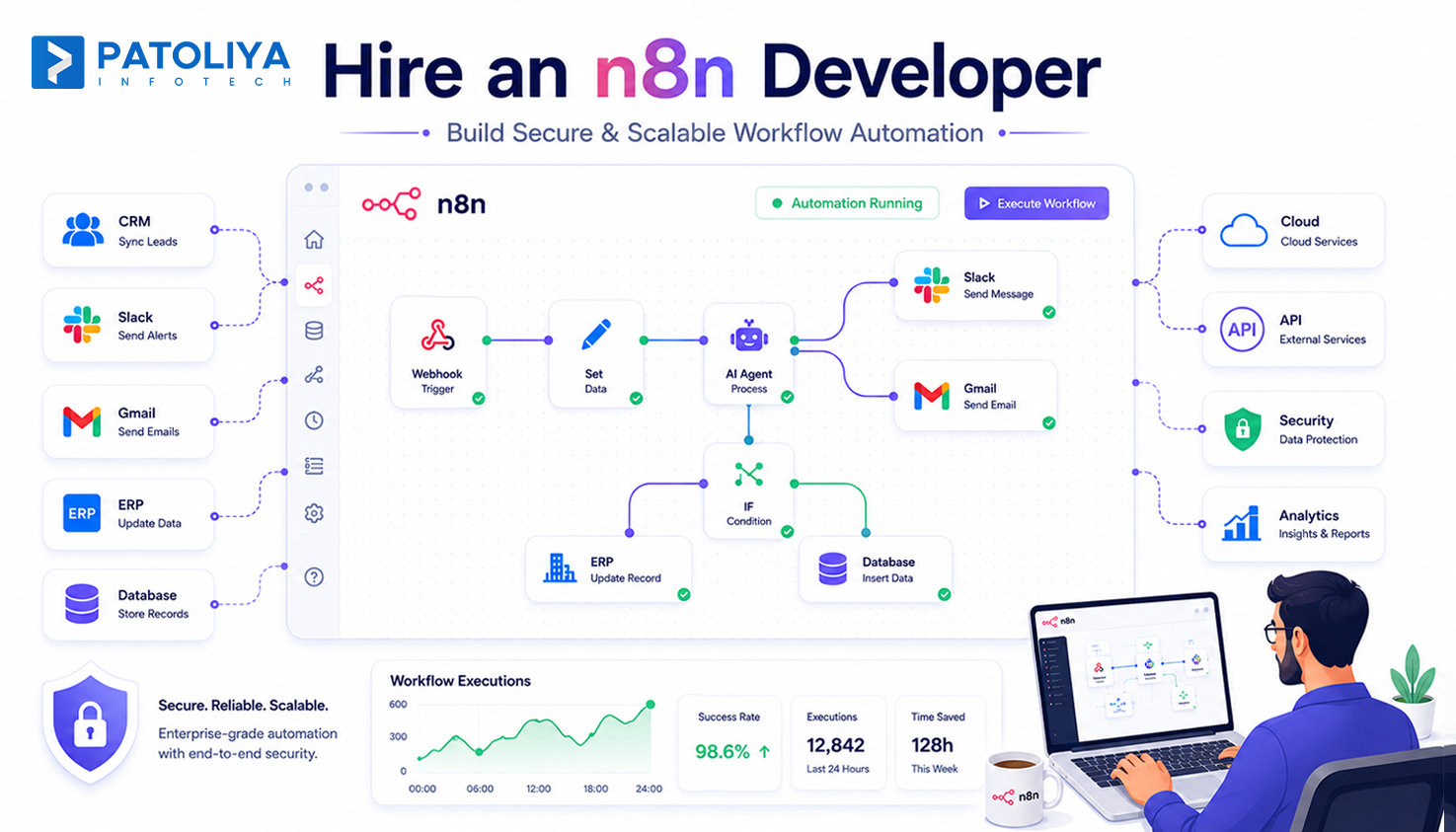
If your team is drowning in manual handoffs between your CRM, your inbox, and half a dozen SaaS tools, you've probably already looked at n8n. The platform is powerful, but powerful doesn't mean simple, a poorly built workflow breaks the moment an API changes, and a poorly secured one can leak customer data. This guide breaks down exactly what to look for when you hire an n8n developer: the skills that separate an automation engineer from a no-code hobbyist, realistic pricing, the risks buyers overlook, and how to evaluate a development partner before you sign anything.
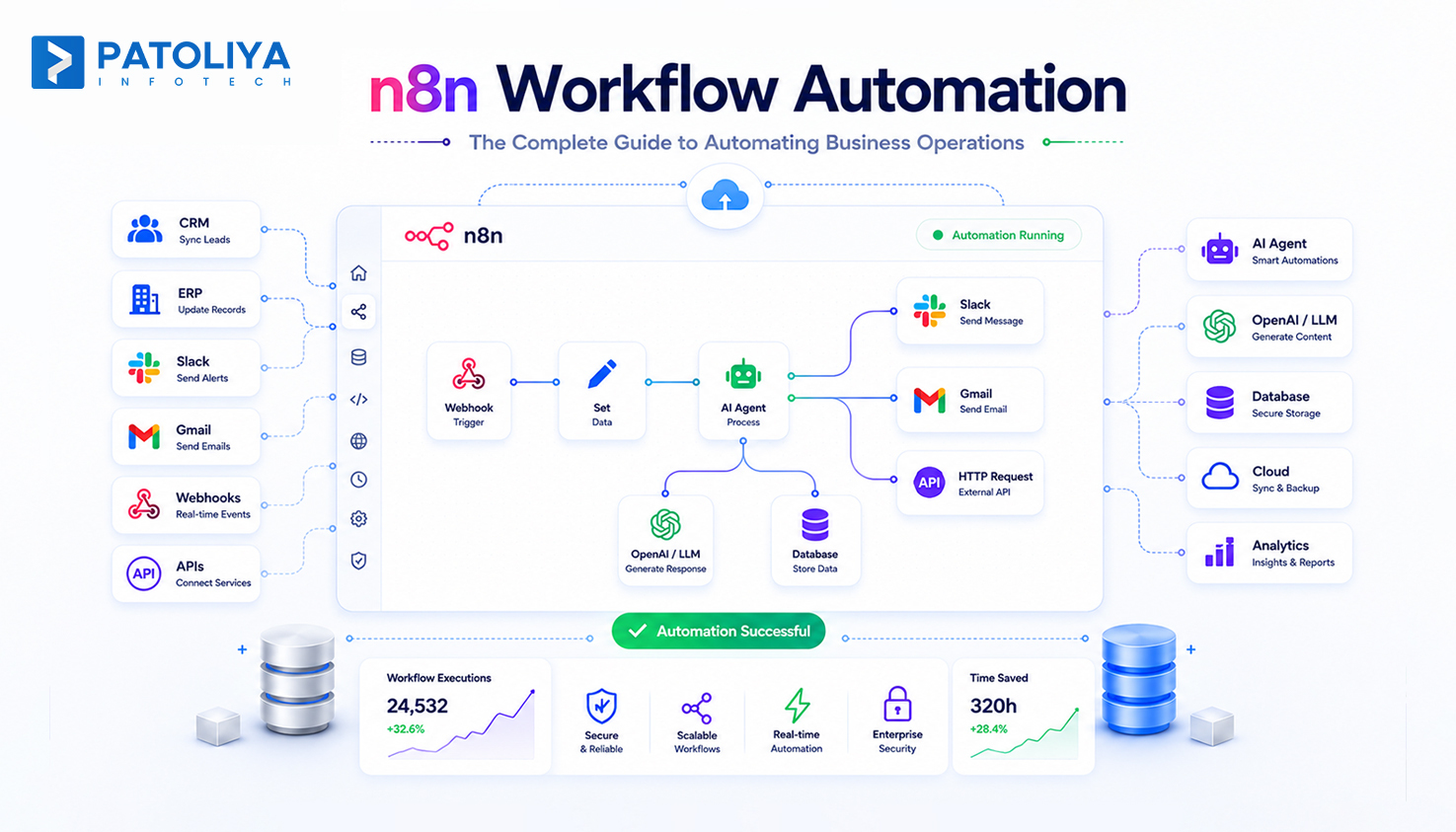
Hiring an n8n developer is not the same as hiring someone who has "used n8n." n8n sits in an unusual middle ground, visual enough that a non-engineer can drag a few nodes together, but flexible enough that production-grade workflows require real software engineering judgment: writing custom JavaScript or Python expressions, designing error handling that doesn't silently fail, authenticating against APIs that were never meant to talk to each other, and deciding when a workflow should be self-hosted versus run on n8n Cloud.
Most businesses reach for n8n after outgrowing simpler tools. A marketing team that started with a couple of Zaps eventually needs conditional logic, multi-step approval chains, or a workflow that has to touch a database directly rather than another app's limited integration. At that point, the question shifts from "can we build this ourselves" to "who do we hire to build this properly."
There are generally three ways companies bring in n8n expertise: a freelance contractor for a single, well-scoped workflow; a staff-augmented specialist who plugs into an existing engineering team on an ongoing basis; or a dedicated development team for organizations running automation as a core part of their operations.
Each hiring model carries different cost structures, different levels of accountability, and different expectations around documentation and handoff. Businesses evaluating this decision alongside broader engineering needs often benchmark it against a guide to building a dedicated development team, since the vetting criteria, communication cadence, IP ownership, code ownership, largely overlap.
The right choice depends less on budget and more on how central automation is to your operations. A one-off integration project rarely justifies a full-time hire; a business running dozens of interconnected workflows across sales, support, and finance usually can't afford not to have dedicated ownership.
A capable n8n developer's output looks nothing like a template pulled from n8n's community library. Here's what separates a production-ready build from a fragile one.
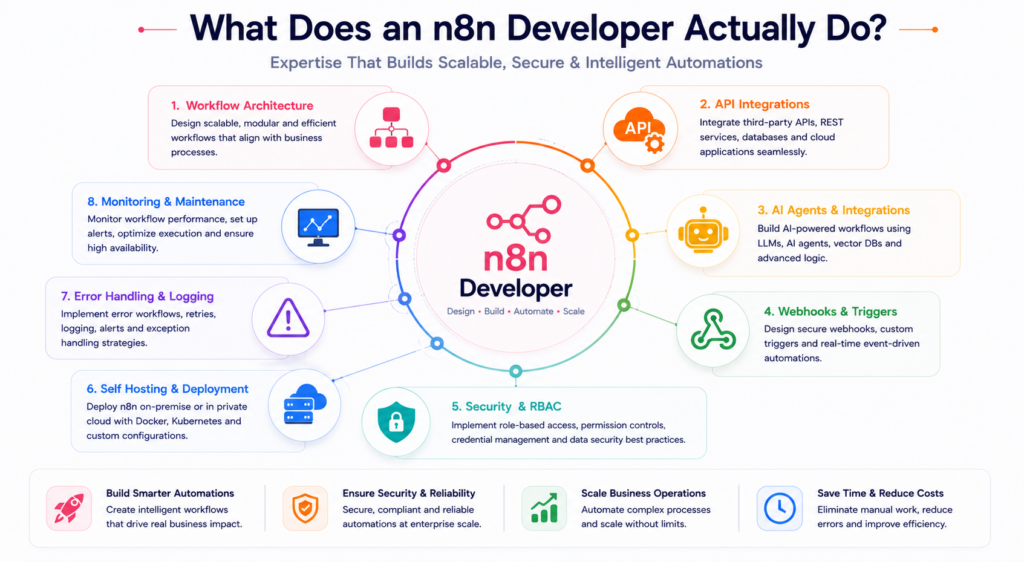
Custom Workflow Architecture: Real workflows are built with modularity in mind, sub-workflows that can be reused, naming conventions that make debugging possible six months later, and version control so changes don't get lost. A developer who builds everything as one giant, unreadable canvas is optimizing for a demo, not for maintainability.
API & Third-Party Integrations: Not every tool has a native n8n node. Qualified developers are comfortable working directly with REST and GraphQL APIs, handling OAuth flows, pagination, rate limits, and webhook signature verification, the unglamorous work that determines whether an integration survives contact with a real API's edge cases.
AI-Agent & LLM Orchestration: This is where n8n has moved fastest. Modern builds increasingly wire workflows to LLM APIs for document classification, customer-support triage, or autonomous multi-step agents. Buyers should understand the practical difference between AI agents and traditional workflow automation before scoping a project, an agent that reasons and calls tools dynamically is a very different build than a linear workflow with an LLM node bolted on.
Developers working in this space should also be conversant with emerging standards like the Model Context Protocol, which is quickly becoming the connective layer between LLMs and external tools. Teams evaluating a broader AI development partner for this kind of work should ask for examples of agentic, not just linear automation.
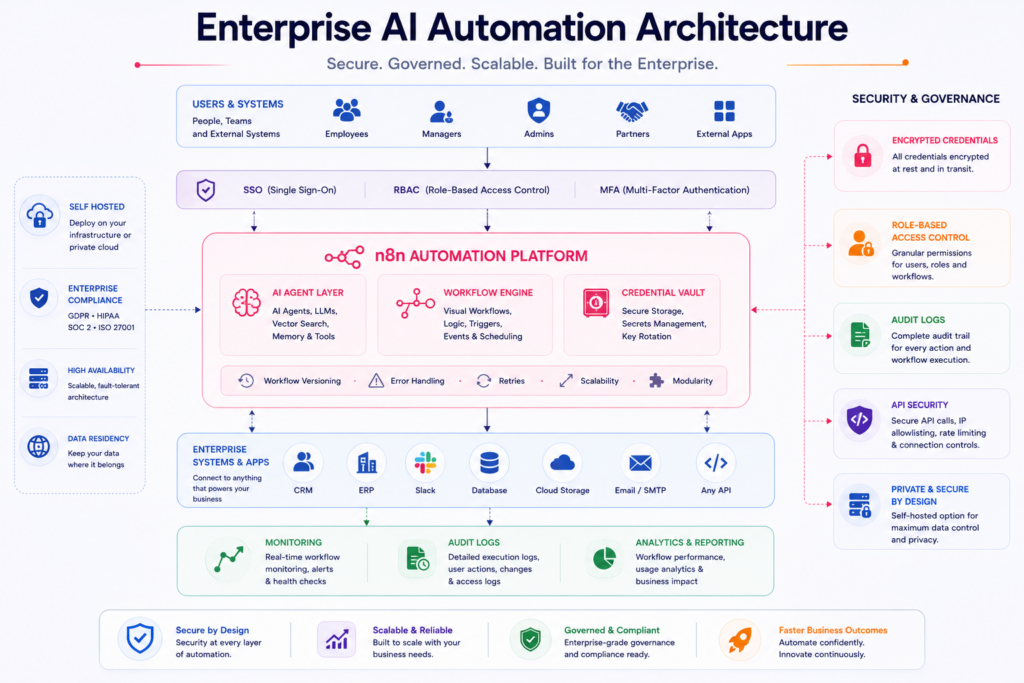
Self-Hosting, Security & Credential Management: Anyone with access to your n8n instance effectively has access to every credential stored inside it. A qualified developer implements role-based access control, credential vaulting, and for regulated data, a self-hosted deployment rather than defaulting to cloud. This overlaps heavily with DevSecOps practices: security has to be built into the pipeline, not bolted on after a workflow goes live.
Post-Launch Monitoring & Maintenance: APIs change without warning. A workflow that isn't monitored will eventually fail silently and silent failures are far more expensive than obvious ones. Ask any candidate how they alert on failed executions before you ask about their build speed.
Most hiring mistakes with n8n fall into four repeatable patterns.
Confusing a No-Code User With an Automation Engineer: n8n's visual builder makes it easy for someone to complete a basic tutorial and call themselves an "n8n developer." The gap shows up the moment a workflow needs custom expressions, error branching, or an integration without a pre-built node, exactly the work that makes the difference between a demo and a production system.
Underestimating Data Security & Credential Exposure: Workflows routinely touch CRM data, payment credentials, and customer PII. Buyers who skip questions about credential storage, access scoping, and hosting environment often find out too late that a contractor had standing access to sensitive systems with no audit trail.
No Post-Launch Support Plan: A workflow delivered and abandoned is a liability, not an asset. Without a maintenance retainer or SLA, the first broken API integration becomes an emergency with no one contracted to fix it.
Vendor Can't Scale Past Simple Automations: Some contractors are genuinely excellent at single-step automations but have no experience with multi-tenant workflows, high-volume execution loads, or AI-agent orchestration. This is where the staff augmentation model tends to outperform one-off freelance hires, it gives you access to a bench of specialists rather than betting the whole project on one person's ceiling.
Before committing to n8n, it's worth understanding where it sits relative to the tools most buyers compare it against.
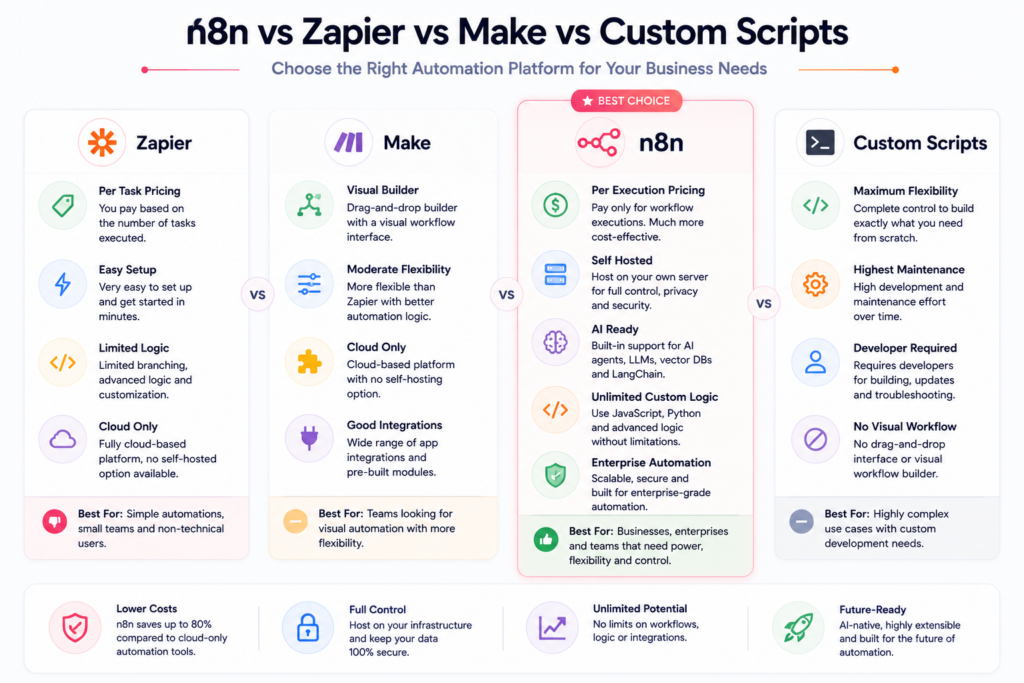
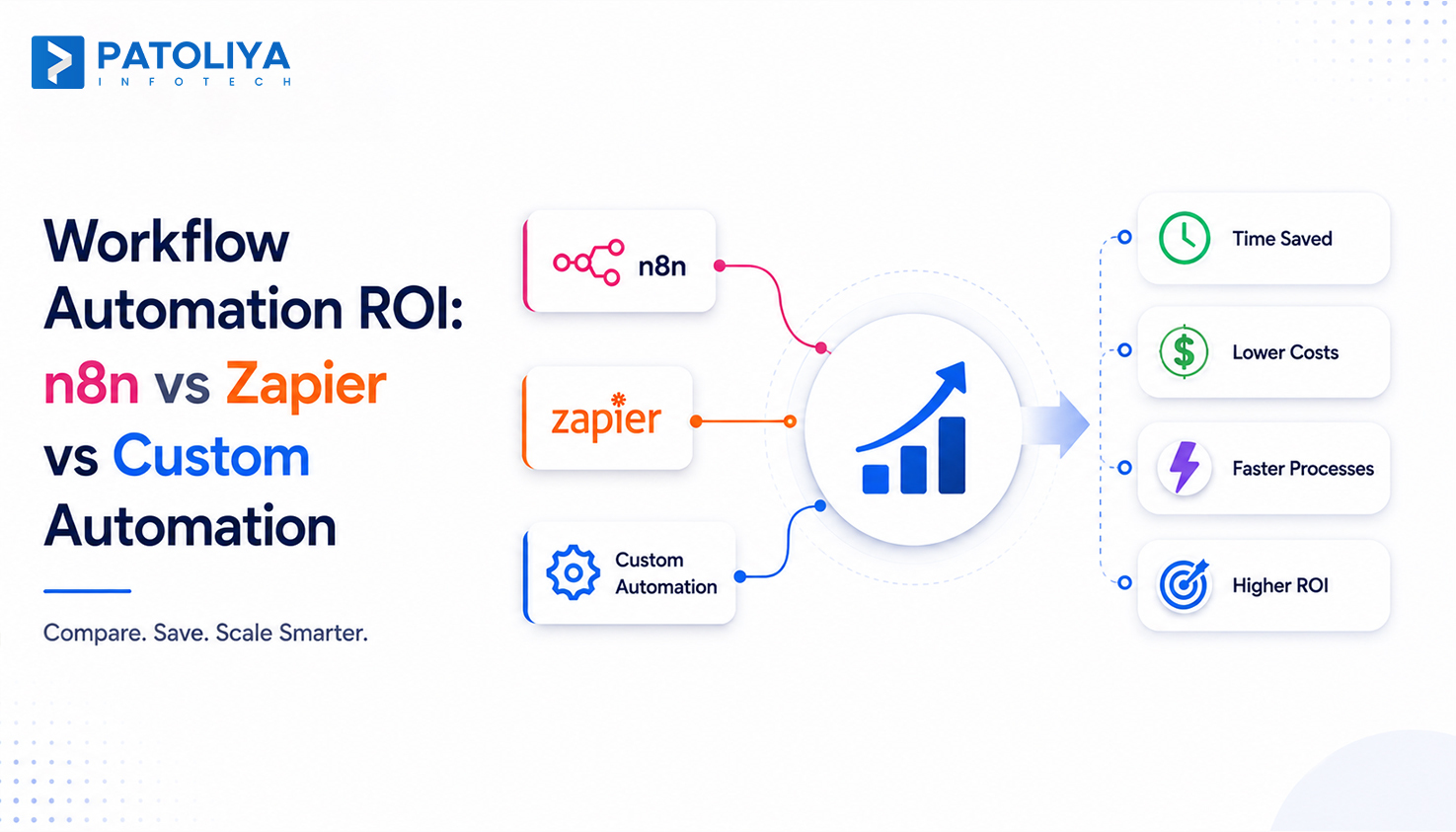
n8n vs Zapier - Pricing Model: The core difference is how usage is metered. Zapier charges per task, meaning every individual step inside a workflow consumes a unit of your plan, a 10-step workflow run 1,000 times uses 10,000 tasks. n8n charges per execution: the entire workflow run, regardless of how many steps it contains, counts as one execution. Industry pricing breakdowns published in 2026 consistently show this gap widening sharply as workflow complexity and volume increase, with n8n becoming dramatically cheaper for any multi-step, high-volume automation.
n8n vs Make (Integromat) - Flexibility & Hosting: Make offers a comparable visual builder but is cloud-only. n8n's open architecture and native self-hosting option give buyers data-residency and compliance control that Make simply doesn't offer. Make tends to remain the cheaper, simpler option for low-volume, single-purpose workflows where self-hosting isn't a consideration.
n8n vs Custom-Built Scripts or RPA Hand-rolled scripts are cheaper to stand up initially but accumulate maintenance debt fast, there's no visual audit trail, and handing a script off between developers usually means a rewrite. n8n workflows are self-documenting by nature of their visual structure, which makes long-term ownership and handoff significantly less painful.
Cost depends far more on workflow complexity than on hourly rate. A simple single-workflow build, one trigger, a handful of steps, no custom logic, typically runs in the low thousands of dollars. Mid-complexity integrations involving multiple systems, conditional branching, and error handling land in the $2,000–$8,000 range. Enterprise-grade builds involving AI-agent orchestration, multi-tenant architecture, or high-volume execution pipelines can run from $8,000 well into six figures, depending on scope.
Beyond the build itself, factor in hosting (self-hosted instances typically cost a few dollars a month in server fees, while n8n Cloud plans scale with execution volume), ongoing maintenance retainers, and whether the vendor includes documentation and credential handoff at project close. A quote that only covers the initial build and excludes support is usually the cheapest option on paper and the most expensive one over a year.
See how Patoliya Infotech's n8n builds compare: Get a scoped estimate.
Time Savings: Every manual handoff eliminated, a support ticket auto-routed, an invoice auto-generated, a lead auto-enriched, is time an employee doesn't spend on repetitive work. Teams that properly scope business process automation initiatives typically see the largest time recovery in the first 90 days, once the highest-friction manual processes are automated first.
Cost Savings vs SaaS Automation Tools: Because n8n bills per execution rather than per step, businesses running complex, high-volume workflows routinely cut their automation-tooling spend substantially compared to task-based platforms, especially once volume climbs past a few thousand runs a month.
Time-to-Market Impact: A properly architected workflow library becomes a foundation, new automations can be assembled from existing sub-workflows rather than built from scratch, compounding speed gains over time.
Scalability Economics: Self-hosted n8n has no hard ceiling tied to task consumption. As execution volume grows, the marginal cost stays close to flat, which is a fundamentally different economic curve than per-task SaaS pricing.
IP & Ownership Risk: Without explicit contract terms, ambiguity around who owns the workflow files, custom nodes, and documentation can leave a business locked into a vendor relationship it didn't intend to sign up for.
Communication & Timezone Risk: Automation work often requires quick iteration during debugging. A vendor with minimal overlapping working hours can turn a same-day fix into a multi-day delay.
Quality & Reliability Risk: Workflows built without proper error handling tend to fail quietly. A vendor that can't describe their approach to retries, alerting, and failure logging is a quality risk, regardless of how fast they build.
Contract & Compliance Risk: For regulated industries, credential handling and data residency need to be spelled out contractually, not assumed. GDPR, HIPAA, or SOC 2 obligations should be addressed before access is granted, not after an incident.
Patoliya Infotech builds n8n automations the way production software should be built with version control, documented handoffs, and security reviewed before a credential ever gets stored. Our team doesn't stop at wiring nodes together; we design for the failure cases, not just the happy path, and we scope AI-agent work with the same rigor we apply to custom software development.
Whether you need a single high-stakes workflow or an ongoing automation practice embedded in your engineering team, our case studies show the range of systems we've shipped, from healthcare data pipelines to multi-tenant e-commerce automation. We also stay close to where n8n itself is heading, from self-hosted enterprise deployments to LLM-orchestrated agents, so the workflows we build today don't need a rebuild in twelve months.
Ready to see what a properly engineered n8n workflow looks like? Book a consultation with Patoliya Infotech.
Hiring an n8n developer is easy to get wrong in ways that don't show up until months later, a security gap, a workflow that silently stops running, a vendor who built something no one else can maintain. The fix isn't more research on n8n itself; it's asking the right questions of whoever you hire: how they handle credentials, how they monitor failures, and whether they can actually build past simple automations. Get those answers up front, and the rest of the decision gets a lot easier.