Table of Contents
TL;DR: AI tools for small businesses now range from free plans to enterprise subscriptions costing hundreds of dollars per month. The wide price difference often comes down to how vendors charge per user, per AI action, per token, or through flat monthly plans. Understanding these pricing models is essential for choosing a solution that delivers value without unexpected costs.
Every week, new AI tools promise to save time, cut costs, and grow your business. The challenge isn't finding AI software anymore; it's choosing the tools that actually deliver measurable value by following a custom AI software development guide before selecting the right solution. From customer support and sales to marketing and operations, the right AI tool can automate repetitive work and improve productivity. However, selecting the wrong pricing model or paying for features you don't need can quickly increase costs.
This guide compares the real pricing of leading AI tools for small businesses, explains the differences between billing models, and highlights the factors that matter when evaluating small business AI automation. For AI agent tools for small businesses, every pricing detail has been reviewed from publicly available vendor information and validated to ensure businesses have a reliable starting point for making informed purchasing decisions.
AI agent tools for small businesses run four core jobs today: closing support tickets, qualifying leads, producing marketing content, and handling repetitive back-office tasks. Each job sits under the broader umbrella of small business AI automation, and each has a different data need and a different payback window.
Support agents read a ticket, pull the answer from your help docs, and close it without a human touching it. Intercom Fin is one of the more established AI customer service tools and resolves tickets at a flat per-resolution fee.
This is the fastest payback category among AI tools for small businesses because ticket volume is predictable and easy to measure against cost. Owners comparing AI tools for support usually start here first.
Sales agents score inbound leads, ask qualifying questions in chat, and route hot leads to a rep. Small teams use this piece of small business AI automation to stop losing leads that arrive after 6 pm when no rep is online. This is one of the clearest wins among AI tools for small businesses because the cost of a missed lead is easy to calculate.
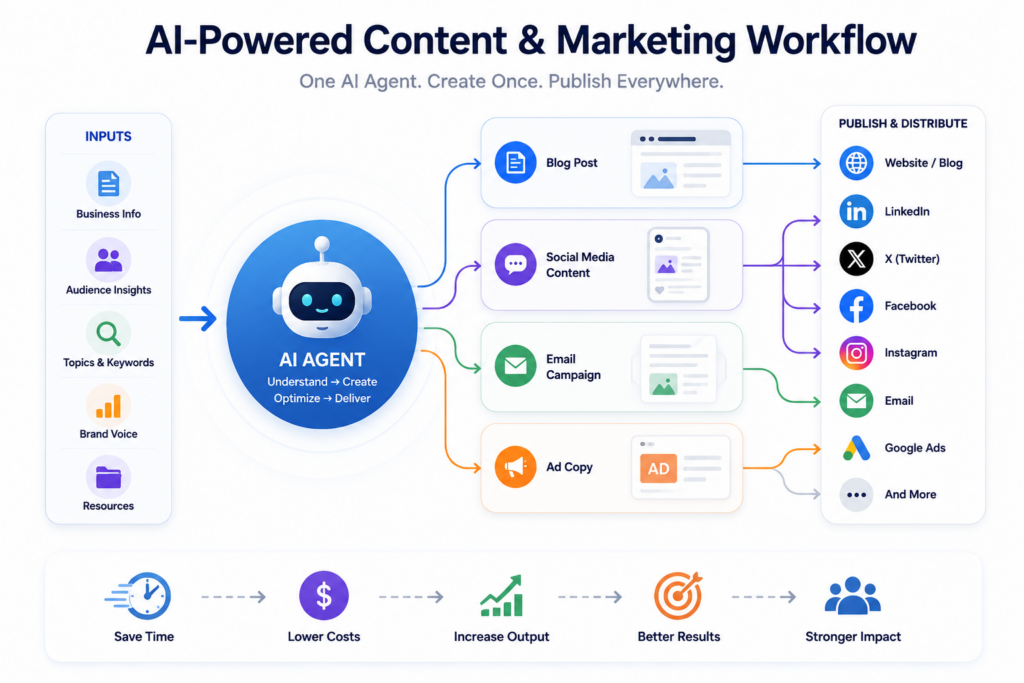
With AI agent tools for small businesses, Content agents draft blog outlines, ad copy, and social captions from a brief. Owners without a marketing hire lean on this category of AI tools for small businesses to keep a content calendar moving without hiring a full-time writer. This branch of small business AI automation works best when an owner still edits the final draft before publishing.
Back office agents reconcile invoices, flag expense anomalies, and draft first-pass reports using AI document automation to reduce repetitive administrative work. QuickBooks AI Intuit Assist is the common entry point here, and it plugs into the books you already keep. This is often the last category owners add to their AI tools for small business stack, even though the hours saved are the easiest to prove.
AI tools for small businesses solve pain points that owners already feel every week: no night coverage, cold leads, stalled content, and manual bookkeeping. The fix is not more staff, it is the right agent aimed at the right bottleneck.
No Budget for 24/7 Support Coverage: A ten-person company cannot staff a night shift. A support agent built through small business AI automation closes tickets at 2 am at a fraction of an hourly wage, which is the exact gap owners describe when asked why they finally bought AI tools for small business.
Leads Go Cold Overnight With No Dedicated Rep: Every hour a lead waits past the first contact, the odds of a reply drop. AI agent tools for small businesses answer the first message instantly and hand a warm lead to a rep the next morning instead of a cold one.
Marketing Output Stalls Without a Content Team: A single owner cannot write five blog posts and twenty social captions a month alone. AI tools for small businesses built for content keep the calendar full while the owner edits instead of drafting from zero.
Manual Bookkeeping Eats Owner Hours Every Week: Owners report spending four to six hours a week reconciling invoices by hand. AI productivity software built for back office work cuts that to under an hour by flagging exceptions instead of reviewing every line. In stack audits we run for small teams, this is consistently the category with the fastest measurable payback.
AI agent tools for small business come in three forms, off the shelf, no code assembled, and fully custom, and each has a completely different cost structure. This is the single biggest reason pricing guides contradict each other online.
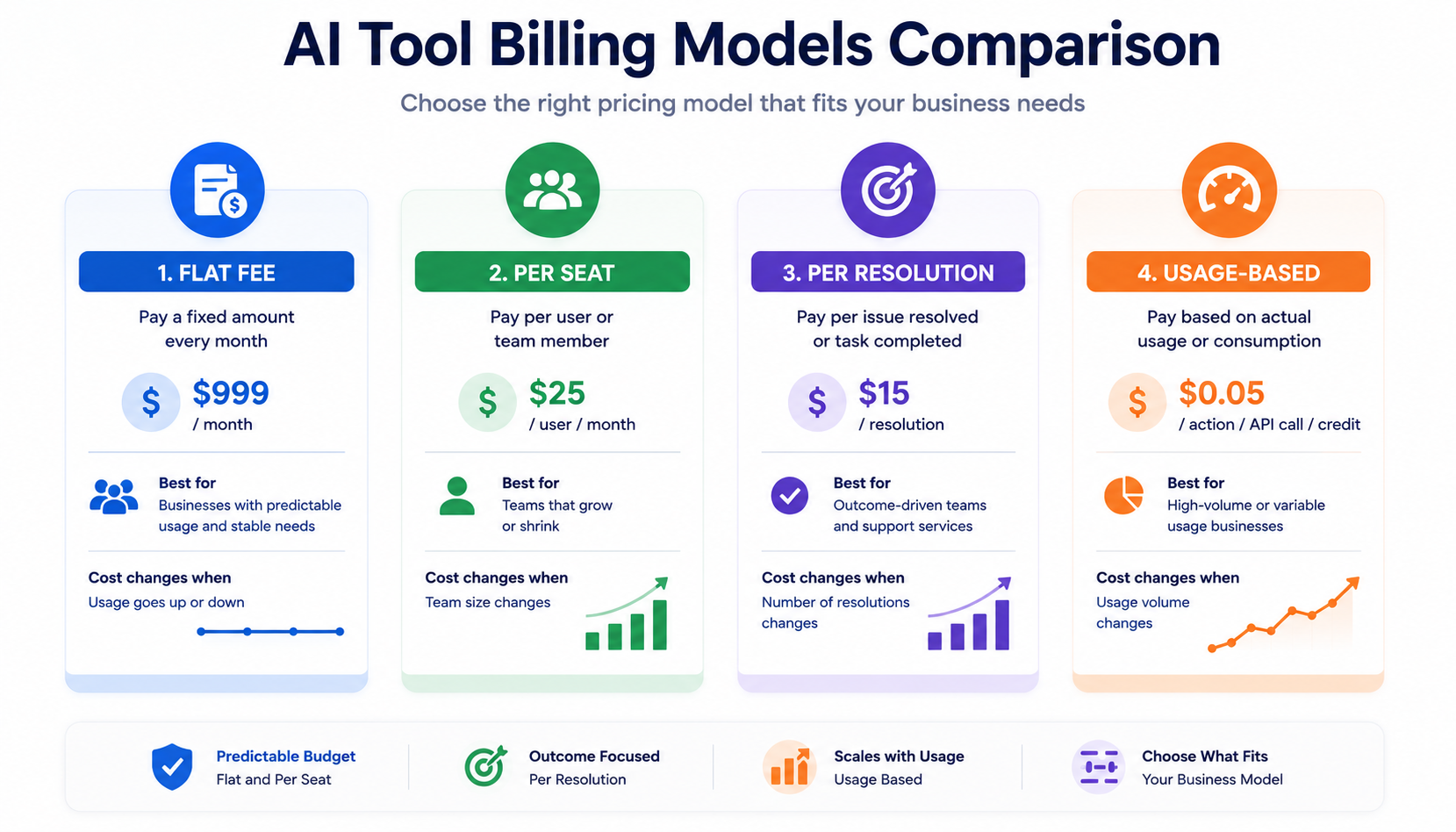
AI tools for small businesses bill through four models: flat fee, per seat, per resolution, and usage-based credits. Real 2026 pricing on AI tools for small businesses and small business AI automation platforms runs from free to over $500 a month, depending on team size and volume.
Flat fee tools charge one price regardless of usage. Per-seat tools charge per employee logged in. Per resolution tools, common in support, charge per ticket closed.
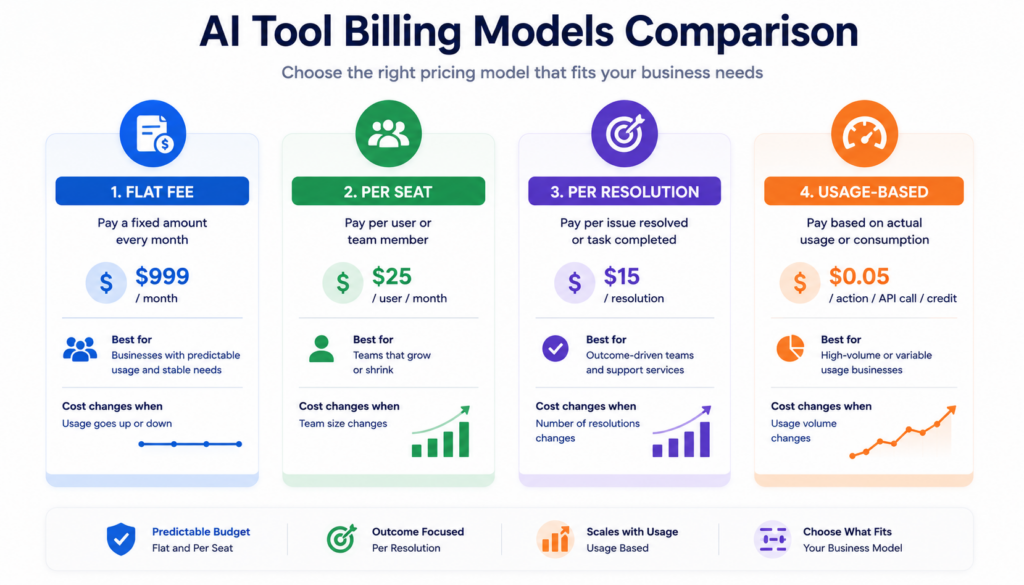
Usage-based tools charge on API credits or messages sent, which is common in AI subscription tools built on top of large language models and increasingly common across AI tools for small businesses.
This tier covers single-function tools, one chatbot, one content generator, and one scheduling assistant. It fits a solo owner testing whether AI tools for small businesses are worth the switch before committing further.
This tier adds seats, integrations, and higher usage caps. Most CRM embedded agents like HubSpot Breeze sit here once a team passes five users, which matches what we typically see when a client's ticket or lead volume outgrows a single seat plan.
In AI agent tools for small businesses, Multiple agents running across support, sales, and content live here. This is where small business AI automation starts replacing part-time hires instead of just assisting existing staff, and it is the tier most AI tools for small business buyers grow into within a year.
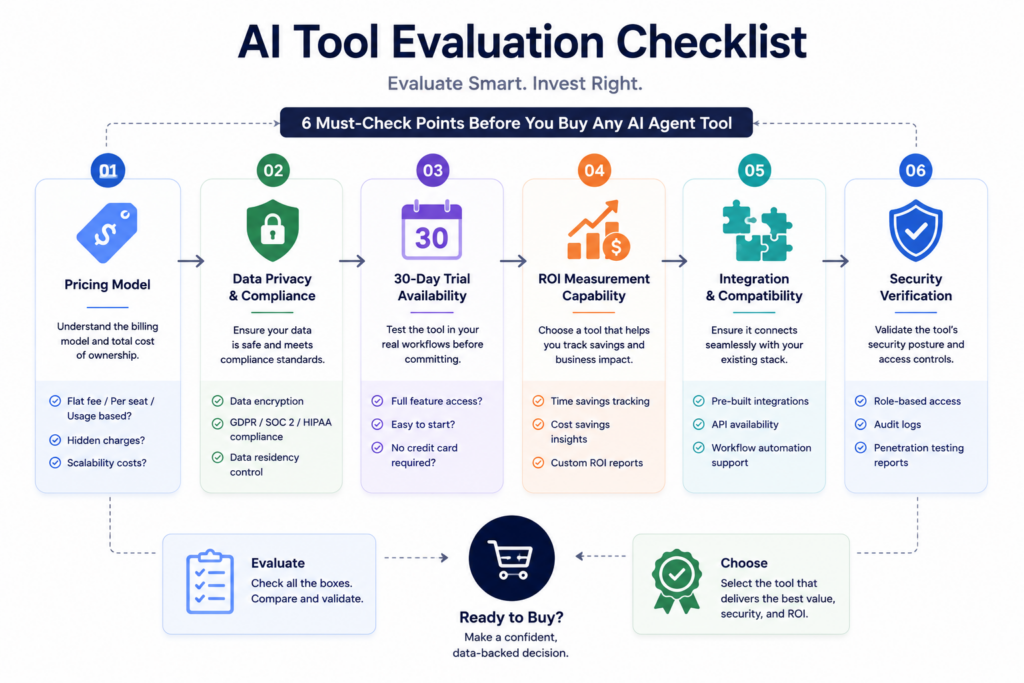
Budget for integration setup fees, overage charges past included usage, staff training time, and cloud cost optimization when calculating your real AI cost for small business operations. Owners who ignore these three line items on AI tools for small business routinely see their real bill land 1.5 to 3 times above the advertised starting price.
AI tools for small businesses return value through three channels: time saved, revenue protected from faster response, and cost displaced from manual labor. The math behind small business AI automation only works when you measure against your actual ticket or lead volume, not a vendor's average case study number.
Support and back office agents save the most measurable hours because the task itself is repetitive and countable, unlike content work, where quality still needs a human pass. This is where AI tools for small businesses show the clearest hour-by-hour return.
Faster first response on leads converts more of them, and AI agent tools for small businesses built for sales exist mainly to close that speed gap before a competitor answers first. We have not seen a client case where a slower first reply outperformed a faster one, which is why this remains the easiest upgrade to justify on paper.
A support agent bought through AI tools for small businesses replaces the marginal cost of a human agent on routine tickets, not the judgment calls that still need a person.
| Monthly Ticket Volume | Manual Cost (@$4.18/ticket) | AI Agent Cost (@$0.46 + $50 base) | Estimated Monthly Savings |
| 200 | $836 | $142 | $694 |
| 500 | $2,090 | $280 | $1,810 |
| 1,000 | $4,180 | $510 | $3,670 |
Run your own ticket count through this table before buying. AI tools for small businesses only pay off once volume clears the base fee, and low-volume teams should stay on a free tier until that threshold hits.
Manual cost per ticket is based on a blended support wage plus overhead, not a vendor-supplied figure, so recalculate it against your own payroll before trusting the savings column.
Per resolution pricing scales with volume, so cost grows in a straight line instead of jumping every time you hire another support rep, which is the main financial argument for switching from headcount to AI agent tools for small businesses. This is the clearest scaling case in the entire AI tools for small business category.
AI tools for small businesses carry four real risks: project failure, data exposure, escalation gaps, and contract lock-in.
Project Failure Risk
Most failures trace back to unclear success metrics set before launch, not the underlying model. Start with one narrow use case among your AI tools for small business that you can measure in dollars before expanding to a second one.
Data and IP Risk
Confirm in writing whether your customer data trains the vendor's underlying model and whether the platform follows Zero Trust security principles to protect sensitive business information. Many AI tools for small businesses default to using submitted data for training unless you opt out in the account settings.
Communication and Escalation Gaps
Every support agent inside a small business AI automation stack needs a clear handoff rule for tickets it cannot resolve, or frustrated customers sit in a queue with no human in sight.
Contract and Lock-In Risk
Annual contracts on small business AI automation platforms often lack a clean exit clause. Ask for a month-to-month option during the trial period, even if it costs slightly more per seat.
A custom AI development company that builds AI agents, workflow automation, and business process automation tailored to each client's operations instead of offering one-size-fits-all software.
Key Features:
Pricing: Custom quote based on project scope.
Best For: Small and mid-sized businesses looking to automate sales, operations, customer support, or internal workflows.
Client Review: 4.9/5.
Enterprise AI development company specializing in custom AI agents, generative AI, and workflow automation.
Key Features:
Pricing: Custom.
Best For: Mid-market and enterprise organizations.
Client Review: 4.8/5.
Builds AI-powered business applications, automation solutions, and intelligent assistants across multiple industries.
Key Features:
Pricing: Custom.
Best For: Businesses requiring industry-specific AI solutions.
Client Review: 4.8/5.
Focuses on AI product development, AI agents, and machine learning solutions for growing businesses.
Key Features:
Pricing: Custom.
Best For: Startups and SMBs building AI-powered products.
Client Review: 4.8/5.
AI consulting and development company helping businesses automate operations using AI and data engineering.
Key Features:
Pricing: Custom.
Best For: Companies modernizing existing business processes.
Client Review: 4.7/5.
| Company | Founded | Team Size | Pricing | Specialization | Skip It If |
| Patoliya Infotech | 2014 | 250+ | Custom Quote | AI Agents, Workflow Automation, Custom Software | You only need a simple AI subscription tool |
| LeewayHertz | 2007 | 250+ | Custom | Enterprise AI & Generative AI | You have a very limited budget |
| SoluLab | 2014 | 250+ | Custom | AI Applications & Automation | You only need an off-the-shelf AI tool |
| Markovate | 2015 | 100+ | Custom | AI Product Development | You need only basic chatbot functionality |
| DataToBiz | 2018 | 100+ | Custom | AI Consulting & Process Automation | You are looking for consumer AI software |
Patoliya Infotech delivers AI Consulting services by mapping AI tools for small businesses to your existing technology stack before recommending a single vendor, which is the step most guides skip entirely.
The team has scoped small business AI automation integrations across support, sales, and back office systems for small teams that needed one working agent, not five half-configured ones.
Schedule a technical scoping call with Patoliya Infotech to map these tools to your stack.
Selection of the right AI tools for small business is less about adopting the latest technology and more about matching the platform to your real operational needs. Evaluate pricing against your ticket volume, lead flow, or transaction count instead of relying on advertised entry-level plans.
Test one focused small business AI automation workflow, measure the results, and verify data ownership, security, and training terms before scaling. A structured rollout reduces risk and improves ROI for AI agent tools for small businesses. Patoliya Infotech helps businesses identify, implement, and optimize AI solutions through custom software development that aligns with their existing systems and long-term growth goals.