Table of Contents
Key Takeaway: Most AI chatbot development projects fail because the architecture around the model is thin, not because the model itself is weak. A setup built on retrieval grounding, intent routing, and a clean handoff to a human performs far better than a bigger language model bolted onto a flat script.
Many businesses invest in AI chatbot development believing a smarter model will solve performance issues. In reality, most failures stem from poor architecture, weak data retrieval, and missing guardrails, not model intelligence. Successful conversational AI platform development ensures the chatbot knows when to answer, escalate, or admit uncertainty.
Teams that try to build AI chatbot systems on scripted flows alone hit a ceiling within months once questions get specific. The real fix is AI chatbot development built around retrieval, intent routing, and a clean exit to a human agent. This guide breaks down what actually works, what it costs, and where most teams get it wrong.
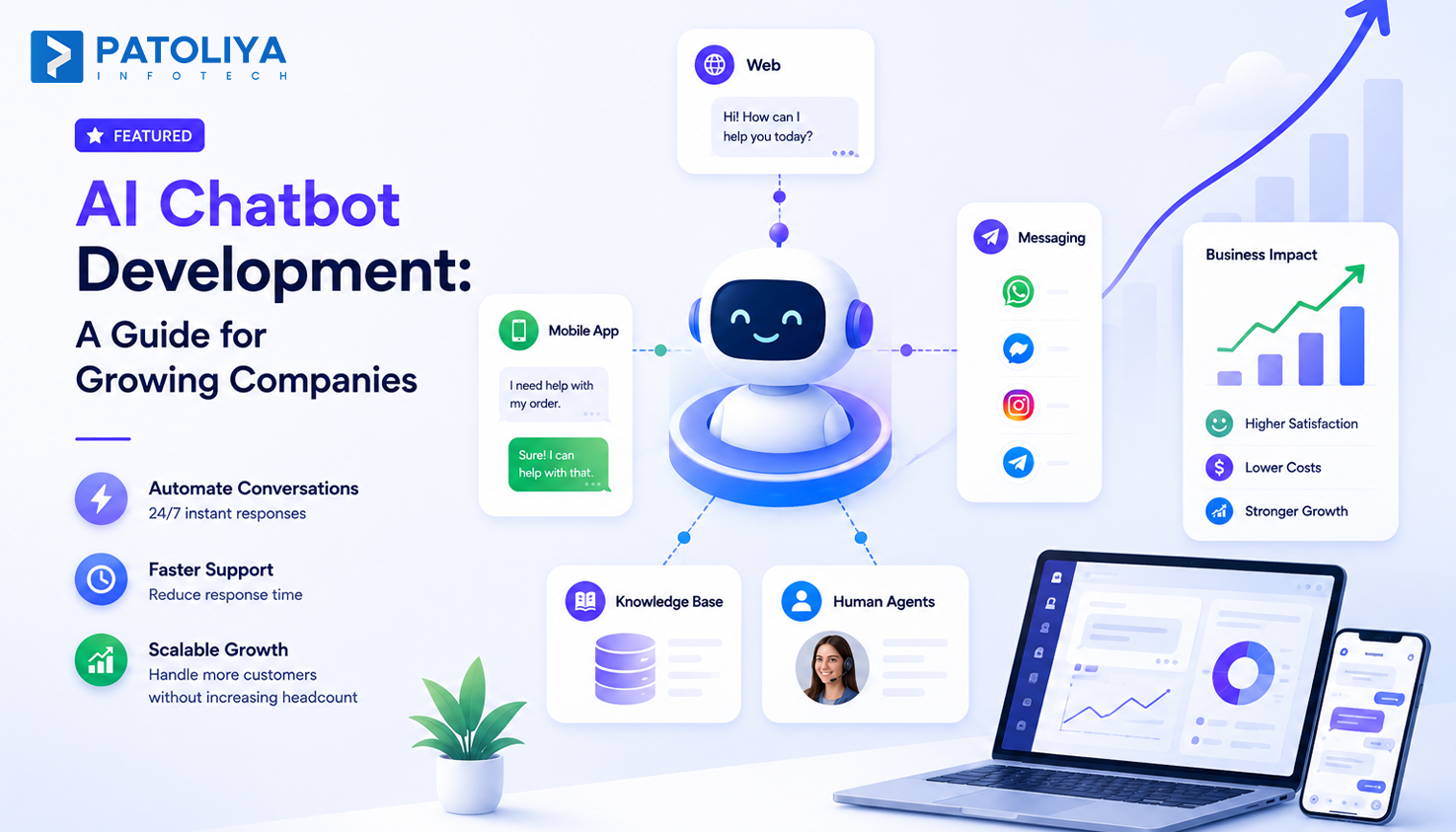
AI chatbot development means building a system that reads intent correctly, pulls accurate answers from a real knowledge base, and knows when to step aside for a person.
It replaces static FAQ pages, long phone queues, and scripted bots that loop customers through the same options. Teams that build AI chatbot flows on rigid decision trees see dropout climb fast once a question gets specific.
Conversational AI platform development is the wider category, covering voice assistants and internal tools alongside customer chat. AI chatbot development is the customer-facing slice, focused on support and sales conversations.
Why Intent Recognition Comes First: NLP intent classification decides what a customer wants before any answer gets generated. Skip this step and the bot guesses, which is exactly where frustration starts.
Knowledge Grounding via RAG: A RAG customer support bot pulls answers from real documentation instead of pulling from the model's general memory. In build AI chatbot, this single choice cuts wrong answers more than any other decision a team makes.
Reaching Customers Across Channels and Regions: Multilingual support lets one bot serve customers across several regions without separate builds for each. Coverage across web chat, WhatsApp, and email runs on the same underlying logic, so nothing gets out of sync.
Escalation Logic and the Exit to a Person: A clean chatbot-to-human handoff passes full context to the agent so customers never repeat themselves. This piece gets skipped constantly in cheap builds, and it shows within the first week of launch.
Analytics and Continuous Tuning: Weekly review of failed conversations shows exactly where intent recognition broke down. That feedback loop separates a bot that keeps improving from one that stays stuck at launch quality forever.
Support Volume Outpacing Headcount: Ticket volume grows faster than hiring budgets in almost every support team. AI chatbot development absorbs the repetitive volume, password resets, and order status checks, freeing agents to handle harder cases instead.
Bots That Misread Intent and Loop Customers: A bot that misreads intent sends customers in circles, and that single failure drives most chatbot abandonment. Good AI chatbot development treats intent accuracy as the core metric, not a side detail buried in a sales demo.
Inconsistent Answers Across Channels: A customer gets one answer on chat and a different one over email because two scripts were never synced. Teams that build AI chatbot systems on a single shared knowledge layer avoid this entirely, since every channel pulls from the same source.
Customers Trapped With No Way to Reach a Human: Nothing damages trust faster than a bot that will not let a customer reach a person. AI chatbot development done right always includes an exit, and that exit carries the full conversation history with it.
These run roughly two thousand to thirty thousand dollars and handle narrow, predictable flows like store hours or order status. This level rarely needs much real reasoning since the logic is simple branching from start to finish.
This level runs thirty thousand to one hundred twenty thousand dollars depending on integrations and the number of languages involved. Most midsize support teams land here once they decide to build AI chatbot systems with genuine intent handling instead of scripts.
Enterprise builds with a GPT API chatbot layer and full system integration start past two hundred fifty thousand dollars. AI chatbot development at this level includes compliance review, security testing, and access across multiple internal systems.
Knowledge base cleanup, ongoing model tuning, and agent training on the new handoff flow rarely appear in the original quote. Budget an extra fifteen to twenty percent on top of the build price to cover these.
A fixed scope works for simple builds with clear requirements written down in advance. Time and materials fits a generative build, where requirements shift once the build AI chatbot meets real customer conversations.
Cost per Resolution Savings: A human agent resolution costs far more than a resolution handled by a fully tuned bot.
AI chatbot development pays back fastest on high-volume, low-complexity ticket types like order status and password resets, and teams that build AI chatbot systems around those ticket types first see the quickest payback.
Returns Reported at the Business Level: Finance teams funding AI chatbot development want a payback window, not a vague promise of efficiency.
Most solid projects show measurable cost reduction within two full quarters of live traffic.
Time to Market and Deflection Impact: Chatbot deflection rate is the cleanest single number for proving value to leadership, since it ties straight to reduced agent load.
A properly built bot should hit a meaningful deflection number within roughly two months of going live.
Scalability Economics: Conversation volume can double without doubling cost once the underlying conversational AI platform development is in place, unlike headcount, which scales in a straight line.
That is the real financial case for the investment, not just convenience for customers chatting after hours.
IP and Data Ownership Risk: Some SaaS vendors retain rights to the trained model or the conversation data that trained it.
Custom AI chatbot development contracts should state ownership in writing before any code gets written, especially if the engagement doubles as broader conversational AI platform development work.
Communication and Project Management Risk: Vendors that go quiet for weeks between updates are the most common complaint in AI chatbot development projects gone wrong.
Set a weekly status call before signing, not after the first missed deadline arrives.
Quality and Hallucination Risk: Quality and hallucination risk is real, a bot that confidently invents a wrong answer is worse than a bot that admits it does not know.
AI chatbot development without strict retrieval grounding will hallucinate policy details that never existed, and one bad answer can cost more than the entire build.
Contract and Compliance Risk: Regulated industries need data residency clauses and audit trails written into the contract itself.
Teams that try to build AI chatbot systems without legal review on data handling tend to find compliance gaps only after an audit lands.
| Selection Criteria | Why It Matters |
| Industry-specific working demo | Demonstrates practical experience and validates the vendor's ability to solve real business challenges rather than showcasing generic examples. |
| Clear ownership of models and data | Prevents future disputes and ensures your organization retains control over trained models and conversation history. |
| Experience with retrieval-grounded AI systems | Confirms the team can build AI solutions that deliver accurate, context-aware responses instead of scripted chatbot interactions. |
| Proven approach to measuring accuracy | Shows the vendor follows performance benchmarks and quality standards before deployment of conversational AI platform development. |
| Defined timeline for MVP delivery | Helps stakeholders evaluate progress early and reduces the risk of project delays. |
| Post-launch optimization support | Ensures continuous improvement after deployment and helps maintain chatbot performance over time. |
| Transparent project scope and architecture | Reduces the likelihood of unexpected costs, scope creep, and technical limitations later in the project lifecycle. |
| Clear budgeting and implementation process | Creates alignment on expectations and minimizes contract renegotiations during development. |
Enterprise platform built for extensive AI chatbot development across banking, healthcare, and retail clients worldwide.
Key Features:
Industries Catered: Banking, healthcare, retail.
Pricing: Custom quote, enterprise tier.
Client Review: 4.3/5 stars.
Platform focused on conversational AI platform development for commerce and customer support automation at scale.
Key Features:
Industries Catered: Ecommerce, telecom.
Pricing: Mid-tier, usage-based.
Client Review: 4.2/5 stars.
Platform with deep WhatsApp integration, popular for retail and BFSI AI chatbot development projects across growth markets.
Key Features:
Industries Catered: Retail, BFSI, travel.
Pricing: Mid-tier.
Client Review: 4.1/5 stars.
Contact center platform built around voice bots and agent support tools alongside standard chat automation.
Key Features:
Industries Catered: Telecom, insurance.
Pricing: Enterprise, custom quote.
Client Review: 4.0/5 stars.
Custom AI chatbot development partner for teams that want full code ownership instead of a locked SaaS platform.
Key Features:
Industries Catered: SaaS, healthcare, fintech.
Pricing: Project-based, scoped per requirement.
Client Review: 4.7/5 stars.
Patoliya Infotech delivers AI chatbot development with full intellectual property ownership transferred to the client, retrieval-grounded answers pulled from your own documentation, and a tested handoff flow that passes complete context to human agents.
If your current bot still cannot tell a customer "let me get you a person," that gap is fixable. Book a working session with Patoliya Infotech and walk through your actual support data before committing to a build.
The bots that actually work share three things: grounded answers, accurate intent routing, and a real way out to a human. Everything else in AI chatbot development is detail work on top of that foundation. Teams that treat the build AI chatbot as a single project instead of a tuned system stay stuck at the same result for years.
Conversational AI platform development done well keeps improving every month after launch, not just at the demo. Patoliya Infotech can walk through what a properly tuned system looks like for your support volume specifically. Let's look at your data together.