Table of Contents
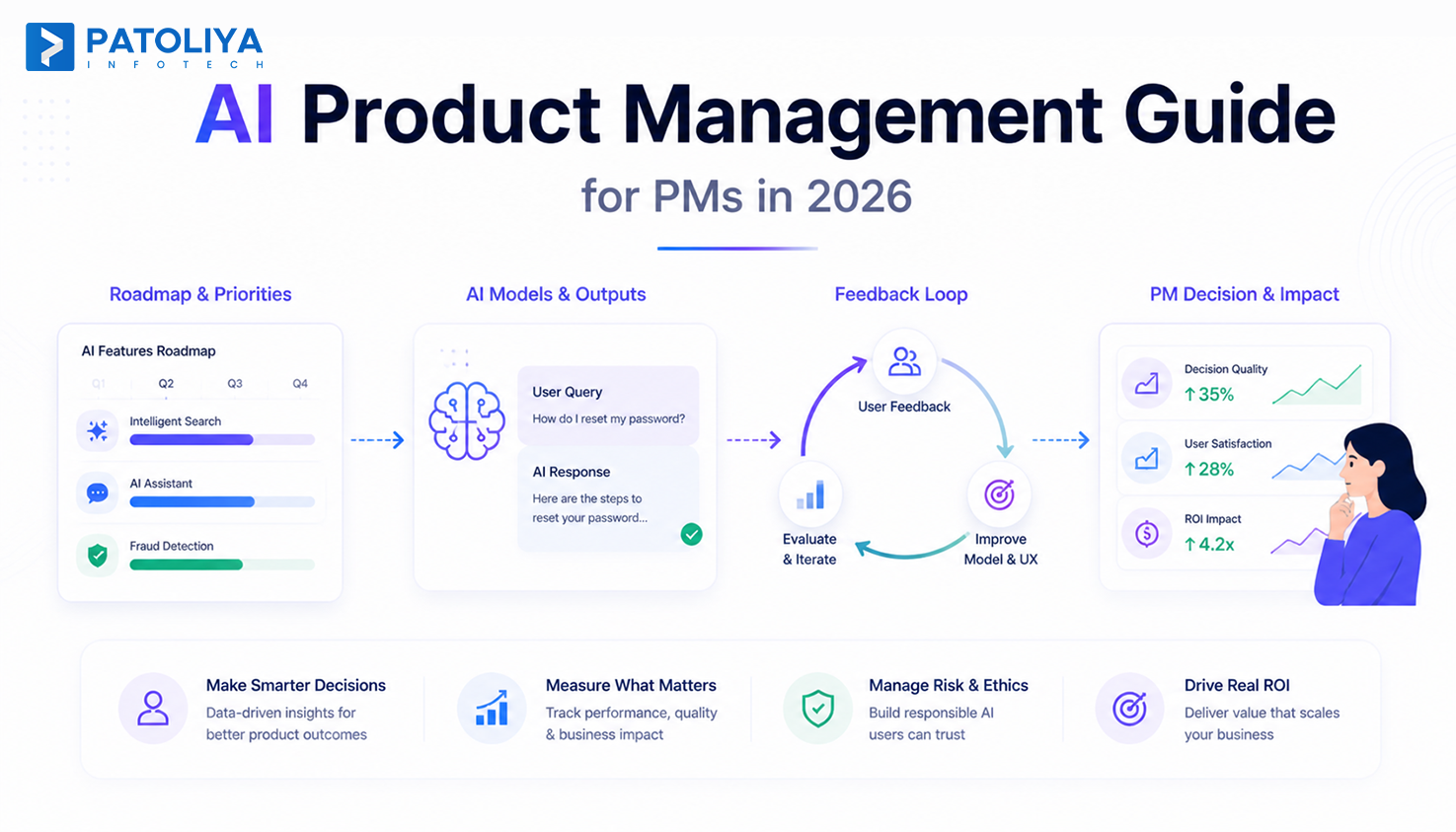
TLDR: AI product management in 2026 goes beyond roadmap ownership. PMs must evaluate models, manage probabilistic outputs, and own AI governance from sprint one. Many teams still lack structured experience in AI system design, and that gap is where most AI features fail.
A growing share of product teams are building AI into core features. The challenge in AI product management is not adoption, it is execution. Without clear evaluation frameworks, feedback loops, and governance, AI features move from demo to production with unstable outputs, rising costs, and unclear accountability.
The problem is not the technology. It is that AI product management requires a fundamentally different operating model, and most PMs are running the old playbook.
This guide covers what AI product management actually demands: scoping, building AI products that survive contact with real users, structuring an AI feature roadmap that accounts for model uncertainty, and developing the product manager AI skills that separate execution from guesswork.
AI product management is the practice of defining, prioritizing, and shipping product features whose core logic is probabilistic rather than rule-based. Traditional PM owns a deterministic spec. AI product management owns an outcome envelope, and the model determines what falls inside it, which depends on the product manager AI skills.
Standard Project management workflows break at three points when AI product management enters the picture. AI feature roadmap specs assume binary behavior. Acceptance criteria assume testable outputs. Launch gates assume stable performance.
AI product management replaces those assumptions with model capability briefs, evaluation thresholds, and SLA definitions for post-launch drift, requiring deeper product manager AI skills.
A traditional PM writes: "The system will return the correct answer." An AI product manager writes: "The model will return a relevant answer with precision above 0.82 on the validation set, with a defined fallback for confidence scores below 0.6." That shift in language is the shift in the AI product management operating model.
The term AI product management gets conflated with data PM, ML PM, and technical PM. They are not the same.
| Role | Core Ownership |
| AI Product Manager | Feature outcomes, model evaluation criteria, and ethical AI gates |
| Data PM | Data pipelines, governance, quality |
| ML PM | Model architecture decisions, training pipelines |
| Technical PM | Engineering delivery, system integration |
AI product management sits above all three in the product layer. It translates business outcomes into model requirements, not model outputs into business slides.
Understanding the role's boundaries is the first practical step of building AI products before you write a single AI feature roadmap item.
AI product management is not a technical role. It is a decision-making role under uncertainty. The product manager AI skills that matter in 2026 come down to one thing: translating incomplete model behavior into confident product calls.
In AI product management, every AI feature carries three cost layers: development, inference at scale, and retraining when the model drifts. Standard feature prioritization AI frameworks miss the second and third.
Prioritize by impact per inference call. The AI feature roadmap that ignores inference cost looks clean in planning and becomes a $20,000 monthly surprise at 10 million calls.
AI sprint planning treats data readiness as a hard sprint dependency. Most delays in building AI products trace back to training data that was not ready when model development started.
Before the sprint kickoff, confirm three things: labeled data volume, distribution match against production conditions, and documented edge cases. Missing any one of these breaks the sprint of AI product management before it begins.
You do not build the evaluation pipeline. You challenge it. Model evaluation for PMs means reading precision, recall, and AUC-ROC outputs and deciding whether the AI product management model meets the product bar through the product manager AI skills.
A model showing 94% accuracy on a balanced test set may perform at 60% on your real user distribution. Catching that gap in the AI feature roadmap is your job.
Ethical AI product design of building AI products is a roadmap dependency, not a legal review at the end. Build fairness audits, explainability requirements, and human oversight mechanisms into the feature spec before development begins with AI product management.
AI UX is the design discipline that traditional UX never had to address: what does the interface show when the model is uncertain?
Design for three output states: high confidence, low confidence, and failure. If your building AI products only has a success state in the UI, you are shipping a broken experience for a significant percentage of users. Define confidence thresholds and map each to a specific interface behavior before handoff to design.
AI product management fails in predictable patterns. These four problems appear across companies regardless of model sophistication, team size, or budget.
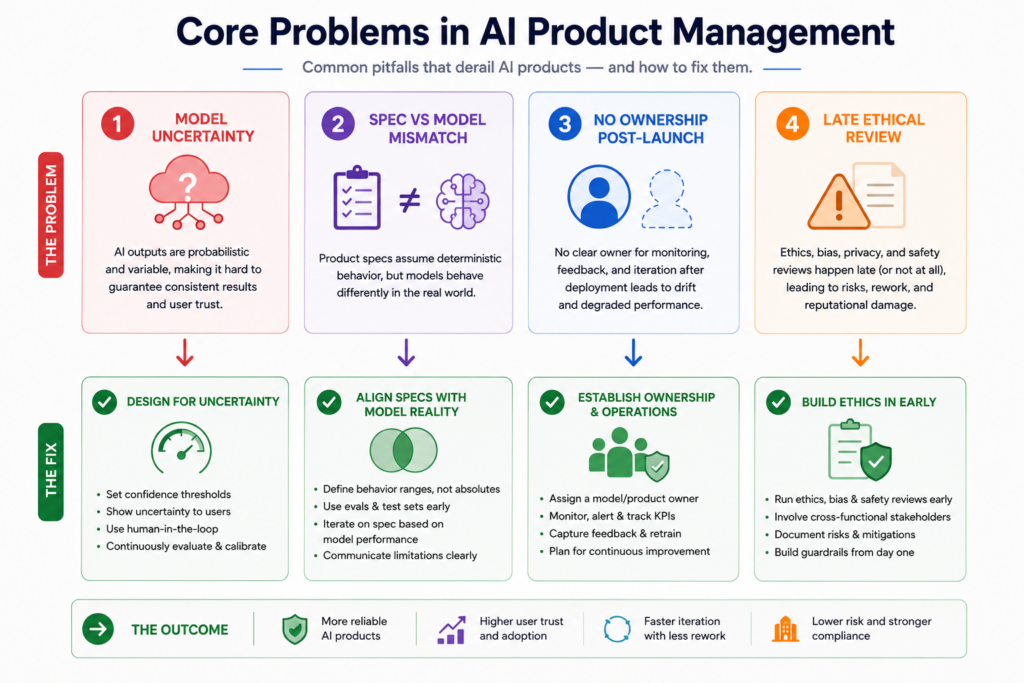
Most AI feature roadmap items are written as if the model behaves like a function call. It does not, and product manager AI skills play an essential role in an effective roadmap.
An AI product management roadmap without model uncertainty ranges, fallback behaviors, and retraining triggers will produce a launch that surprises everyone.
Add a model uncertainty field to every feature spec. Define the acceptable confidence range, the fallback below it, and the retraining trigger. Thirty minutes per feature prevents weeks of post-launch rework.
The spec says personalized recommendations for building AI products. The model delivers statistically similar items from the same category. Those are not the same product experience with AI product management.
This misalignment between AI product strategy and model capability is the most common cause of a failed AI feature roadmap. A model capability brief, reviewed jointly by PM and data science before sprint entry, closes the gap before it costs development cycles.
Traditional features degrade on a visible schedule. The AI feature roadmap degrades silently. A classification model for AI product management trained in Q1 may drift significantly by Q3 as user behavior shifts.
Assign a post-launch model SLA owner on day one of building AI products. Define what drift looks like numerically, what threshold triggers a review, and who authorizes retraining. AI product management owns that accountability chain.
Legal reviewing an AI feature in the final sprint is not governance. It is a delay machine.
Ethical AI product design requirements include bias audit protocol, human override mechanism, and explainability outputs. For AI product management teams shipping into EU markets, the EU AI Act makes these mandatory from day one of the feature spec.
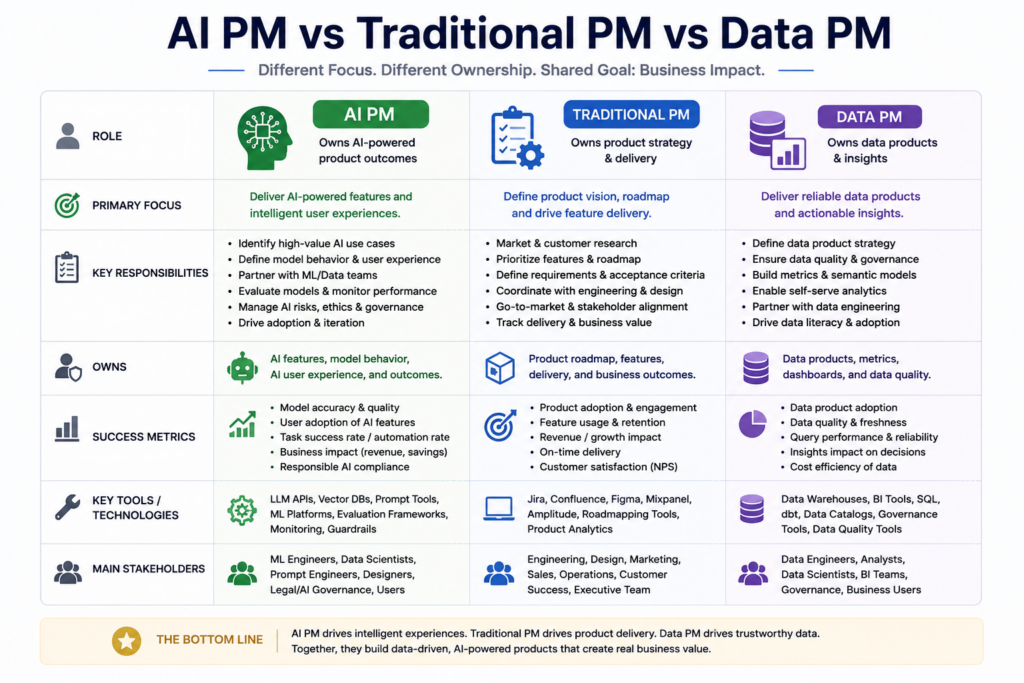
| Dimension | Traditional PM | AI PM | Data PM |
| Core output | Feature spec | Model evaluation criteria | Data governance |
| Success metric | Feature adoption | Model performance vs. acceptance threshold | Data quality score |
| Key dependency | Engineering sprint | Data readiness + model training | Data pipeline |
| Post-launch ownership | Bug triage | Model drift monitoring | Data freshness |
Product manager AI skills are now listed as required, not preferred, in 61% of senior PM job postings at companies with 500+ employees (LinkedIn, 2025). The roles that pay a premium are not those with the most AI tool experience. They are roles that can write model evaluation criteria and own post-launch model SLAs for AI product management.
AI product management sits between product and data science. The reporting line varies. What does not vary: the AI PM is the person who translates between business outcome language and model performance language. That translation function of the AI feature roadmap is where most cross-functional AI product strategies fall apart without a dedicated owner and product manager AI skills.
Building AI products costs more than most initial estimates because AI product management routinely scopes the development cost and misses the operational cost, where the product manager AI skills become essential. Here is what the full picture looks like.
| Tier | Feature Type | Typical Cost Range | Timeline |
| Tier 1 | Prompt engineering, API integration | $15,000 to $60,000 | 4 to 8 weeks |
| Tier 2 | Custom ML model with training pipeline | $80,000 to $250,000 | 12 to 24 weeks |
| Tier 3 | Core AI product, novel architecture | $300,000 to $500,000+ | 6 to 18 months |
These are development costs for AI product management. They do not include inference costs at scale, retraining cycles, or compliance overhead.
Inference cost at scale is the most common budget surprise when building AI products through AI product management. A model that costs $0.002 per call looks trivial. At 10 million monthly calls, that is $20,000 per month in operational cost that was never in the product budget.
Four hidden cost categories to include in every AI feature roadmap budget:
Fixed-price contracts work for Tier 1 features with a clearly defined scope for building AI products. For Tier 2 and Tier 3, time-and-materials or milestone-based contracts are more appropriate because model performance outcomes cannot be fully specified upfront.
Any vendor of AI product management offering a fixed-price contract for a custom ML model without a model capability brief has not assessed the scope. That is a risk signal, and a product manager's AI skills can help to overcome it.
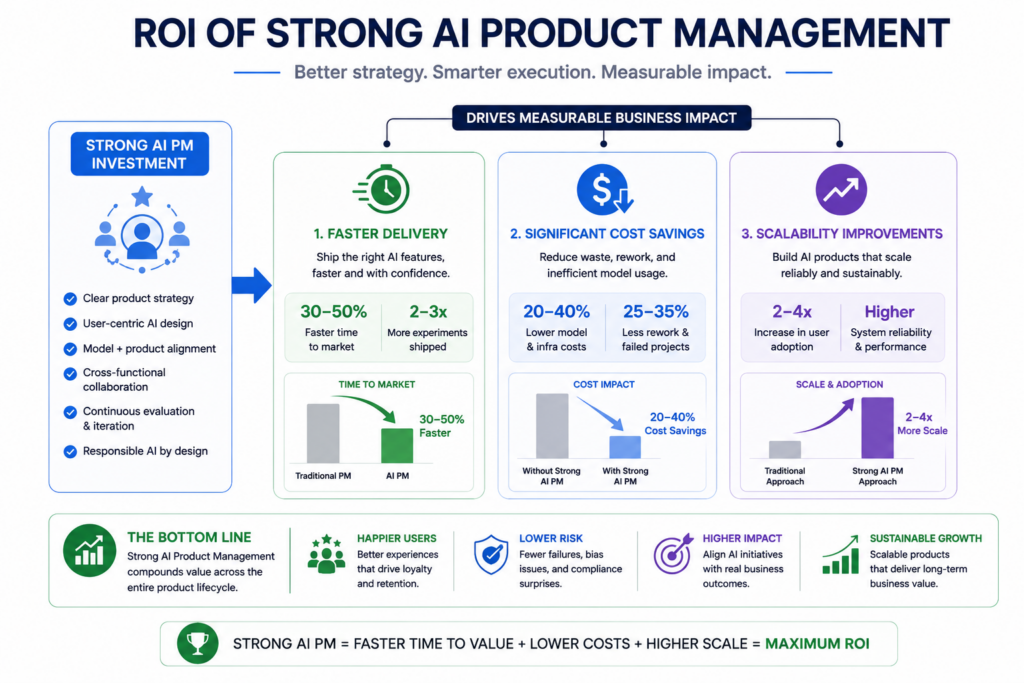
Strong AI product management generates measurable ROI through three vectors: faster time-to-market, cost avoidance, and scalability economics.
Teams with a dedicated AI product management function ship AI features 40% faster than teams where AI PM responsibilities are split across data science and traditional PM roles. The reason is simple: model evaluation decisions do not wait for a calendar alignment between two teams.
A failed AI feature without an AI feature roadmap at Tier 2 complexity costs $80,000 to $250,000 in development. Post-launch rework on a model that shipped without proper evaluation criteria adds 30 to 60% of that development cost again.
The three most expensive AI product management failures:
An AI feature roadmap built with proper inference cost budgeting and retraining triggers scales profitably. One built without those structures scales into a margin problem where a product manager AI skills become essential. AI product management is the function that determines which outcome you get.
AI product management carries a distinct risk profile from traditional product development.
A recruitment AI trained on historical hiring data will replicate historical hiring bias for AI product management. The PM owns the requirement to audit for disparate impact before launch.
Ethical AI product design of building AI products requires bias testing on stratified subsets of your user population, not aggregate metrics alone. Aggregate accuracy can mask severe performance gaps on minority subgroups of AI product management.
Training data provenance is a PM-level concern, not just a legal concern. If your model was trained on third-party data without proper licensing, the IP risk sits in your product. Validate data ownership before the model of AI product management enters production.
Cross-functional AI product management teams fail most often on language mismatch. Data scientists describe model performance in statistical terms. Stakeholders want business impact terms. PMs and product manager AI skills translate between them.
Build a shared glossary in sprint zero of AI product management. Define what "good performance" means in both metric and outcome terms before building AI products begins.
The EU AI Act classifies AI systems used in employment, credit, and healthcare as high-risk. High-risk systems require conformity assessments, technical documentation, and human oversight mechanisms before deployment.
For AI product management teams shipping into EU markets after August 2026, compliance is a launch gate, not a post-launch item, requiring strong product manager AI skills to define governance early.
The right AI product management partner delivers evaluation methodology, not just demos. Use this checklist before signing.
Must-Have Criteria:
An AI product management vendor that can only show portfolio outputs but cannot explain their evaluation framework is a code shop. For building AI products that hold up post-launch, you need a team that owns model performance accountability, not just delivery timelines.
The building AI products vendor market is fragmented. Most AI product management vendors are strong on execution and weak on AI product strategy and evaluation methodology. Evaluate on these four dimensions: model evaluation rigor, ethical AI process, cross-functional team structure, and post-launch SLA ownership, which depends on the product manager AI skills.
| Vendor Tier | Strength | Limitation |
| Tier 1 (Strategy + Execution) | Full PM, data science, engineering integration | Higher engagement cost |
| Tier 2 (Execution Focused) | Strong delivery, fast timelines | Limited strategic advisory |
| Tier 3 (Niche/Specialist) | Deep expertise in one vertical | Limited scalability |
Avoid AI product management vendors who cannot show documented evaluation frameworks from prior AI feature roadmap builds. Past delivery speed is not a proxy for model quality.
AI product management requires a partner who can operate at the product layer, not just the engineering layer. Patoliya Infotech structures every AI engagement around three accountabilities with the best product manager AI skills.
If your AI feature roadmap has features in active development but no defined evaluation thresholds or post-launch model SLAs, that is the conversation to start. Get a scoped estimate from Patoliya Infotech tied to your specific model requirements.
AI product management has moved from a nice-to-have specialization to the function that determines whether your AI investment generates returns or generates rework. The gap is not technical. It is structural: teams without a dedicated AI PM function are shipping slower, spending more, and accumulating compliance debt they have not priced in. The framework and evaluation methodology of AI product management exist. The decision is whether you build that function internally or find a partner who already has it. Let's talk scope.