Table of Contents
71% of organizations use agile software development life cycle practices, yet 43% still cite poor phase execution as the leading cause of failed software delivery cycles. According to the 17th Annual State of Agile Report. That gap tells you something important. Most teams adopt the label. Fewer execute the structure. For CTOs and product leads, this is not a methodology debate. It is a delivery risk and budget risk with a measurable cost at every phase. This guide breaks down each of the 5 phases of the agile software development life cycle, with a focus on what each agile SDLC phases should deliver, what it costs when skipped, and how to measure ROI at every stage.
The agile software development life cycle is a structured delivery and risk management system, not simply a flexible alternative to Waterfall. For enterprise teams, it controls rework cost, release predictability, and stakeholder alignment across each sprint cycle of the agile software development life cycle.
Most leadership teams treat Agile as an operating philosophy. That is where the gap opens. The real structural difference between the agile software development life cycle and with the waterfall methodology is not flexibility. It is the feedback frequency. Agile surfaces problems within a sprint of agile SDLC phases. Waterfall surfaces them at project completion, when the cost to fix them is exponentially higher.
McKinsey's enterprise agility research found that successful agile project delivery improves customer satisfaction scores by 10 to 30 points and operational performance by 30 to 50 percent. Those numbers come from execution discipline, not adoption volume.
The phase structure of the iterative software development process is what creates that discipline. When teams skip or compress phases, they forfeit the compounding advantage for agile methodology for enterprises that makes the agile software development life cycle worth the investment.
| Factor | Agile Software Development Life Cycle | Waterfall |
| Feedback Loop | Feedback Loop | End of project |
| Rework Risk | Low (continuous testing) | High (late-stage discovery) |
| Cost of Change | Low in early phases | Exponentially higher |
| Stakeholder Visibility | Continuous | Milestone-based |
| Failure Rate | 9% | 29% |
| Time-to-Market | Faster (incremental releases) | Slower (full-build release) |
The 9% vs. 29% failure rate comparison is the metric every engineering leader should anchor their vendor and process conversations to, as agile software development life cycle phase execution is what separates those two outcomes.
Understanding what the agile software development life cycle actually means for enterprises sets the foundation for evaluating what each phase delivers, and what it costs when skipped.
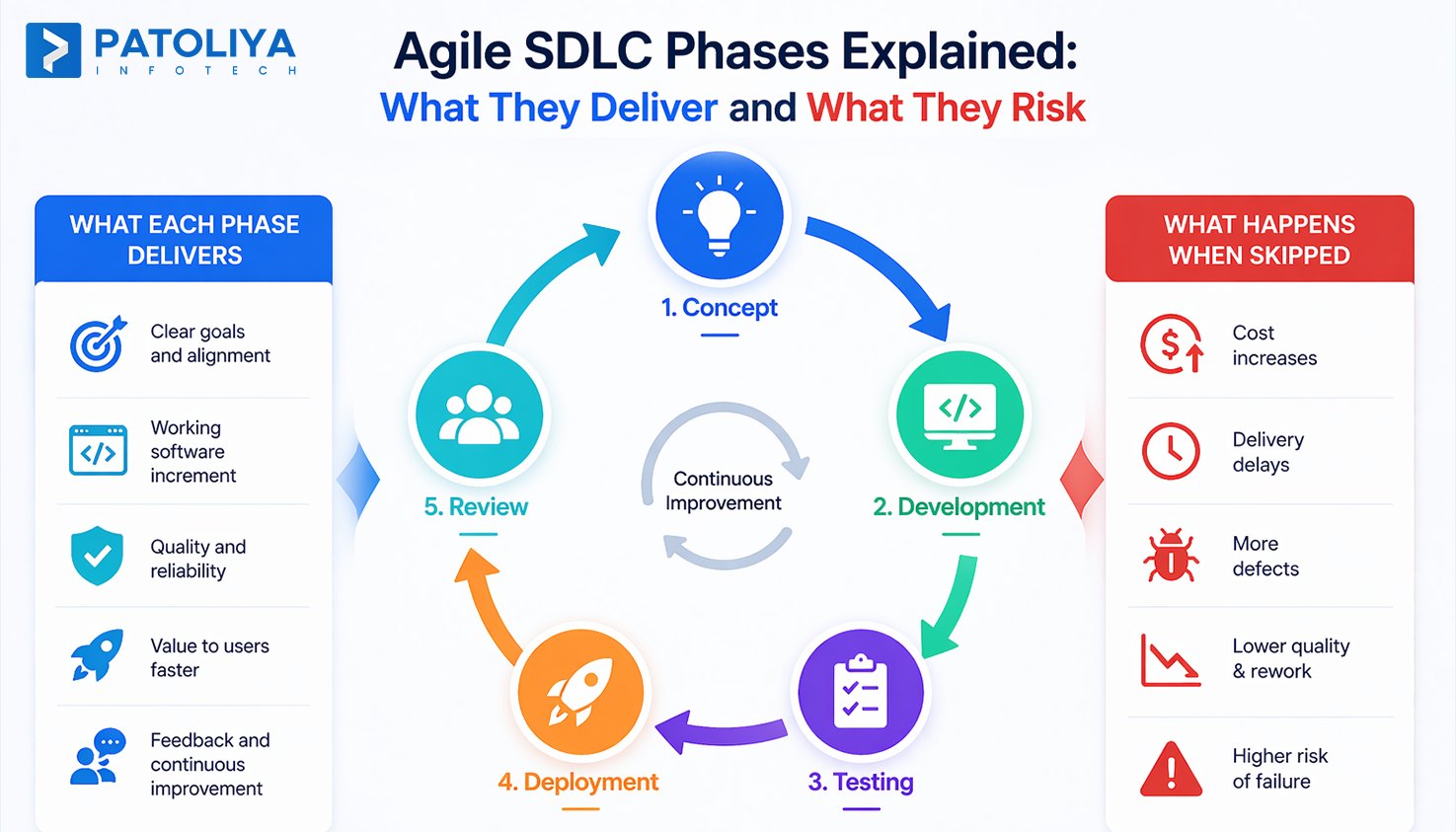
These five agile SDLC phases are not sequential gates you unlock and close. They are iterative software development process loops that repeat across every scrum development cycle, compounding business value with each sprint when executed correctly.
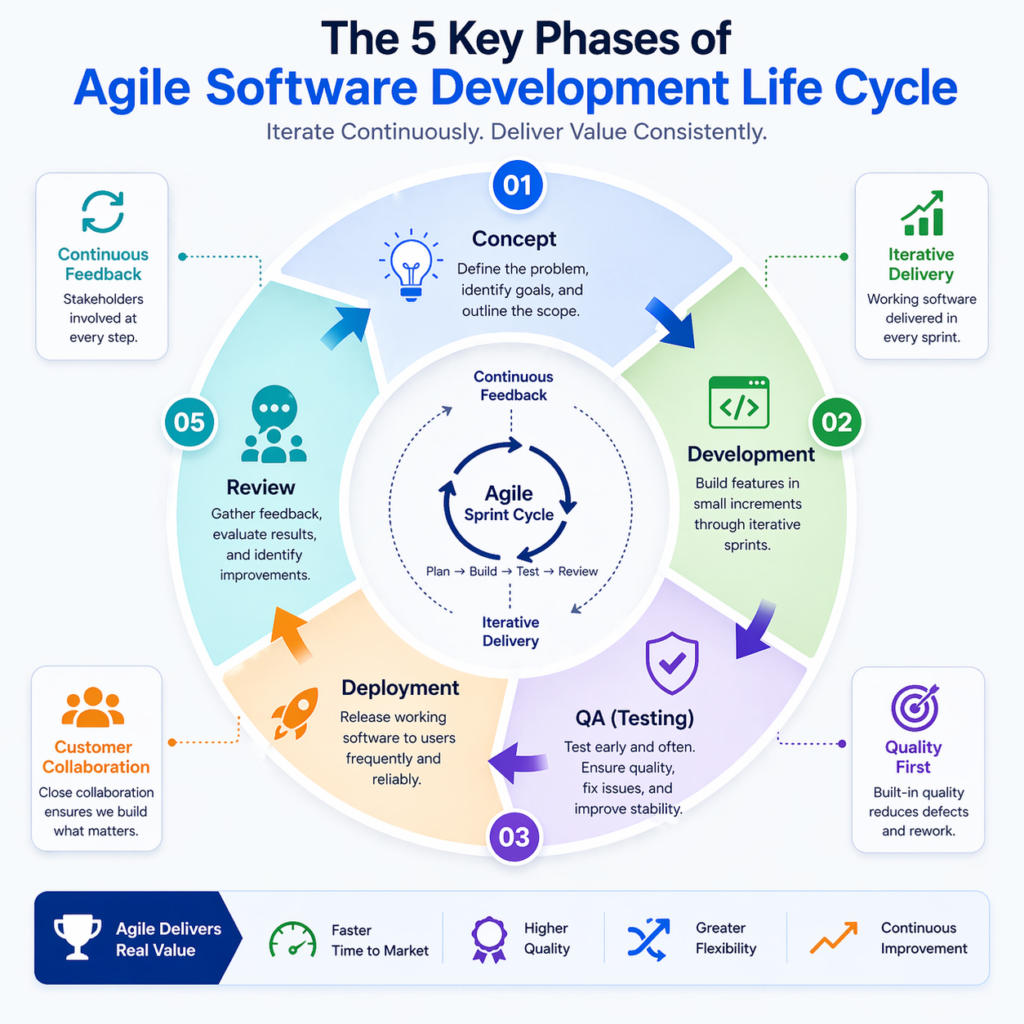
Sprint 0 is the phase most engineering teams under-invest in, yet it determines everything downstream. These agile SDLC phases cover stakeholder alignment, business requirement mapping, product backlog creation, and ROI baseline definition. The agile software development life cycle starts here, and teams that rush it pay for it three sprints later.
This phase of the iterative software development process consumes just 5 to 10% of total project time but prevents approximately 30% of costly rework downstream. That is the strongest cost-benefit ratio at any stage in the agile project delivery cycle.
What gets skipped when this phase is compressed in the agile software development life cycle: scope definition and success KPIs leave sprints measuring output instead of outcome. Sprint planning baselines cannot be established without defined velocity metrics.
Initial cost of Scrum development cycle estimates become unreliable once scope shifts before procurement approvals arrive.
Expected outputs of agile software development life cycle include a prioritized product backlog with user stories mapped to business outcomes. An agile project delivery charter with ROI projection and success criteria, and an initial cost estimate with sprint cadence structure.
High-performing teams in the iterative software development process define what "done" means before the first sprint starts. Teams of agile software development life cycle that skip this create scope creep and delays every release of agile methodology for enterprises that follow it.
This is where the agile software development life cycle earns its commercial argument. Every scrum development cycle produces a potentially shippable product increment, meaning revenue generation can begin before the full product is built.
Sprint cycles run one to four weeks during iterative software development process. Daily standups keep teams aligned. Features move from backlog to working code inside a single agile software development life cycle. Teams are not waiting for a 12-month waterfall release to capture early market feedback or validate product decisions.
The compounding risk of the Scrum development cycle here is defective debt. Teams skipping code reviews or test-driven development create bugs that cost four to five times more to fix post-release of agile software development life cycle. That is not a testing argument in agile project delivery. It is a budget argument.
Strong iterative software development process execution means feature development ties directly to prioritized user stories.
CI/CD pipeline triggers run on every commit, so broken code is never left undetected. Daily standups function as blocker removal tools, not status rituals for agile software development life cycle.
Jira is used by 62% of teams at agile methodology for enterprises for sprint tracking, alongside GitHub for version control and Jenkins for CI/CD pipeline automation.
Agile testing is not a phase that happens after development. In the agile software development life cycle, QA runs inside each sprint, and that shift is the single largest driver of defect cost reduction.
Traditional QA operates as a gate at the end of the agile software development life cycle. Agile testing is a continuous activity embedded within every agile SDLC phases execution. Defects caught inside a sprint cost roughly six times less to fix than defects found post-deployment of the agile software development life cycle.
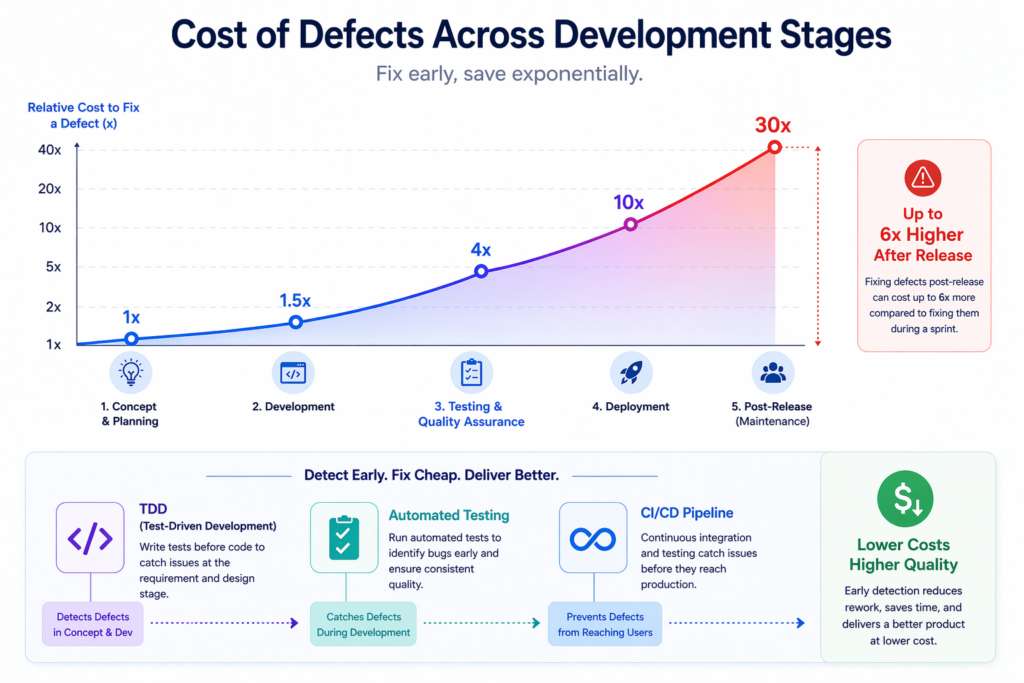
Agile teams running a full scrum development cycle with embedded QA achieve 250% better quality outcomes than teams separating development and testing, according to the 17th Annual State of Agile Report.
Correctly embedded QA means that test-driven development (TDD) is applied, so tests are written before features. Automated regression tests run on every CI/CD pipeline.
In the agile software development life cycle, ensuring stability and catching defects early in the iterative software development process. Sprint acceptance criteria in the agile software development life cycle include quality sign-off, not just feature delivery.
Deliverables include test reports per sprint of agile SDLC phases, defect density metrics, and sprint acceptance criteria sign-off before any increment reaches review.
In a mature agile software development life cycle, release operates as a continuous delivery rhythm embedded within the Scrum development cycle. Agile project delivery teams average four production releases per month, compared to quarterly releases under traditional models.
That cadence makes the commercial case for agile project delivery compelling at the executive level for agile methodology for enterprises. Faster releases produce faster market feedback, driving product decisions based on real user behavior in the agile software development life cycle compared to assumptions made months earlier.
DevOps integration is the operational enabler at this phase of the agile software development life cycle. CI/CD pipeline automation reduces manual deployment time by 15 or more hours per sprint for a five-person team. This is compounding into hundreds of engineer-hours recovered annually during the Scrum development cycle.
Strong agile SDLC phases execution means that the feature freeze is declared at a defined sprint cutoff. Staging environment validation runs the same automated test suite used inside the sprint in the agile software development life cycle.
Production pushes are logged with deployment markers for post-release observability in the iterative software development process.
These agile SDLC phases convert sprint effort into measurable business value for any agile methodology for enterprises during implementation.
The sprint retrospective is the most skipped ceremony in the agile software development life cycle, and it determines whether teams improve or repeat the same scrum development cycle at the same velocity indefinitely.
The sprint review is stakeholder-facing. The team demos the working increment and collects feedback against the original acceptance criteria during the iterative software development process. This is where the agile software development life cycle closes its feedback loop with the business, not just the codebase.
The sprint retrospective is internal. It surfaces what slowed the team, what caused defects to slip through, and what the next sprint must change during the agile software development life cycle.
Organizations using retrospective loops during the Scrum development cycle reduce sprint failures over time. For agile methodology for enterprises, this directly lowers operational costs through fewer emergency hotfixes and unplanned sprints in the iterative software development process.
After launch, bug fixes are prioritized against new feature work in the backlog of the agile software development life cycle. Feature requests from post-launch users feed directly into the next sprint cycle. Post-launch monitoring data informs velocity metrics and capacity planning for agile project delivery teams going forward.
Teams of agile software development life cycle that run retrospectives with discipline steadily close the gap between current and target velocity.
Each skipped phase in the agile software development life cycle has a quantifiable business cost. The table below is a decision tool for executives evaluating agile SDLC phases investment versus risk exposure.
| Phase Skipped | Immediate Risk | Business Cost |
| Concept/Requirements | Scope creep | 30% rework increase |
| Iteration/Development | Poor code quality | 4 to 5x defect resolution cost |
| QA/Testing | Defect accumulation | Post-release fixing costs 6x more |
| Release/Deployment | Production instability | Revenue loss, SLA breach risk |
| Review/Retrospective | Stagnant team velocity | Long-term delivery degradation |
The pattern here is clear: costs do not stay at the phase where the skip happens. They move downstream and multiply. Skipping QA in Phase 3 does not just create bugs. In the agile software development life cycle, it creates bugs that reach production, damaging release confidence. Also, it requires a hotfix sprint that disrupts the iterative software development process two cycles later.
This is why the agile software development life cycle is only as strong as the discipline applied at every phase, not the average quality across phases.
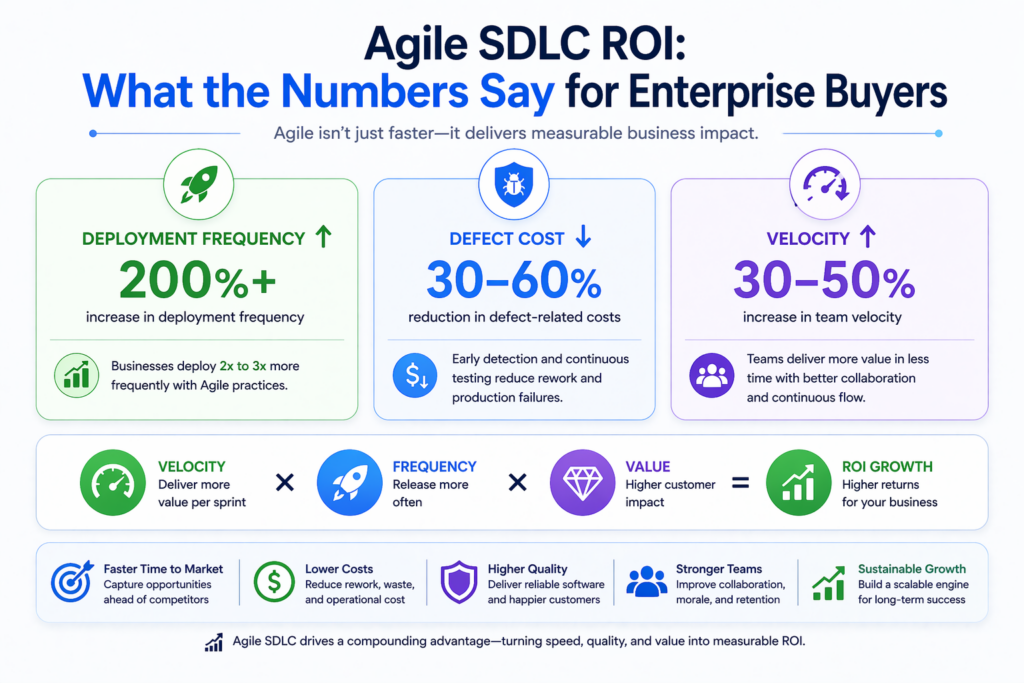
For agile methodology for enterprises, the ROI case for the agile software development life cycle is documented and practical. The real challenge for enterprise buyers is identifying where that ROI concentrates and the conditions required to capture it during the iterative software development process.
Research shows that organizations completing structured agile transformations see measurable gains only when Agile is treated as a delivery system, not a label.
According to McKinsey’s enterprise agility research, companies report 10–30 point improvements in customer satisfaction and 30 to 50% gains in operational performance. These outcomes of the agile software development life cycle are tied to disciplined execution across all agile SDLC phases in agile project delivery. ROI for agile methodology for enterprises compounds most clearly in three areas.
First, deployment frequency improvement: teams releasing multiple times per month gain faster feedback cycles, accelerating product intelligence.
Second, defect cost avoidance: resolving issues within the sprint creates up to 6x savings compared to post-production fixes in agile project delivery.
Third, retrospective-driven velocity gains: consistent retrospectives improve delivery efficiency and reduce cost per story point over time in the agile software development life cycle.
A simple ROI model for sprint-based delivery is:
Sprint velocity × release frequency × customer value per feature = compounding output value.
Data from the World Quality Report 2024 supports this, showing 40% faster time-to-market in teams with mature agile methodology for enterprises, driven by CI/CD, embedded QA, and structured execution.
Enterprise buyers evaluating agile project delivery of agile software development life cycle need a total cost of ownership lens. A project quote alone will not show you what this engagement actually costs over 12 months in agile SDLC phases.
Cost drivers that move the number most: team size, scrum development cycle velocity, tooling stack, and offshore vs. onshore composition. Typical engagements range from $50,000 to $250,000 or more, depending on complexity, geography, and whether you run Scrum or the scaled agile framework (SAFe).
SAFe carries a 20 to 35% premium over standard Scrum. For enterprises running three or more concurrent product teams, the premium buys multi-team agile SDLC phases alignment at the portfolio level. It is not overhead in the agile software development life cycle. It is what prevents conflicting roadmaps in the Scrum development cycle.
Hidden costs most agile project delivery quotes ignore:
TCO over 12 months is the right frame for any serious agile methodology for enterprises evaluation.
The agile software development life cycle often fails at execution, not adoption. Many organizations adopt the process but lack the discipline required to capture real ROI.
Leadership Misalignment is the First Bottleneck
One in three organizations cites leadership as the main barrier to successful agile methodology for enterprises adoption. The issue is role clarity, when leaders treat Agile as a team-level activity instead of an organizational model, misalignment and failure follow.
Other Execution Challenges That Affect Agile SDLC Phases Quality
Scope creep disguised as flexibility: The iterative software development process supports change, not uncontrolled additions mid-sprint. Teams of agile software development life cycle that confuse responsiveness with unlimited flexibility break the sprint cadence.
Over-reliance on tools without discipline: 62% of Agile teams use Jira, but tools don’t create agile SDLC phases. The iterative software development process depends on behavioral discipline.
Velocity inflation: Over-estimating story points distorts metrics and weakens retrospectives. Inflated numbers hide real improvement signals in the agile software development life cycle.
Scaling friction from Scrum to SAFe: Moving from the Scrum development cycle to SAFe is a structural shift. Without updated planning and coordination, teams of agile project delivery lose alignment with broader objectives.
Organizations or agile methodology for enterprises that succeed treat agile SDLC phases execution as non-negotiable.
The right toolchain enables the agile software development life cycle without adding coordination overhead. These six tools cover the full phase spectrum for any agile methodology for enterprises implementation.
| Tool | Phase | Primary Use |
| Jira | All phases | Sprint planning, backlog management, velocity metrics |
| Confluence | Concept, Review | Documentation, retrospective records |
| GitHub / GitLab | Development | Version control, code review workflows |
| Jenkins / GitHub Actions | Deployment | CI/CD pipeline automation |
| Selenium / Cypress | QA and Testing | Automated test execution |
| Figma | Concept, Development | UI/UX prototyping |
DevOps integration between Jira and GitHub Actions has become the standard for teams running a mature agile software development life cycle. The combination provides sprint-level commit traceability and automated build validation on every pull request. Also, in the scrum development cycle, the deployment pipeline status is visible directly in the same tool the product owner uses for backlog management.
Teams running all six tools in a connected workflow across their agile project delivery process have full phase visibility in the agile software development life cycle. Teams running three or four tools with gaps in between create the blind spots where defects and scope drift hide until they surface as production incidents.
Patoliya Infotech brings phase-level execution discipline to the agile software development life cycle, not general Agile process claims. For mid-size to enterprise engineering teams running a serious agile methodology for enterprises, that distinction is the difference between transformation and rebranding.
If you are comparing agile project delivery partners and need a sprint planning consultation before committing to a structure, Patoliya Infotech offers a free initial review.
The agile software development life cycle delivers its documented ROI only when phase execution matches the promise of the framework. McKinsey's data shows 30 to 50% operational improvement and 10 to 30 points of customer satisfaction gain from proper agile transformation. Those results require all five agile SDLC phases running with discipline, not just the phases that feel manageable in the first two sprints.
The 9% failure rate that defines well-executed agile software development life cycle programs versus the 29% that plagues poorly structured ones comes down to one thing: treating each phase as a commitment, not a formality.
If your team is ready to build software that delivers consistent value sprint by sprint, let's talk about where your current agile project delivery process stands. Book a sprint planning consultation with Patoliya Infotech.