Table of Contents
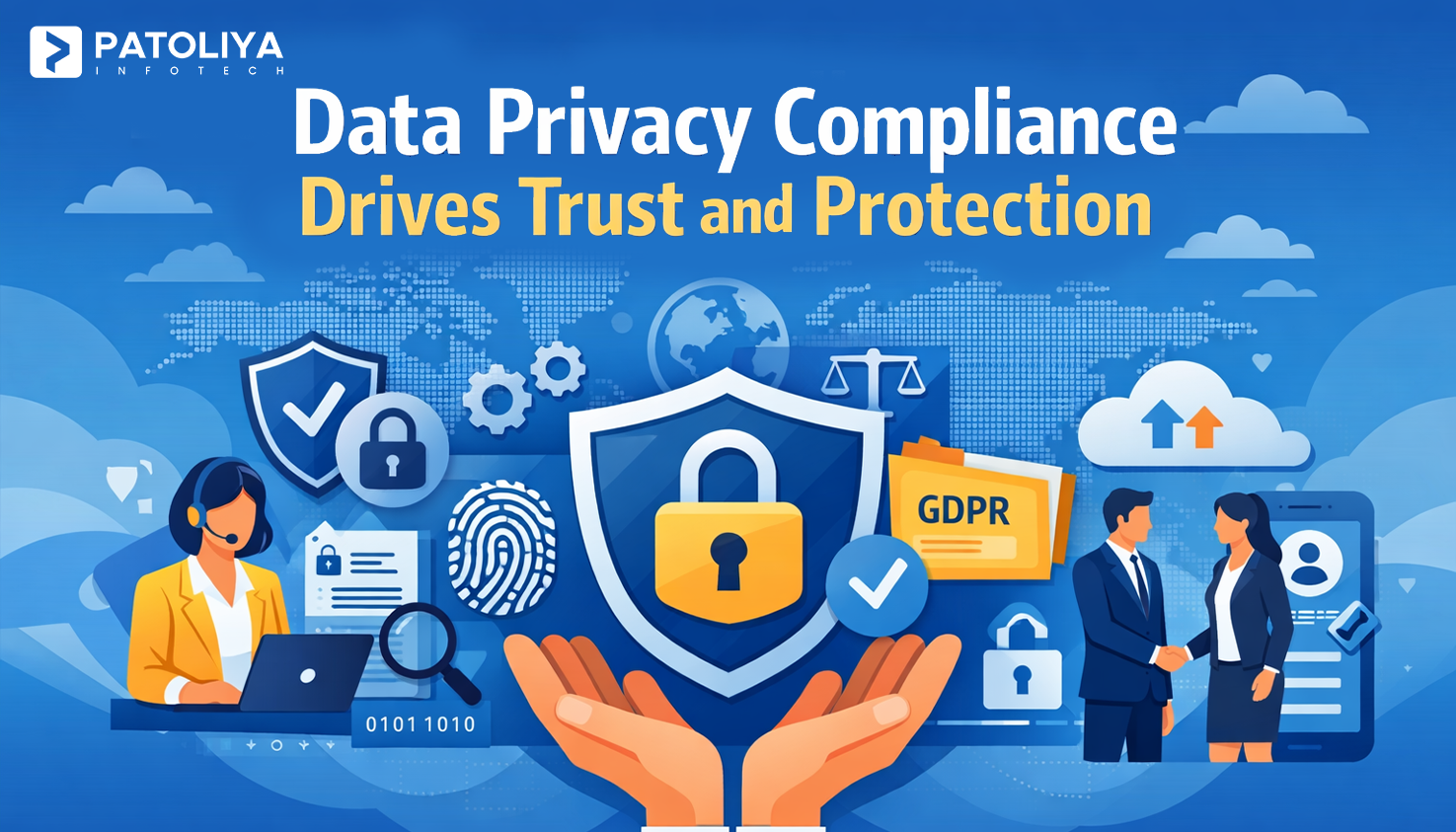
Data privacy compliance is the practice of ensuring your organization collects, stores, and uses personal data within the boundaries set by law, individual consent, and internal accountability frameworks. In 2026, this governance for cyber security is essential and a business-critical discipline.
GDPR, CCPA, and India's Digital Personal Data Protection Act have created an enforcement environment where non-compliance carries financial penalties, customer trust processing bans, and permanent reputational damage. These data privacy laws are actively enforced, jurisdiction-specific, and expanding in scope every year.
Organizations that understand what Compliance challenges demand operationally are better positioned to avoid costly failures and build the customer trust that drives long-term business value. This blog covers the real challenges, the concrete benefits, and what getting it right actually looks like in practice for data privacy and security compliance.
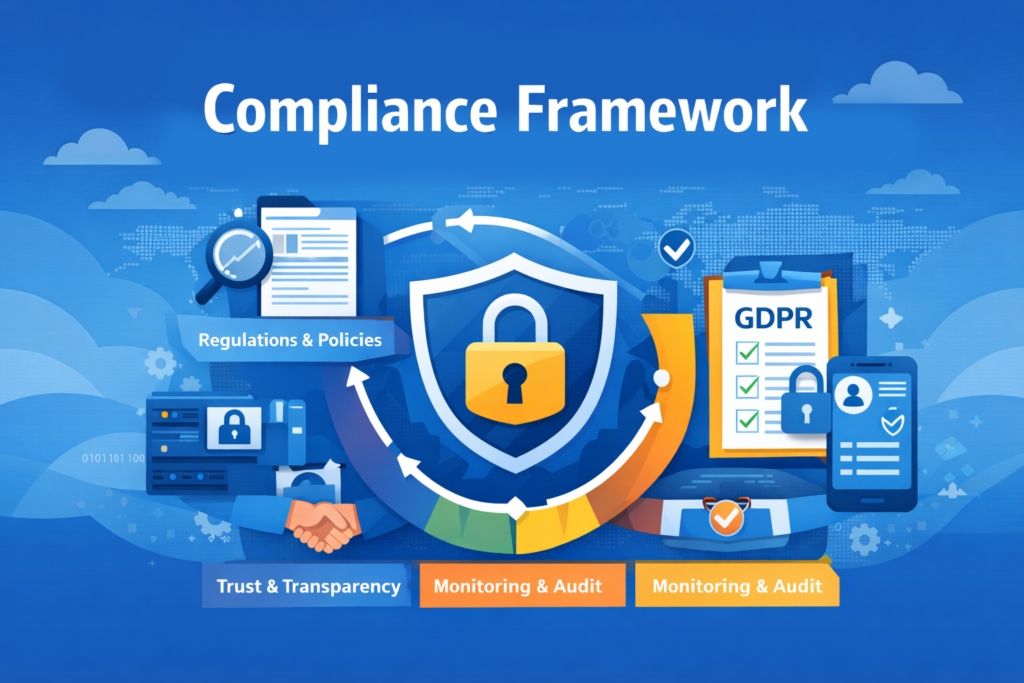
Data privacy compliance is the structured practice of ensuring that an organization collects, processes, stores, and disposes of personal data in accordance with applicable laws, industry standards, and its own internal policies. Data privacy and security compliance are ongoing operational commitments. Below are its foundational pillars:
| Compliance Pillar | What It Covers | Why It Matters |
| Privacy Policies | Clear, accessible disclosure of data practices. | Builds user trust and satisfies transparency obligations under data privacy laws. |
| Consent Mechanisms | Opt-in/opt-out systems, cookie banners, preference centers. | Ensures a lawful basis for processing personal data. |
| Access Controls | Role-based permissions, MFA, and least-privilege principles. | Prevents unauthorized internal and external data exposure. |
| Data Minimization | Collect only what is necessary for the stated purpose. | Reduces breach exposure and satisfies regulatory requirements. |
| Ongoing Auditing | Periodic reviews of data flows, vendor agreements, and policies. | Identifies compliance challenges and gaps before regulators or attackers do. |
The landscape in 2026 is defined through three frameworks every enterprise must understand. GDPR remains the global benchmark for data privacy compliance, requiring explicit consent, breach notification within 72 hours, and strict purpose limitation. CCPA and its amendment, CPRA, extend rights to California residents, including the right to correct inaccurate data and limit the use of sensitive personal information.
The Indian Digital Personal Data Protection Act has introduced enforceable obligations around consent-based processing, Data Protection regulations Officer appointments, and mandatory breach reporting. For any organization operating across these jurisdictions, the Compliance challenges are not just legal interpretation. It is building systems that satisfy all three simultaneously.
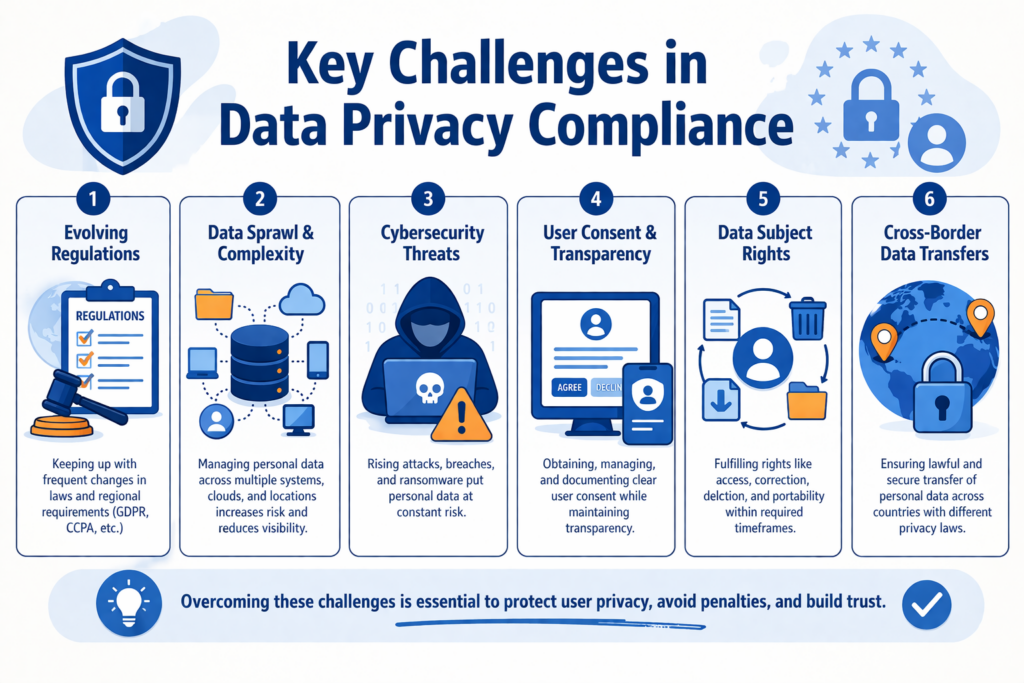
One of the most persistent Compliance challenges in data privacy compliance is that no single global standard exists. Regulators define personal data differently, impose conflicting consent requirements, and update enforcement priorities without warning. GDPR broadly includes IP addresses and cookie identifiers. The DPDP Act india structures obligations around data fiduciaries. CCPA centers on consumer opt-out rights. No single compliance template satisfies all three.
For instance, A SaaS company in Bengaluru serving clients in Germany and California must meet three separate breach timelines, consent standards, and documentation requirements simultaneously. A framework designed for one jurisdiction creates direct exposure in the others.
Execution is where most organizations fall short of data privacy Compliance challenges. Classifying sensitive personal information under CCPA versus special category data under GDPR requires legal expertise combined with data engineering capability that most mid-size teams do not have in-house. Technical controls, including data masking, automated DSAR workflows, and vendor compliance monitoring demand dedicated resources and mature tooling.
Compliance challenges grow when regulatory guidance evolves faster than internal programs can adapt. Staying current is a continuous investment for data privacy and security compliance. Understanding broader IT risk management in projects helps organizations build the structured frameworks needed to keep pace with evolving obligations.
For instance, A Mumbai-based healthtech company discovered its analytics vendor was processing patient data outside the agreed scope, requiring contract renegotiation, updated consent flows, and cross-timezone team retraining.
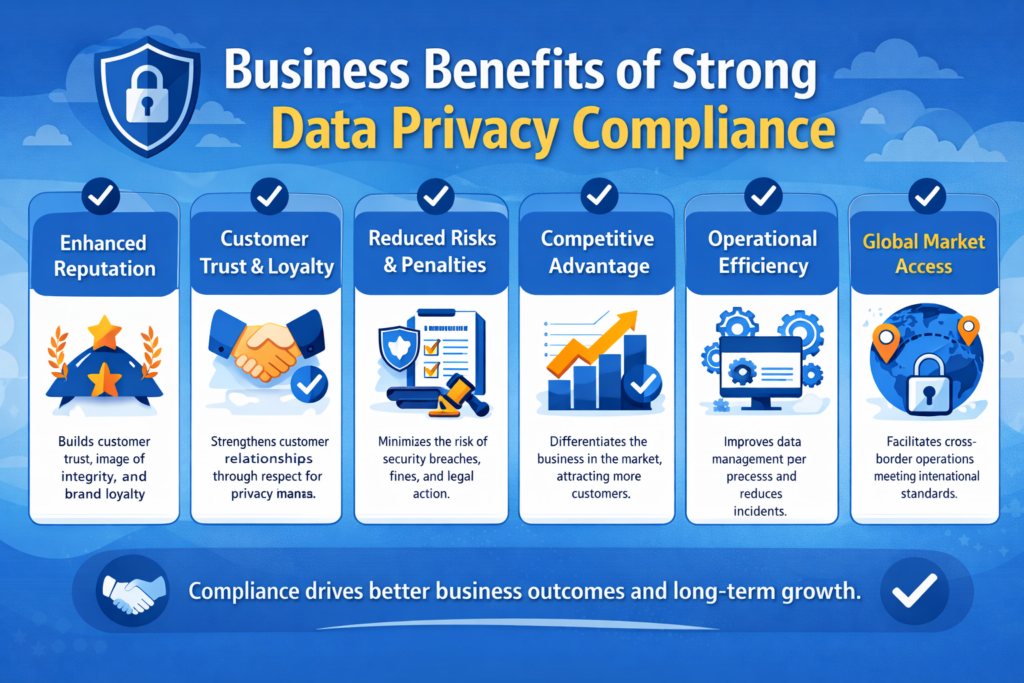
Consumers in 2026 choose organizations based on how personal data is handled, not just on price or product, reflecting the growing benefits of data compliance in driving trust. Strong data privacy compliance delivers that confidence through:
These practices for Compliance challenges signal values, build loyalty, and directly influence retention and revenue under data privacy laws.
For instance, a UK insurance company that communicated its GDPR posture during onboarding saw measurably higher renewal rates. The benefits of data compliance were in contrast to competitors who buried privacy disclosures in footer links.
A mature data privacy compliance program reduces both the likelihood and impact of a breach systematically, demonstrating the benefits of data compliance:
In enterprise procurement, documented data privacy and security compliance is now a qualifying requirement. This reinforces the measurable benefits of data compliance, including trust, resilience, and sustained business value. Organizations in regulated sectors can also look at how HIPAA compliance frameworks are structured as a reference model for building sector-specific privacy governance programs.
For instance, a B2B software company that combined SOC 2 Type II with its GDPR program won three financial services contracts, while competitors were disqualified early for lacking privacy governance documentation.
Non-compliance with data privacy laws carries concrete financial, operational, and reputational consequences. This is accelerating as enforcement matures globally, with the benefits of data compliance for organizations that adhere to regulations. According to the IAPP's global GDPR enforcement tracker, fines have surpassed EUR 2 billion and enforcement against mid-market firms is intensifying.
| Risk Category | Consequence | Recent Context |
| Legal Penalties | GDPR fines up to 4% of global annual revenue or EUR 20M. | Global GDPR fines exceeded EUR 2 billion in 2025; mid-market firms increasingly targeted. |
| Regulatory Scrutiny | Mandatory breach notifications trigger immediate audits. | DPDP Act enforcement ramping up for high-volume digital businesses in India. |
| Reputational Harm | Customer churn, negative media, and loss of partner trust. | Breach disclosure is near-instantaneous via social media and mandatory filings. |
| Operational Disruption | Injunctions suspending data processing activities. | Enforcement in the EU now includes data processing bans as well as penalties. |
Data privacy compliance demands integrated legal, technical, and operational expertise working together, and most organisations lack all three internally. Patoliya Infotech bridges that gap. Their practice combines deep knowledge of data privacy laws like GDPR, CCPA, and India's DPDP Act with hands-on implementation of consent management, data flow mapping, vendor assessment frameworks, and breach response protocols built around actual regulatory timelines.
What sets us apart is sustained engagement. We maintain continuous monitoring, update data privacy compliance frameworks as regulations evolve, and run internal readiness assessments before audits occur. For businesses operating across multiple jurisdictions, these benefits of data compliance eliminate the fragmented, multi-region compliance approach that drains internal resources. Our custom software development services are built with healthcare software security reflects the same rigorous standards we apply across all compliance engagements.
Clients consistently report improved audit readiness and faster breach response times, reflecting meaningful data privacy compliance transformation in practice.
In 2026, data privacy compliance defines how organizations are trusted, evaluated, and chosen. It is a strategic business function that determines how much risk your organization carries, how much trust your customers extend, and how competitively you operate in markets where privacy accountability is now a procurement requirement.
Understanding the operational, regulatory, and technical challenges enables businesses to design a more effective and sustainable compliance strategy. The benefits follow directly: reduced breach exposure, stronger customer loyalty, and organizational resilience that compounds over time.
Embedding data privacy and security compliance into core operations, compared to treating it as a periodic audit exercise. This is what separates compliant organizations from resilient ones, showing the benefits of data compliance. Start by aligning privacy governance with your business objectives and turn data privacy laws from a compliance cost into a competitive asset. Ready to get started? Contact our team to discuss how we can support your compliance programme.