Table of Contents
The big question facing every business today is where its work should be done. This choice between oThe big question facing every business today is where its work should be done. This choice between onshore vs offshore has a big impact on every aspect of a business, including how it communicates day to day, as well as how it grows as a business. As global competition becomes more fierce, more businesses are rethinking their service models to remain lean, efficient, and effective without compromising quality or control. Many organizations partner with a reliable offshore development center to design the right delivery model aligned with their growth strategy.
Understanding onshore vs offshore outsourcing is a strategic choice if you are building a new software product, managing a customer support function, or growing a business at large. Whether you are building a new software product through structured custom software development services, managing a customer support function, or growing a business at large. Each model has real advantages and trade-offs to consider before making a choice.
This blog explores 10 key differences between onshore and offshore in this onshore vs offshore decision guide to help you make a valuable choice to choose smarter, to plan better, and to grow with confidence at every step of your business journey.
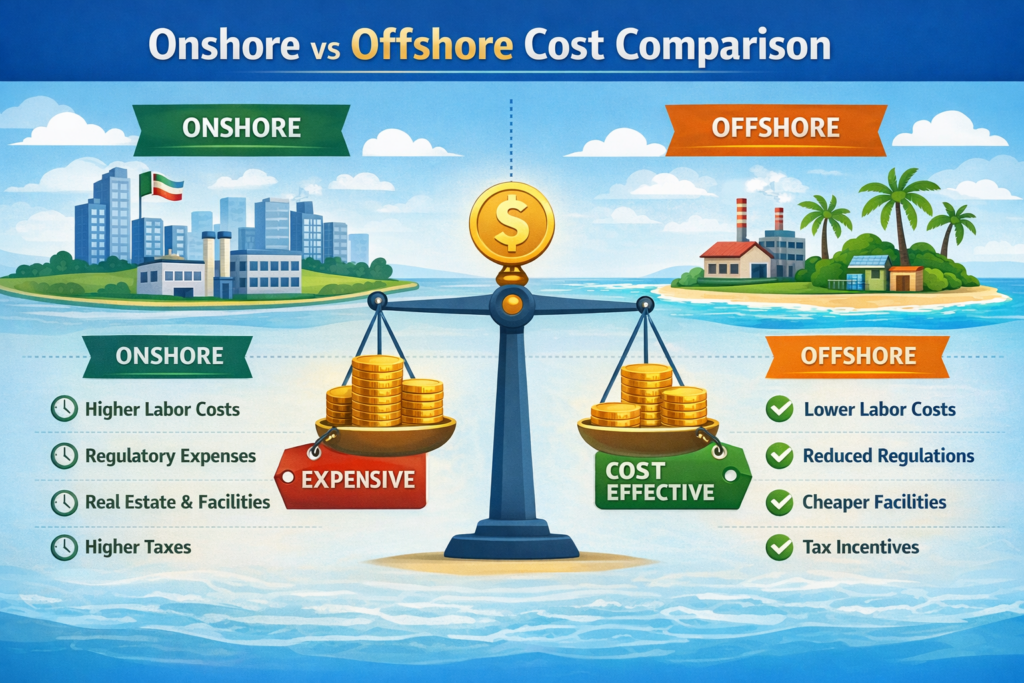
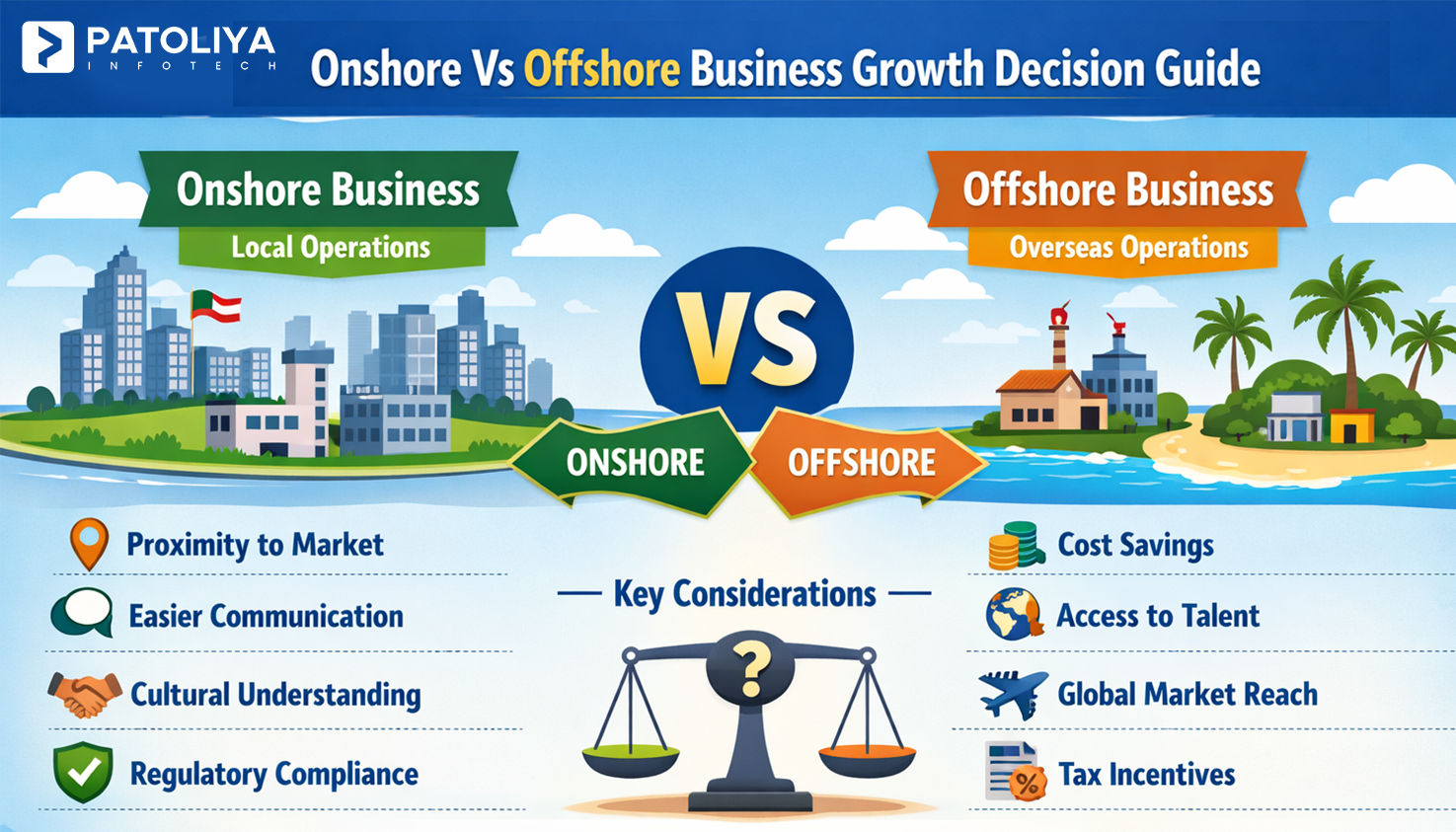
Choosing between onshore vs offshore depends on cost, control, and scalability. This quick comparison helps you understand onshore vs offshore at a glance for faster decision-making.
| Factor | Onshore | Offshore |
| Cost | Higher labor and operational costs | Lower cost due to global labor arbitrage |
| Talent Access | Limited to the local talent pool | Access to global and specialized talent |
| Communication | Real-time, same time zone collaboration | Time zone gaps require async communication |
| Control | High control with direct oversight | Requires structured processes and governance |
| Scalability | Slower hiring and expansion | Rapid scaling with large talent availability |
| Speed to Market | Standard development cycles | Faster with 24/7 development cycles |
| Compliance | Easier due to local regulations | Requires careful legal and compliance checks |
Onshore refers to the hiring or outsourcing of a service within your country. When a US company works with an agency that is also from the US, it is a typical onshore relationship. This is where you can enjoy the benefits of a similar timezone, regulations, and ease of working with the other party. Any firm that values regulations, speed of communication, and cultural compatibility always chooses the onshore approach for its ease of control and simplicity of operation in the onshore vs offshore outsourcing context.
Offshore means working with teams in a foreign country, generally one with a lower labor rate. A UK company working with developers in India is operating offshore. This is a great business strategy, but time zone, legal, and cultural considerations need to be carefully navigated in each onshore vs offshore decision.
The most common factor that prompts organizations to consider the onshore vs offshore outsourcing question is the factor of costs. The costs of operating an offshore business are much lower than the costs of an onshore business. This is because the labor costs in countries like India and the Philippines are much lower than in the US and the UK. A senior developer in the US may cost between ~ $120 and $150 per hour , while a senior developer in an offshore country may cost between ~ $25 and $45. We deliver quality engineering talent with efficient offshore support. The costs of compliance and onshore benefits for a business are much higher.
The choice differences between onshore and offshore also come down to the availability of people you can hire. In comparison of onshore vs offshore, when it comes to onshoring, you are limited to your home country’s labor pool and may struggle to find people with specific skills, such as AI development or cyber security. It may take months to find such skills in your home country and require a high salary to compensate for that.
In onshore vs offshore talent access, with offshore benefits, you have talent access to a labor pool that spans across the world in the onshore vs offshore outsourcing context. This is one of the core advantages businesses achieve through structured IT outsourcing services that provide access to global talent without long hiring cycles. In India alone, there are more than 1.5 million engineers graduating each year and providing expertise in various technologies that a business may need. Businesses leveraging IT outsourcing services gain access to a global talent pool that spans across multiple regions and technologies.
A frequently discussed challenge in onshore vs offshore teams revolves around the timing of onshore vs offshore communication challenges. When you have your teams onshore, you are all in the same time zone, which allows you to communicate, provide feedback, and even collaborate spontaneously without the differences between onshore and offshore. This is always keeping your projects moving quickly without any delays.
When you have your teams offshore, you are five to twelve hours apart. That bug you found at 3 PM EST might have to wait till the next day if you have your teams offshore. While tools such as Slack and Jira can help bridge this gap, challenges related to communication between onshore vs offshore outsourcing teams do exist.
Studies on distributed team collaboration research highlight that structured communication processes can significantly reduce time zone-related delays.
Culture influences team communication styles, decision-making processes, and conflict resolution approaches in the differences between onshore and offshore. When teams are based in an onshore setup, cultural norms help prevent misunderstandings. All teams share a common business language and work culture in every engagement. This makes team collaboration an effortless process.
At outsourcing onshore vs offshore, when teams are based offshore, they may have varying approaches to giving feedback or their perceptions of professional status. Some cultures may also have difficulty confronting conflict openly.
The cultural difference between an onshore vs offshore outsourcing team is not impossible to bridge, but it does take real effort to develop effective team collaboration.
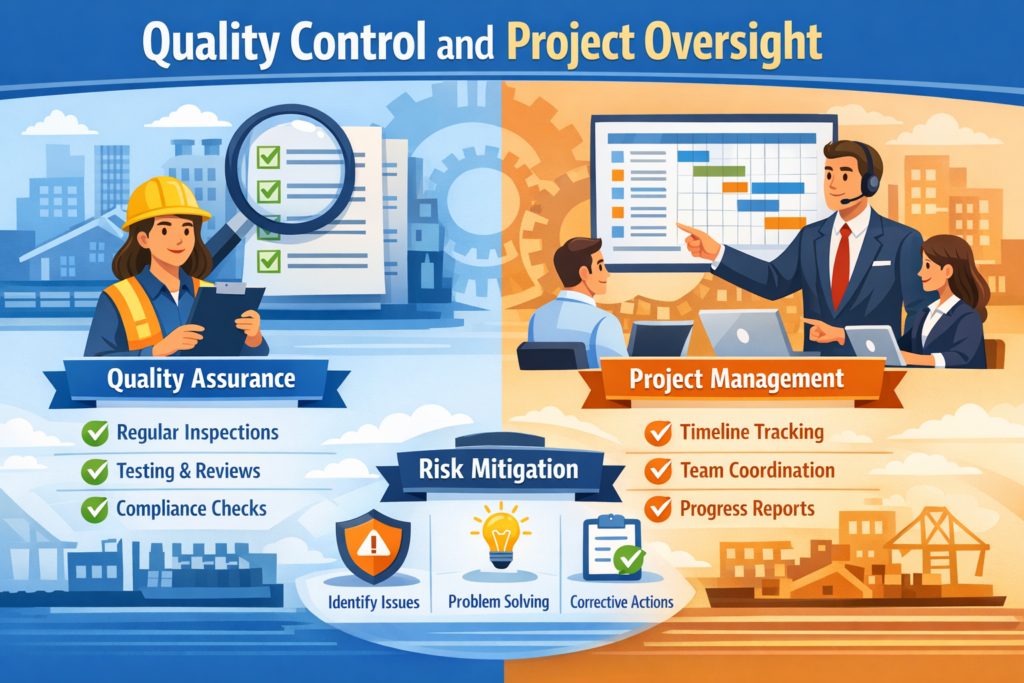
The major difference between onshore vs offshore quality control is the feasibility of daily monitoring. Onshore quality assurance allows the management to plan and schedule physical quality review sessions with ease.
On the other hand, offshore quality assurance requires the development of processes such as well-defined milestones, regular sprint review sessions, and the use of testing pipelines.
Without these processes, quality assurance may not be maintained. Onshore quality assurance naturally facilitates effective onshore vs offshore project control differences between onshore and offshore. However, offshore quality assurance with strong governance systems can absolutely meet and exceed quality expectations.
Onshore vs offshore risk factors show a great variance in the aspects of law and regulation. Onshore operations are subject to the same laws as your business, which makes the process of contract compliance and intellectual property compliance very easy to implement and monitor. From onshore vs offshore, when you are involved in an offshore engagement, you are exposed to factors such as differences in intellectual property compliance, data sovereignty, and political instability in the region.
The process of complying with the GDPR regulation becomes very complex in the case of non-EU based offshore regions. It is important to ensure that you conduct adequate diligence on the vendors before you commit yourself to the onshore vs offshore process.
Where growth requires rapid scalability, offshore has a significant structural advantage in the differences between onshore and offshore. Having an established talent market in countries such as India or Vietnam allows for growth from five engineers to fifty engineers in a matter of weeks. This is compared with the time required for the same growth in an onshore market due to the lack of supply.
From onshore vs offshore outsourcing, Onshore growth is not only slower but also more expensive at each stage of the hiring cycle. For businesses requiring significant growth or those with seasonal demands, the flexibility of offshore outsourcing represents a significant operational advantage for faster execution and a substantially lower cost per hire. Many organizations establish an offshore development center to scale engineering teams quickly while maintaining long-term operational efficiency.
The ability to reach the market sooner is a competitive requirement for almost all industries. The choice of onshore vs offshore outsourcing, with the help of an offshore team and time zone differences, allows the development cycle to be almost uninterrupted. That means that as your onshore team goes home for the day, your offshore team is already continuing the effort.
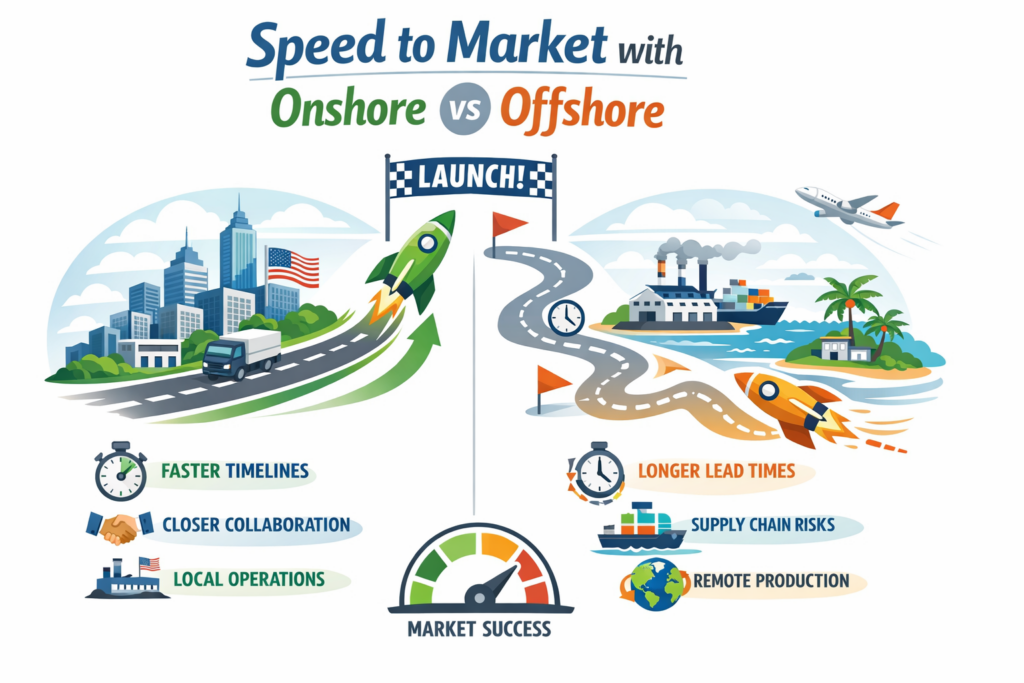
The mobile application that might take your team six months with an onshore team might now be possible in four months with well-coordinated offshore workstreams.
There is a potential for significant time savings with an offshore team in the onshore vs offshore scenario. Without good handoff documentation and sprint planning, the potential for offshore speed is the potential for offshore confusion.
A comparison of onshore vs offshore outsourcing, in the onshore approach, visiting your team means a small domestic trip, which is very affordable. In the case of the offshore approach, the international travel, the cost of the visa, and the hotel stay can add up very quickly.
The onshore vs offshore cost comparison of a single leadership team visit to an offshore partner in Southeast Asia can range from $3,000 to $8,000 per person. In onshore vs offshore, Video conferencing helps minimize travel in most cases, but the milestone reviews and relationship-building efforts are still worthwhile in any serious offshore partnership based on accountability.
Recent global outsourcing statistics show that businesses are increasingly adopting offshore models to optimize costs and access specialized talent.
Data security is a non-negotiable criterion in any honest and fair onshore vs offshore discussion. When it comes to onshore providers, the data protection laws and regulations of the country apply equally to them. This means that adhering to data protection standards like HIPAA or SOC 2 is much simpler.
In the onshore vs offshore debate, in the case of offshore providers, the data protection standards of different countries may not be the same. Businesses need to consider data handling certifications like ISO 27001 and data system access restrictions rigorously.
Data security in offshore providers is not a problem in the onshore vs offshore context, but it does require accountability and contract agreements right from the start.
Deciding differences between onshore and offshore is rarely straightforward, and this is precisely where Patoliya Infotech adds real value to a business decision. With extensive experience in helping businesses across various sectors and industries, Patoliya Infotech assists companies in making decisions with clear priorities. Whether it is cost optimization, leveraging in-demand global skills, or maintaining tight control over projects that are often required in demanding sectors in the onshore vs offshore context.
What really differentiates Patoliya Infotech from other players in the offshoring vs onshoring debate is that we are committed to transparency and communication in a structured format in the onshore vs offshore approach. Our experience in managing projects ensures that quality control and milestone achievement are never left undefined. With strategic advice and hands-on support in managing offshoring vs onshoring projects, Patoliya Infotech delivers real business results every day in onshore vs offshore execution. Many businesses benefit from having experts evaluate their outsourcing strategy to balance cost, control, and long-term scalability effectively.
The decision between onshore vs offshore outsourcing is never a one size fits all decision and must never be approached as such. In each of the 10 significant differences that have been discussed in this blog post, such as cost, talent, communication, culture, quality, compliance, scalability, speed, travel, and data security, each aspect is important in its own right and based upon your business requirements and priorities in the onshore vs offshore context. Offshoring wins in cost and scalability, while onshoring wins in control and communication.
However, smart businesses are increasingly moving away from deciding between one end of the spectrum and the other and instead embracing a hybrid model that incorporates both differences between onshore and offshore strategies for well-known and well-documented reasons.
The final decision differences between onshore and offshore must be based on what suits your business today and will continue to suit it in the future as you scale.
However, smart businesses are increasingly moving away from deciding between one end of the spectrum and the other and instead embracing a hybrid model that incorporates both differences between onshore and offshore strategies for well-known and well-documented reasons.
The final decision differences between onshore and offshore must be based on what suits your business today and will continue to suit it in the future as you scale.