Table of Contents
Every IT project carries uncertainty. Deadlines shift, requirements change, technologies behave unexpectedly, and teams face resource gaps nobody anticipated. Without a structured approach, even well-planned projects spiral into delays, cost overruns, or failure, which is why many organizations partner with a reliable custom software development company experienced in managing complex IT initiatives.
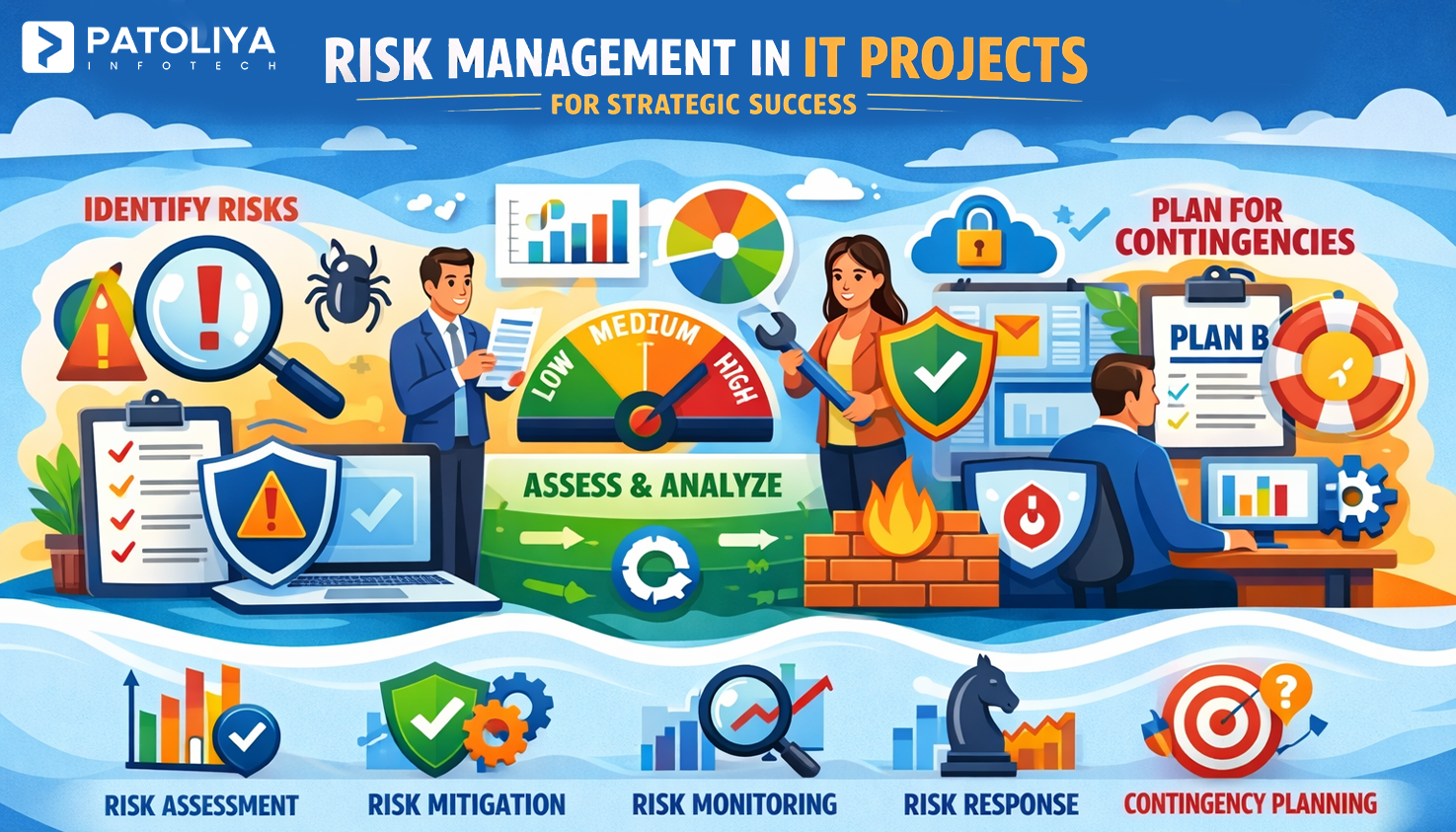
Risk management in IT projects is the proactive framework that helps teams anticipate, evaluate, and address uncertainties before they cause real damage. Rather than reacting to problems after they occur, risk management in IT projects prepares teams to act early and keep initiatives on track. For any organisation serious about delivering IT initiatives successfully, risk management in IT projects is not optional. It is a core discipline that separates projects that succeed from those that consistently struggle and fail.
Risk management in IT projects is a systematic process that enables teams to identify, analyse, and respond to potential threats and opportunities throughout the project lifecycle. A risk is any uncertain event that could affect project objectives such as timelines, budget, quality, or scope.
Risk management in IT projects is not about eliminating every possible risk. The goal is to lower the impact of negative risks while capitalising on positive ones. Risk assessment IT projects forms the analytical backbone of this process, helping teams understand which risks deserve most attention. IT project risk mitigation involves preparing responses before risks materialise, so teams spend less time firefighting and more time delivering real value.
IT projects are uniquely vulnerable to uncertainty. Risk can arise from technology choices that underperform, scope changes mid-project, resource gaps, or external factors like regulatory changes and vendor delays. Industry studies analysing global project failure statistics consistently show that unclear requirements and unmanaged risks are among the leading causes of project delays and budget overruns. IT project risk mitigation or risk management in IT projects is what stands between a team that reacts to crises and one that anticipates them. Risk management in IT projects ensures teams are never caught off guard.
Effective risk management in IT projects follows a structured lifecycle, keeping risk activity consistent from planning through delivery. Risk assessment IT projects anchor the early stages, while monitoring keeps the process active throughout.
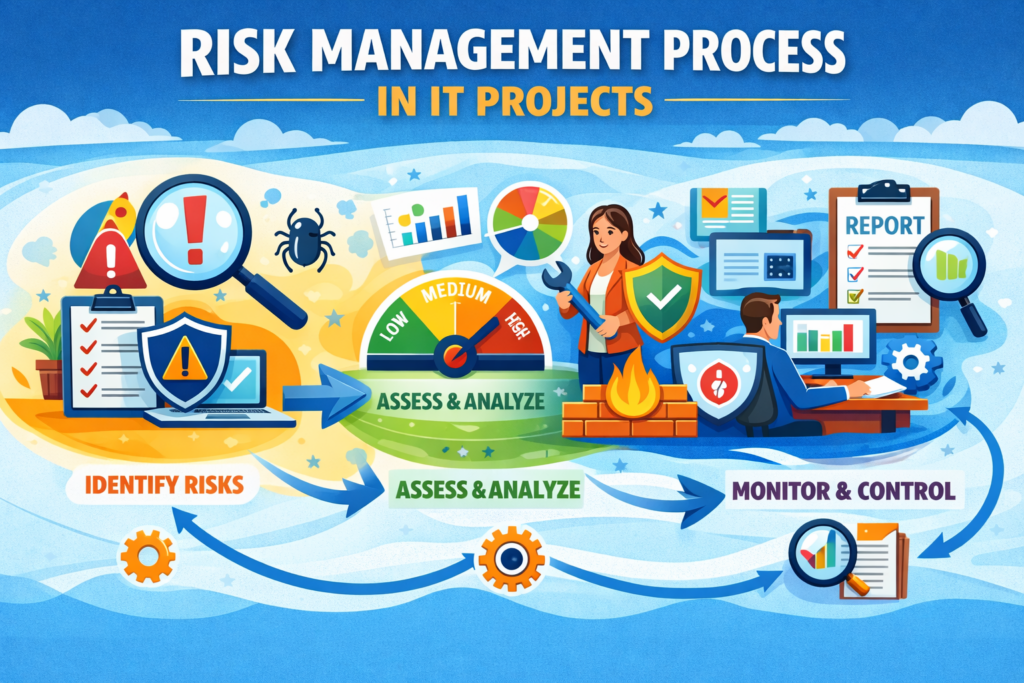
Teams use workshops, expert interviews, brainstorming, and historical project reviews to surface risks early. IT risk identification casts a wide net, capturing technical, people, and process risks before work begins.
The risk analysis process determines the likelihood and impact of each risk. Risk prioritization techniques, such as a risk probability and impact matrix, help teams focus IT project risk mitigation efforts on the risks that could cause the greatest disruption. This kind of risk management in IT projects helps teams focus IT project risk mitigation efforts on high-impact risks first.
Risk response planning develops actions for priority risks using four strategies: avoid, mitigate, transfer, or accept. Proactive risk mitigation through risk assessment IT projects turns threats into manageable action items with clear owners and timelines.
Risk monitoring and control tracks identified risks and captures new ones as the project evolves. Updating the risk register in IT projects at regular intervals keeps the team aligned throughout delivery.
Understanding common IT project risks strengthens risk assessment IT projects and supports targeted IT project risk mitigation across all project types.
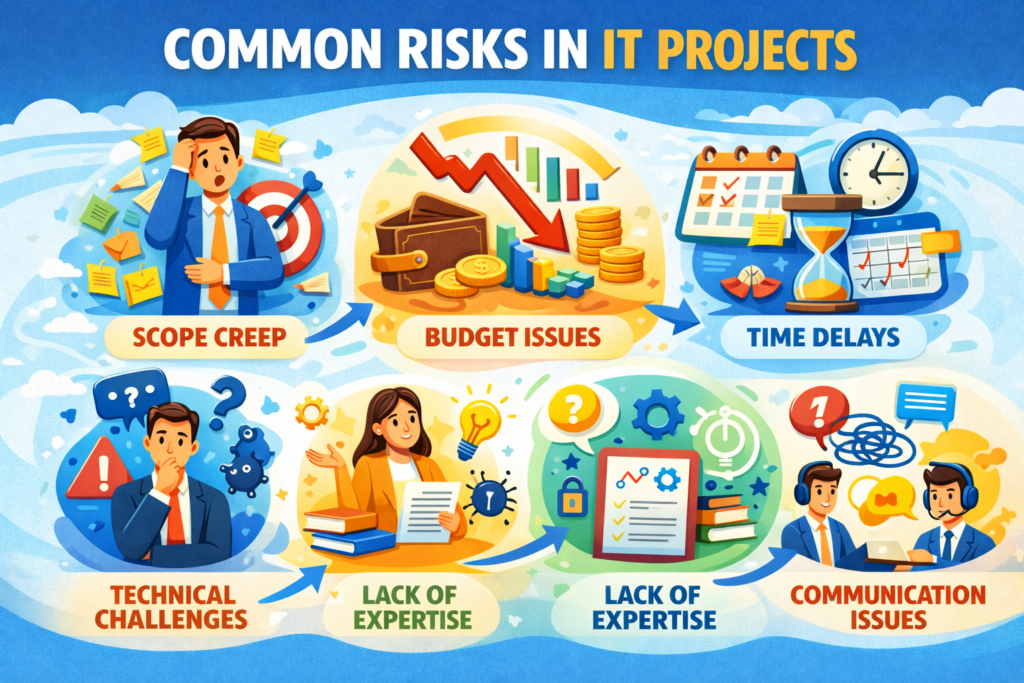
Technical risks include underperforming tools, compatibility issues between new and legacy systems, and poorly implemented API integration services that fail to synchronise critical data across platforms, and emerging technology challenges.
For instance, a company migrating to cloud infrastructure may face integration risks connecting existing databases to the new environment, causing deployment delays without early risk management in IT projects.
Scope creep is one of the most damaging risks IT teams face. When requirements evolve mid-project without change control, timelines stretch, and budgets expand. For instance, A client requesting additional features after development starts without adjusting timelines is exactly what structured IT project risk mitigation is designed to handle.
Project uncertainty control or risk management in IT projects involves cross-training team members, maintaining budget reserves, and establishing clear stakeholder communication protocols. Poor communication triggers late-stage changes that are expensive to fix, and risk assessment IT projects must account for these threats from the beginning.
Applying risk management best practices consistently strengthens risk management in IT projects and improves reliability across all project sizes.
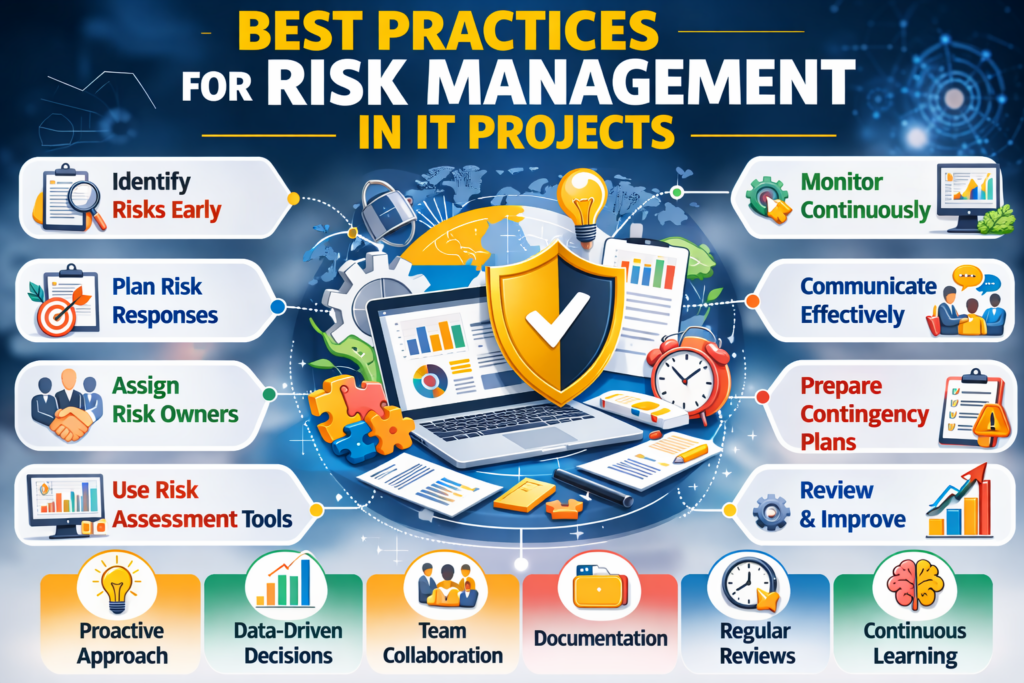
Early planning is the most critical factor in successful IT project risk mitigation. Beginning risk identification during project initiation gives teams maximum preparation time. Revisiting the risk plan regularly ensures risk management in IT projects stays relevant as conditions evolve and new threats emerge throughout delivery.
Every identified risk should have a named owner responsible for monitoring it and executing the response plan. Without clear ownership, risks get overlooked, and actions stall. Assigning risk owners ensures accountability at every level and keeps IT project risk mitigation moving forward without delay through risk management in IT projects.
A risk register records every identified risk with its likelihood, impact, owner, and response plan. Dashboards and project tools visualise risk status, keeping stakeholders informed. Strong documentation makes risk management in IT projects repeatable, auditable, and continuously improving across every project completed.
At this stage, many organizations choose to review their project risk strategy with experienced IT consultants to validate assumptions and identify hidden project dependencies before delivery begins.
Patoliya Infotech brings structured expertise to risk management in IT projects, helping clients navigate complexity with confidence from the very first planning session.
We embed risk identification early in the project lifecycle, well before development begins, so response strategies are ready before threats cause disruption. We align our risk assessment IT projects directly with your business objectives, ensuring prioritised risks are the ones that matter most to your outcomes.
Our IT project risk mitigation strategies are practical, clearly owned, and reviewed at every key milestone. With proven experience across diverse industries, we bring structured risk management in IT project practices to every engagement, giving clients confidence that their projects are delivered with transparency, accountability, and proactive planning at every stage.
Risk management in IT projects is a strategic discipline that makes complex initiatives more predictable and resilient. Early IT risk identification, structured risk analysis, practical risk response planning, and consistent risk monitoring and control reduce surprises and keep projects on course.
Embracing risk management in IT projects not only prepares teams for challenges but also uncovers opportunities to innovate and streamline delivery. Organisations that treat risk management in IT projects as a core practice consistently deliver better outcomes. Adopting these fundamentals today is the most reliable investment any team can make in the long-term success of their IT projects.