Table of Contents
Legacy system in healthcare pose the greatest threat to hospitals and management. Imagine you're transferring money with your ancient cell phone. Suddenly, it turns off or hangs, and you become concerned about the security of your account. Just like this, a single error in EHR can cause hospitals to lose all of their data. One single error during an emergency can lead to a dangerous condition for the patient. Legacy systems include EHRs, HIS, LIS, billing platforms, PACS, and a wide range of clinical and administrative applications.
Many systems may not even comply with rules or poor quality due to their age. The outdated system delays operations and makes it difficult to interface with newer technology. A high-quality, compliance-friendly system is important since it is worthwhile in the long run.
And there is actual pain of,
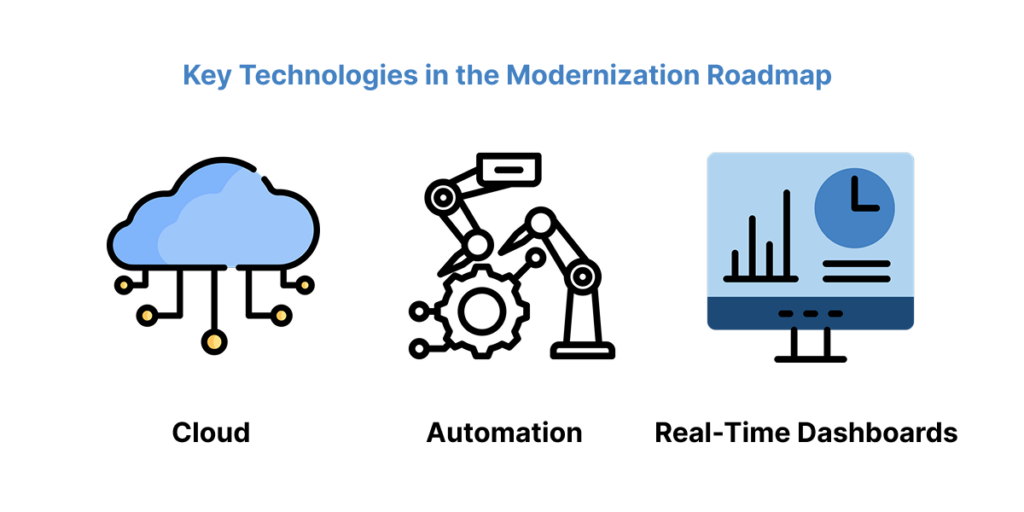
Hospitals can expand their infrastructure by moving their old systems to cloud settings like hybrid, private, or public. This lessens reliance on outdated on-premise technology and increases uptime. Adopting the cloud is essential to updating any legacy system in healthcare.
In the healthcare industry, segmenting a legacy system into microservices allows for independent module deployment, incremental modernization, and quicker feature delivery. Microservices design lowers risk and makes changes to legacy healthcare systems easier.
Healthcare legacy systems often face interoperability issues. A legacy system may safely communicate data with EHRs, laboratories, imaging, billing, and patient apps by updating with FHIR, HL7, DICOM, and reliable APIs.
Low-code systems allow for quick digitization of workflows, form automation, and integrations without requiring extensive engineering. This method effectively reduces technical debt while modernizing a legacy system in healthcare.
In the healthcare industry, updating a legacy system's interface enhances clinician usability, lowers errors, and boosts adoption. When modernizing a legacy healthcare system, a mobile-first and intuitive design is essential for care teams.
Actionable insights are frequently lacking in healthcare legacy systems. Continuous operational, clinical, and financial indicators are provided by systems with integrated data analysis and dashboards.
Modernizing a legacy healthcare system with zero trust, identity access control, encryption, and ongoing threat monitoring improves security architecture.
| Approach/ Description | When to Use / Pros / Cons | Healthcare Example |
| Re-host (Shift and Lift)Convert the healthcare industry's legacy system from on-premises servers to a public, hybrid, or private cloud architecture without altering the codebase. | When you require quick modernization, cheaper infrastructure, or less downtime.Reduced hosting costs, quick migration, and little disruption.limits performance gains and does not eliminate technical debt. | Moving a 15 year old HIS to AWS to provide reliable hosting and automated backups. |
| Re-platformTo increase performance without sacrificing essential workflows, upgrade the database, operating system, middleware, or runtime. | When rewriting is impractical, yet the system slows down.Enhanced scalability, increased security, and better performance.Requires testing and some code modifications. | Switching to a cloud-managed PostgreSQL database from an antiquated SQL Server EMR. |
| Re-architect (Microservices)For increased versatility, convert monolithic legacy healthcare systems into microservices and modular components. | when you require interoperability, scalability, regular updates, or API capabilities.Easily integrated with FHIR/HL7 systems, highly scalable, and supports DevOps.Longer implementation time and high effort. | Split an outdated RCM suite into separate services for analytics, billing, claims, and payments. |
| Replace and RebuildCreate a completely new system employing contemporary designs like serverless, cloud-native, and low-code platforms. | When integrating the legacy system is unfeasible, outdated, and unsafe.long-term ROI, interoperability, and a future-proof basis.The highest costs are associated with major shifts in the organization. | Rebuilding a longtime LIS with real-time dashboards, mobile access, and a contemporary user interface. |
| Integrate via APIs and Interoperability Layer Utilize middleware, HL7 integration engines, and FHIR APIs to expand the functionality of the legacy system. | When funds are scarce or phased modernization is required.Enhances interoperability, eliminates data silos, and produces quick wins.Legacy restrictions are still in place. | Connecting an outdated EMR to patient interaction and telemedicine applications via an API gateway. |
Strict adherence to PHI security, access controls, audit logs, retention regulations, and encryption must be ensured by every modernization effort.
Every workflow improvement needs to be evaluated for operational and clinical risk.
In the healthcare industry, vendor lock-in frequently makes replacing a legacy system challenging.
An appropriate plan must consist of:
Errors in data can have serious medical consequences.
Therefore, modernization needs to incorporate:
Hospitals can't afford system outages.
As a result, teams use:
Legacy system in healthcare make the security posture weaker.
Modernization needs to incorporate:
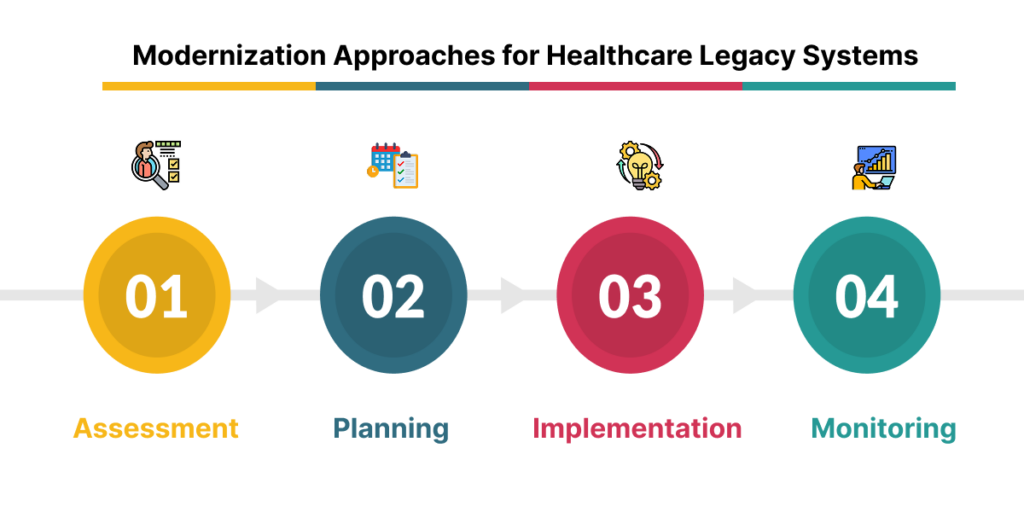
Your current situation and modernization objectives will determine which strategy is best for you.
When a healthcare legacy system is reliable, but on-premise maintenance is costly.
You urgently need improved uptime and less expensive hosting.
You want to begin cloud adoption without massive restructuring.
Database constraints and performance bottlenecks have an impact on clinical workflows.
Managing OS upgrades and security patches is challenging on legacy technology.
You want rapid enhancements without a complete rebuild.
Interoperability with FHIR/HL7 systems is essential.
For patient apps, healthcare workflows, or billing, you demand modular services.
You are shifting toward cloud-native IT solutions for healthcare.
The healthcare industry's legacy system is nearing its end of life.
Old architecture is unable to accommodate the additional capabilities that clinical teams require.
A top priority is long-term digital transformation.
You have a tight budget and require quick results.
You want to maintain the basic system while adding FHIR connectivity.
Instead of doing an entire remodel, you intend to modernize in stages.
Healthcare system modernization goes beyond just upgrading IT software. It gives organizations the IT foundational solutions needed for a safe, faster, and value-based approach to Interoperability and the Delivery of Care. Organizations that are successful in their modernization initiatives will benefit from increased efficiencies. This was achieved through improved patient outcomes, lower costs of operation, and greater levels of Compliance.
The first step for achieving these benefits is to take incremental steps, validate progress along the way, utilize intelligent APIs, and continue to scale over time. Organizations need to create a well-defined roadmap with clearly defined stages like data Quality, Cloud Readiness, API Interoperability, Cybersecurity Upgrades, and Clinical Safety Checks. This will have the ability to transition their Legacy systems that do not support these new marketplace requirements into modern, flexible, future-ready platforms.
Companies have to select someone who has proven experience in the development of a new system or in integrating it. This directly influences how your future technologies will work, so trust someone like Patoliya Infotech, which delivers high-quality software solutions and constant support.