Outsourcing eCommerce Development Without Losing Control or Quality
Table of Contents
Outsourcing ecommerce development services helps address the problem of complexities involved in running an e-commerce business to deliver services fast and securely, with the need to provide personalized experiences for customer satisfaction.
As companies seek to work with other teams externally, it provides the ability to lower production costs, accelerate the development lifecycle, and access the best eCommerce development talent on the market for platforms such as Shopify, Magento, WooCommerce, and even headless commerce.
Nowadays, it is a good idea to consider outsourcing e-commerce development as a means of expanding business successfully and efficiently. This will ensure that appropriate partners and means of delivery are adopted effectively to reduce cost and boost business development without expanding or limiting innovation.
What is Outsourcing eCommerce Development
Outsourcing eCommerce development services involves hiring a professional service provider who will carry out specific tasks, like website development and maintenance, for enhanced productivity and reduction of operational costs.
Companies intentionally rely on an outside team to develop and support eCommerce websites, freeing up internal personnel to focus on marketing, sales, and customer growth.
Full-Cycle Development vs Task-Based Outsourcing
Planning, UI/UX design, programming, testing, deployment, and support are included in full-cycle eCommerce development. For startups and companies creating a new online store from the ground up, this strategy is perfect.
Task-based outsource ecommerce development concentrates on specific services such as performance enhancement, payment gateway integration, eCommerce website customization, and API integration. It functions best when you already have an internal team.
Common Outsourcing eCommerce Development Models
Dedicated development team: A dedicated eCommerce Development Team works exclusively on your project, promising long-term support, scaling, and flexibility relevant to growing an online business.
Project-based outsourcing: This model ensures the completion of a specific eCommerce project on time and within a certain budget.
Staff augmentation: Staff augmentation enables skill gaps to be temporarily bridged by experienced eCommerce developers without making any long-term employment commitments.
Read More: If testing feels overwhelming, outsourcing eCommerce development can help you optimise faster, without slowing your team down.
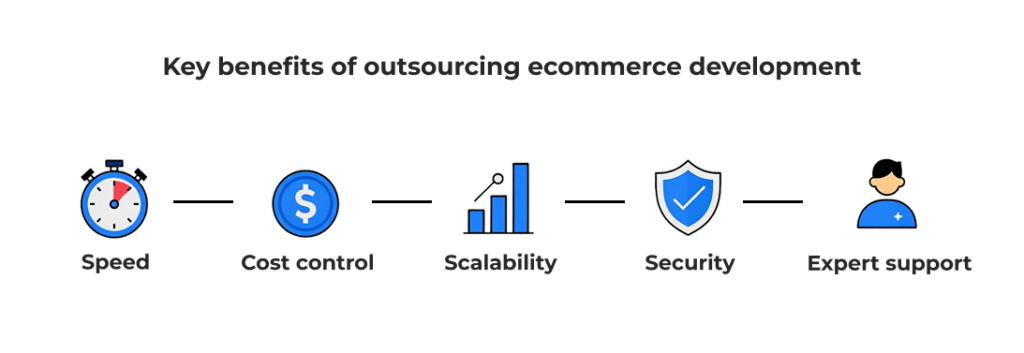
Key Benefits of Outsourcing eCommerce Development
Speed and Execution
Outsourcing e-commerce development helps organizations launch faster as there is a functional team without having to wait on hiring. The development process is faster when design, back-end development, and front-end development all integrate. This facilitates continual improvements, feature launches, and quicker updates.
Cost and Budget Control
Outsourcing e-commerce development eliminates long-term pay responsibilities and HR expenses while providing predictable pricing with fixed-cost and monthly models. This ensures that payment will be made for work that is actively completed.
Access to Expertise
It gives users access to certified e-commerce developers, including experts in APIs and headless e-commerce. Using best practices, understanding platform limitations, and contributing cross-industry expertise, teams build scalable and high-performing stores.
Quality and Reliability
Proven frameworks and architectures provide maintainable code that serves as the foundation for outsource e-commerce development. Integrating testing and quality assurance reduces errors and rework, resulting in reliable e-commerce solutions.
SEO and Performance
It provides an SEO-ready site structure with integrated speed optimization and quick-loading pages. In addition to being mobile-first and in line with Core Web Vitals, the strategy produces layouts that are conversion-focused for improved outcomes.
Scalability and Flexibility
This allows an increase or decrease in scale where required, assisting in peak periods and when introducing fresh products. It is also beneficial in guaranteeing flexibility in the system and facilitates conversion.
Read More: Thinking about launching in 2026? See how outsourcing eCommerce development can simplify setup, scaling, and long-term growth.
Why Outsourcing Ecommerce Development Is a Long-Term Growth Strategy
It will help with the security and compliance of outsourcing e-commerce development with knowledge of PCI-DSS, regular updates, and secure third-party connectors. This reduces the probability of data leaks.
Additionally, it ensures ongoing support and business continuity through ongoing maintenance, monitoring, and timely issue response. PWA, headless commerce, and systems for ERP and CRM connectivity enable you to sustain platform innovation without requiring employee training.
This reduces operational stress and management overhead, thus enabling the internal team to focus on growth and sales. E-commerce Outsourcing will enable long-term growth and seamless expansion, driven by scalable design, performance tuning, and ongoing optimization.
Best Practices for Outsourcing eCommerce Development Successfully
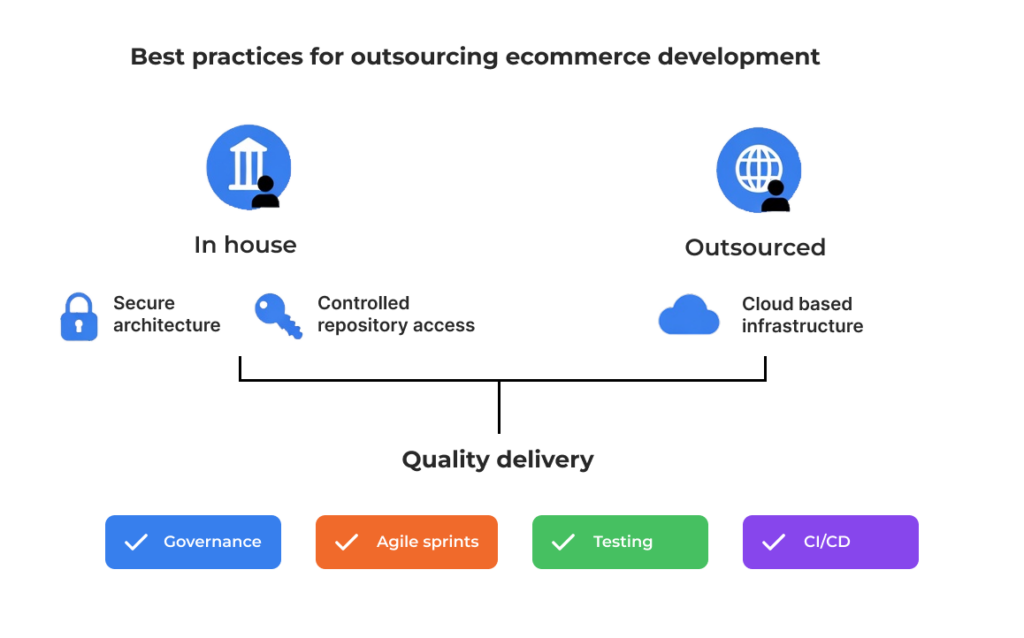
Define the plan, scope, and measures of success
Before work begins, clearly identify the features that will be built, what is outside the scope, significant dates and milestones, and how success will be evaluated using metrics like conversion rate, load time, uptime, etc.
Maintain product ownership and architectural decisions within the organization
Your team should make decisions about architecture, including hosting, platforms, and integrations, as well as business demands and UX. Outsourced teams should focus on execution. Outsource ecommerce development to ensure defined product ownership and maintain control over strategic architecture decisions.
Integrate milestones and sprint demos into Agile delivery
Make use of weekly sprints, sprint demos, and distinct milestone checkpoints when implementing Agile delivery. This cycle ensures that you can quickly change objectives, monitor results early, and avoid spending time on work that is not aligned.
Enforce coding standards, documentation, and testing
By making a system for unit testing and integration testing, setting up, deployment, and documenting APIs, and ensuring a review for every feature, a system for testing, documenting, and coding standards will be enforced to avoid messy coding and easy maintenance.
Maintain access to repositories, CI/CD, and cloud accounts
You are responsible for maintaining your own cloud or hosting account, CI/CD pipeline, and Git repository. By doing this, you can avoid vendor lock-in and ensure control even if you decide to switch teams later.
Set channels for escalation and communication
Develop an escalated process related to blocks, weekly progress meetings, and daily updates. This prevents delays and misconceptions since there is one point of contact.
Read More: Curious how AI fits into your store? Learn how outsourcing eCommerce development helps turn AI ideas into practical experiences.
Industry Trends and Forecasts for Outsourcing eCommerce Development
Headless and Composable Commerce: There are increased need for decoupling architectures. There are opportunities to enable brand performance in omnichannel experiences across social media and mobile platforms via front and backend decoupling.
AI-Driven Personalization: Organizations are partnering with dedicated experts to make the most out of machine-learning algorithms with the help of AI-driven hyper-personalization.
Dedicated Teams versus Project-Based Work: Nowadays, the market prefers to have a dedicated development team instead of project-based work. This offers access to deep knowledge of a domain and a product mindset as well.
Security and Compliance as Differentiators: The ability to support PCI DSS compliance, DevSecOps, and maximize website speed is becoming a choice for choosing a hosting provider due to the increasing regulatory landscape for data privacy.
Nearshore and Hybrid Delivery: Nearshore or Hybrid outsourcing is another option to bridge the gap of Costs and Teams. This will allow us to benefit from the advantages of real-time communication of local teams and the scalability of global talents.
How to Choose the Right Outsourcing eCommerce Development Vendor
Platform expertise: It is best to select vendors that have built a successful e-commerce site in the past. Of course, the selected vendor needs to be familiar with the platform constraints, customizations, connectors, gateways, and optimizations, too.
Relevant industry case studies: Prepare case studies of the same industry based on the real-time results obtained by the companies in the same particular domain, such as an improved conversion rate, better page loading time, improved checkout procedures, etc.
Transparent pricing and delivery models: Good software providers know that transparency is essential in defining the scope, schedule, milestones, and engagement models that can vary from a model based on a fixed price to a model based on material, to a dedicated team model.
Documentation, security, and assurance of quality: This ensures effective security operations, such as PCI and ATA, are in place, as are effective quality assurance operations. Strict coding standards are in place with full documentation to ensure the system is running effectively.
Clear ownership of IP, code, and data: For instance, if you need to eliminate vendor lock-ins, you must ensure ownership over your source codes, repositories, and customer data in Outsource ecommerce development.
Support and scalability after launch: Ongoing support, monitoring, upgrade, and scalability offered by the vendor would allow the ability to cope with the rise in traffic, features, and seasons without encountering performance problems.
Read More: Not sure which features actually matter? Explore how an outsourced eCommerce team helps you choose and build what drives results.
Market Analysis of Outsourcing eCommerce Development
Outsourcing ecommerce development has grown into an effective and well-established industry on a global scale as a result of rising demand for digital commerce and increasing technical complexity.
Businesses around the world rely on external partners to build scalable e-commerce systems, and a shortage of skilled e-commerce developers and architects is driving the growth of outsourcing.
Popular outsourcing locations, including India, Eastern Europe, and Southeast Asia, allow for flexible delivery methods such as offshore, nearshore, and dedicated teams.
While SMEs outsource primarily for speed and cost efficiency, companies prioritize scalability, security, and long-term partnerships more.
The market is progressively selecting specialized eCommerce partners over generic development shops due to their deeper platform experience and issue awareness, even if there are both large service firms and boutique eCommerce agencies in the vendor environment.
Pricing Models and ROI Considerations for Outsourcing eCommerce Development
Cost control, speed, and return on investment are all directly impacted by the price model selected when outsourcing e-commerce development. Every model is appropriate for various business situations.
Common models of pricing:
Fixed price model: Projects with set prices are ideal for clearly defined needs, like moving a store from WooCommerce to Shopify. Costs and schedules are predictable, making budgeting easier, but modifications may result in increased scope and expense in outsourcing ecommerce development.
Time and material: Perfect for iterative builds when needs change in response to testing and user input, such as continuing feature improvements or custom checkout optimization.
Devoted development teams: Ideal for long-term expansion, like overseeing a sizable Magento or headless eCommerce platform that requires ongoing development, integrations, and performance optimization.
ROI considerations:
Reduced staffing and infrastructure costs: Companies just pay for the necessary knowledge instead of hiring an entire internal team, including developers, QA, and DevOps.
Faster time-to-market: A skilled vendor may create a Shopify store in a matter of weeks, which enables firms to begin making money sooner.
Decreased rework: Skilled eCommerce teams steer clear of typical platform errors, saving money on subsequent adjustments and redesigns in outsourcing e-commerce development.
Scalable without overhead: Without long-term payroll obligations, teams can scale up at busy times like sales campaigns, product launches, and scale down afterwards.
Conclusion
The success of outsourcing ecommerce development depends on teamwork and collaboration. Outsourcing provides scalable architecture, access to skilled labor, consistent pricing, and faster execution when done right.
The businesses can ensure quality while taking the help of external teams for efficient execution by maintaining ownership of strategy, architecture, data, and decision-making. e-commerce Outsourcing can be changed from a cost-saving strategy into a long-term growth plan with clear protocols, effective communication, and the right delivery model.
Businesses that use specialized eCommerce development teams get advantages in speed, security, and innovation as eCommerce systems adapt to headless, AI-driven, and networked architectures.
Choosing the right partner and governance model will help you expand with confidence and quality. Choose Patoliya infotech because we have highly skilled specialists who understand all of your concerns and are there whenever you need them.
FAQs:
What do you mean by outsourcing?
Assigning specific tasks or services to an outside company or group instead of carrying them out internally is known as outsourcing. Businesses outsource to acquire specialized knowledge, save costs, and save time.
What is the best example of outsourcing?
Instead of expanding its in-house marketing team, the company outsources SEO, content marketing, and social media management to the digital marketing agency.
Who benefits most from outsourcing?
Companies that benefit the most from outsourcing are startups, small and mid-sized businesses, as well as companies with growth potential but struggle to hire due to the associated costs.
When should you not outsource?
You should avoid outsourcing core business strategy, brand vision, sensitive decisions, or cases where requirements are unclear, and fast collaboration inside the company is necessary.
What are 4 types of outsourcing?
These include offshore outsourcing, nearshore outsourcing, onshore outsourcing, and hybrid outsourcing as the main types.
What are the three levels of outsourcing?
The levels of service providers can be categorized as task-based, project-based, and full-service dedicated team providers.
What level of post-launch support and maintenance can I expect from an outsourced eCommerce partner?
Ongoing services can also be expected, including maintenance like bug fixes, performance monitoring, security patches, feature additions, backup services, and other forms of support, depending on the chosen services.
Can outsourced teams handle complex eCommerce integrations?
Yes. Outsourcing teams that are experienced can handle integrations like payment gateways, ERP, CRM, logistics management systems, APIs, and headless commerce efficiently and effectively.