Cloud Finops Benefits and Business Impact
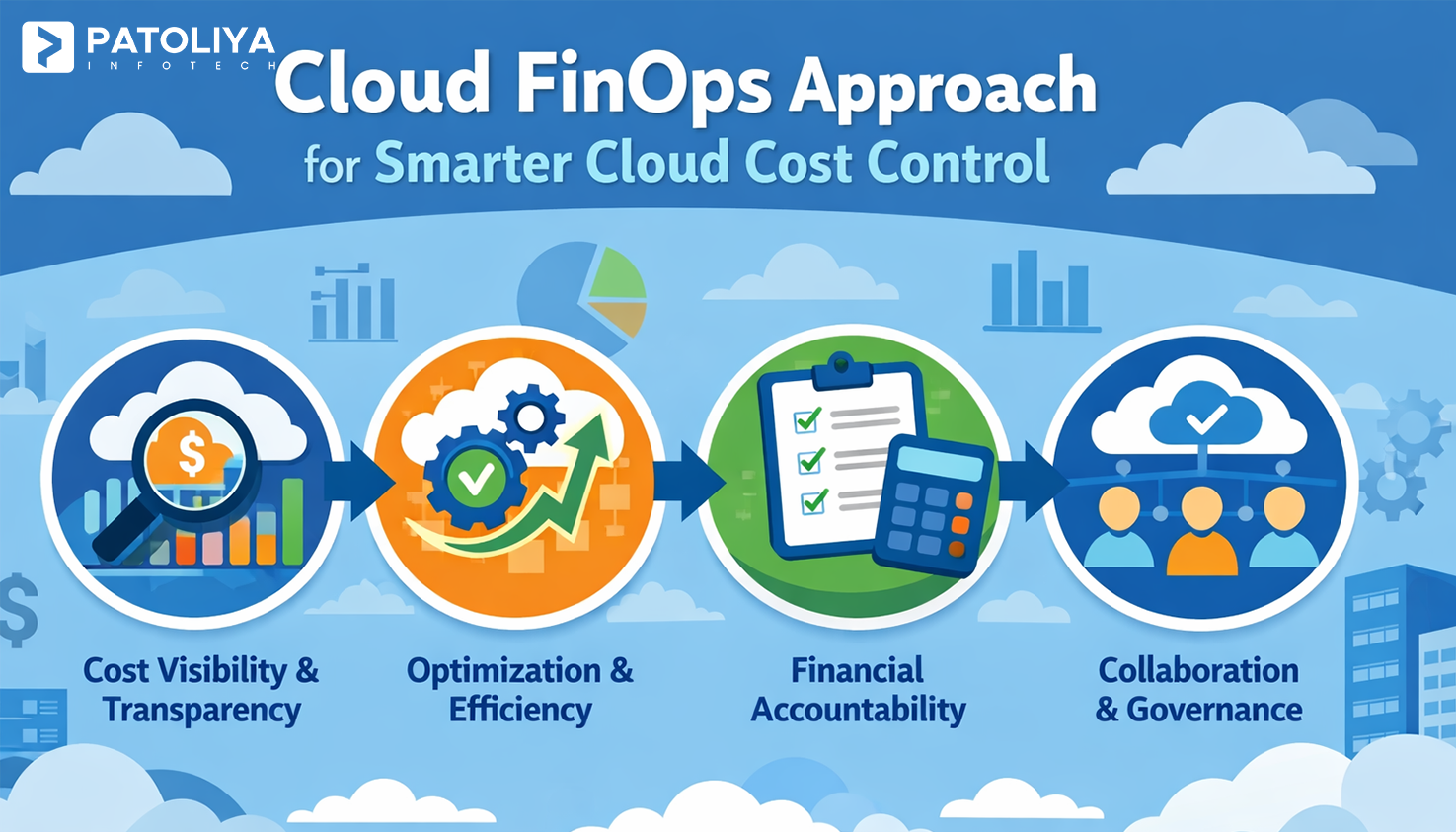
Table of Contents
Cloud infrastructure has transformed how businesses operate, but it has also introduced a new and complex challenge: uncontrolled spending. Cloud FinOps, short for cloud financial operations, is the discipline that solves this problem directly. Without a structured approach, organizations often face surprise billing, duplicated resources, and zero accountability across teams.
Cloud cost optimization brings financial discipline to cloud environments by aligning engineering, finance, and product teams around shared goals. Many organizations also work with an experienced IT software development company to design scalable cloud infrastructure while maintaining strong financial governance and cost control.
As cloud budgets grow larger and more unpredictable, adopting Cloud Spend Optimization is no longer optional. It is a foundational practice for any business serious about sustainable cloud growth and smarter resource utilization.
What Cloud FinOps Means
Cloud FinOps is the practice of financial accountability, uniting finance, technology, and business teams to manage cloud spending effectively. Implementing effective FinOps strategies often requires specialized cloud infrastructure transformation services to align architecture, cost monitoring, and automation. It creates shared ownership where every team understands cost impact.
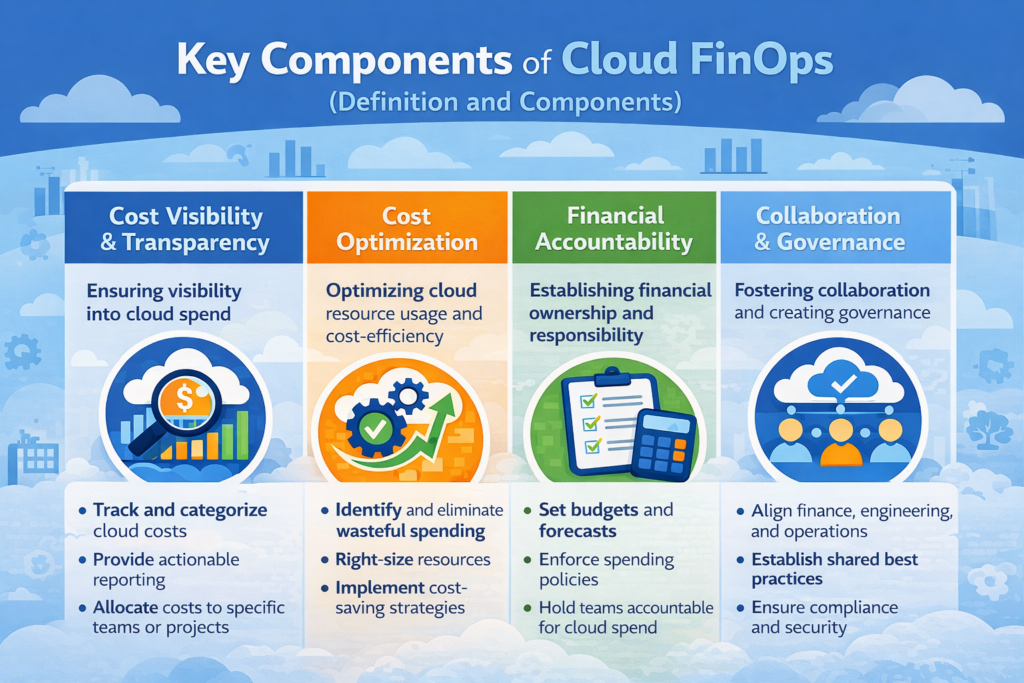
Key components include cost allocation, real-time visibility, chargeback models, and continuous optimization. Cloud cost optimization embeds cloud spend governance into daily workflows, making every infrastructure dollar a deliberate investment.
Traditional IT budgeting handled fixed, predictable costs well. According to the widely accepted cloud computing definition, cloud services provide scalable infrastructure delivered through on-demand network access. As cloud usage expanded across AWS, Azure, and Google Cloud, costs became variable and hard to forecast. Cloud FinOps emerged to handle dynamic pricing and multi-cloud complexity. It brought financial rigor to environments where infrastructure costs shift hourly, formalizing cloud financial management as a necessary organizational discipline.
Why Cloud FinOps is Important
Cost Transparency and Accountability
Cloud FinOps introduces cloud cost transparency by giving every stakeholder clear visibility into spending. Teams see exactly where money flows and where waste hides. For example, unused test environments running for weeks cost thousands. Cloud cost visibility stops overspending before it compounds and builds financial accountability across all departments effectively.
Better Decision-Making and Forecasting
Cloud Finance Management enables data-driven budgeting through cloud financial management. Teams analyze historical usage, identify seasonal spikes, and model future infrastructure needs accurately. A business launching a product can forecast computing costs proactively. Cloud budget management becomes precise when decisions rest on real usage data rather than assumptions.
Core Benefits of Cloud FinOps
Optimized Cloud Costs
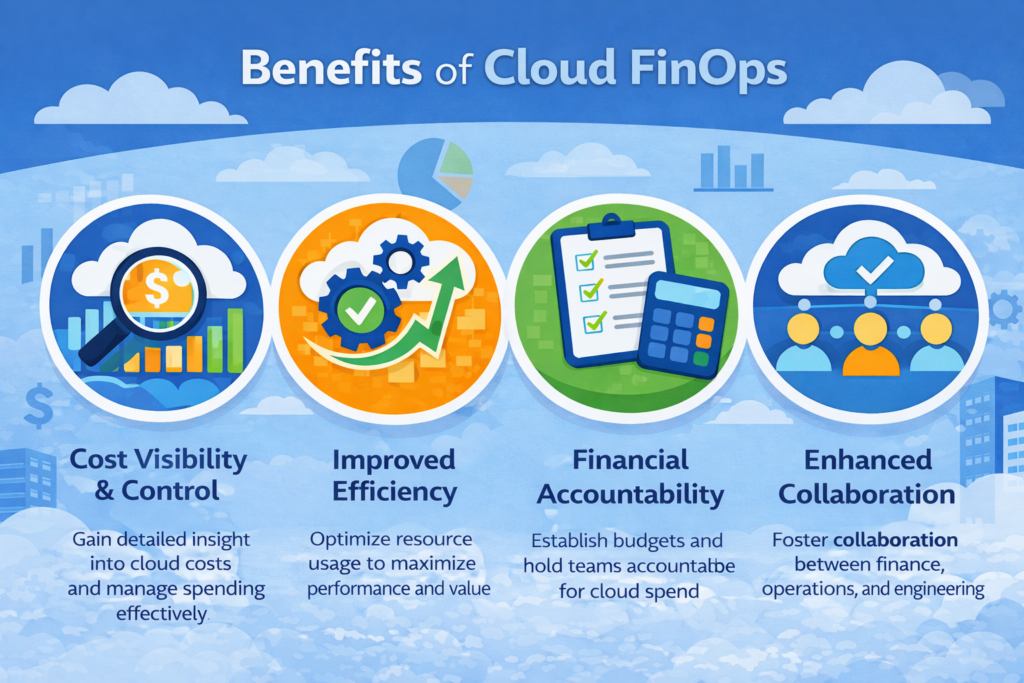
Cloud Cost Management drives direct cost reduction through shared accountability and smart cost allocation. Teams identify idle resources, rightsize underutilized instances, and eliminate redundant services. Consider an enterprise running oversized virtual machines with no ownership review.
Cloud cost optimization assigns responsibility and drives cloud cost optimization continuously. Organizations typically cut unnecessary spend by 20 to 30 percent within the first year of adopting cloud FinOps practices.
Cross-Team Collaboration and Culture
Cloud Spend Optimization breaks silos between finance and engineering teams. Engineers think in cost efficiency terms. Finance gains technical literacy. Product managers weigh feature costs deliberately.
This alignment is among the strongest cloud FinOps benefits, creating a culture where cloud spend governance becomes shared responsibility, producing better decisions and measurable business outcomes organization-wide.
Cloud FinOps Framework and How It Works
The Inform Phase
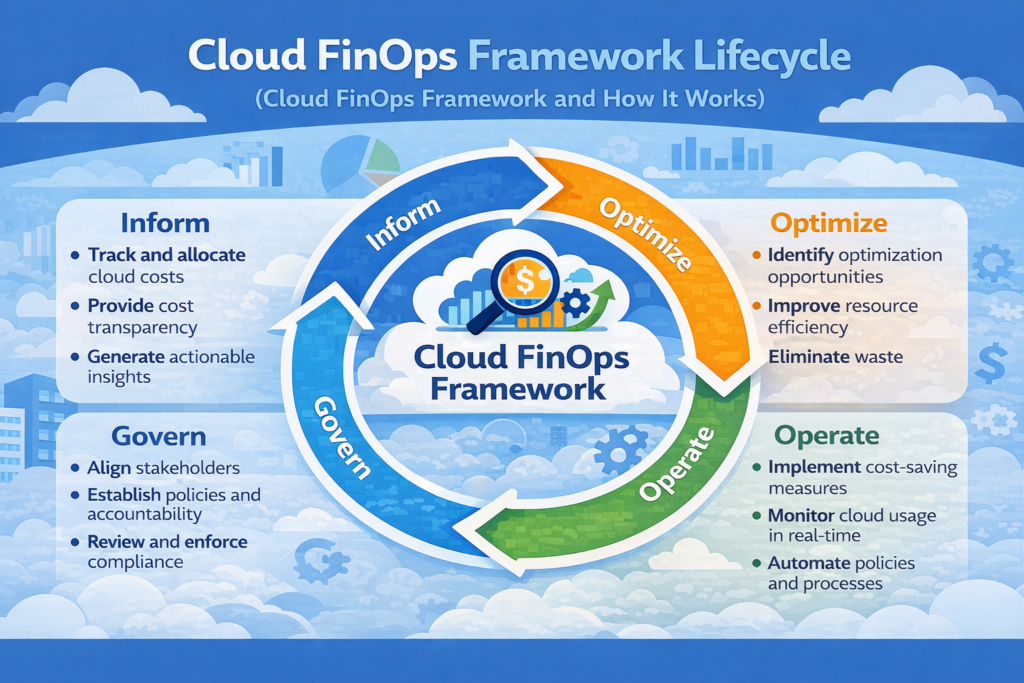
- The Inform phase focuses entirely on cloud cost visibility. The FinOps framework outlines collaborative practices that help organizations monitor, optimize, and govern cloud spending effectively. Organizations centralize billing data, tag resources by team, and build spending dashboards.
- Tools like AWS Cost Explorer and Azure Cost Management surface patterns clearly. Cloud FinOps best practices require this foundation before any optimization or governance work begins successfully.
The Optimize Phase
- The Optimize phase drives continuous cloud cost optimization. Teams rightsize compute instances, purchase reserved capacity, eliminate zombie resources, and schedule non-production shutdowns.
- Cloud Spend Optimization treats optimization as an ongoing discipline rather than a one-time project. Engineering and finance collaborate directly on efficiency decisions that align with budget targets consistently.
The Operate Phase
- The Operate phase embeds cloud spend governance into regular business rhythms. Teams hold cost reviews, track budgets in real time, and respond to anomaly alerts instantly.
- KPIs like cost per business output unit become standard. Cloud FinOps lifecycle practices scale financial accountability as the organization grows and cloud environments evolve continuously.
Common Cloud FinOps Challenges
Visibility and Data Complexity
Complex cloud billing data is among the biggest FinOps challenges. Invoices span hundreds of line items across regions and accounts. Without proper tagging strategies, cost allocation becomes guesswork. Poor cloud cost visibility stems from inconsistent resource tagging and missing analytics tools that translate raw usage data into actionable intelligence.
Organizational Resistance
Teams often resist financial accountability, viewing it as a barrier to speed. Engineers prioritize performance. Finance lacks technical confidence. FinOps importance becomes clear only after early wins demonstrate real savings. Executive sponsorship and cross-functional FinOps champions drive cultural adoption, turning resistance into shared commitment over time.
Why Patoliya Infotech Is Important for Cloud FinOps and Why It Excels
Patoliya Infotech stands out as a trusted partner for organizations implementing Cloud Spend Optimization with precision and lasting impact. With deep expertise in cloud cost optimization and cloud financial management, Patoliya Infotech brings technical depth and strategic vision to every engagement. Their team supports real-world cloud FinOps implementation from initial assessment through full lifecycle governance, tailoring frameworks to each organization's unique architecture and goals.
Patoliya Infotech trains cross-functional teams in cloud financial accountability, helping organizations establish tagging strategies, build cost dashboards, and run optimization sprints delivering measurable results. Clients experience Cloud Cost Management in practice, not just theory. For businesses of any size, Patoliya Infotech provides the expertise and ongoing support to make cloud financial management a sustainable competitive advantage.
Conclusion
Cloud FinOps is an essential discipline for any organization running cloud workloads. By uniting finance, engineering, and product teams around shared financial accountability, Cloud Spend Optimization delivers cost transparency, smarter forecasting, and a continuous optimization culture.
The cloud FinOps framework guides organizations through Inform, Optimize, and Operate phases regardless of size or maturity. Cloud financial management benefits are tangible, measurable, and strategic. Businesses embracing Cloud Spend Optimization gain cost control and a stronger foundation for innovation.
Adopting Cloud Cost Management today means spending smarter, forecasting accurately, and growing more confidently with every cloud investment made. Organizations planning to implement cloud financial governance can speak with our cloud experts to explore scalable FinOps strategies tailored to their infrastructure.
FAQs:
What is Cloud FinOps in simple terms?
Cloud FinOps is a collaborative framework helping organizations manage and optimize cloud spending by uniting finance, engineering, and business teams. It creates shared accountability so every cloud dollar is intentional, tracked, and aligned with business value.
Who should implement Cloud FinOps in an organization?
Any organization using cloud services benefits from Cloud Cost Management. Finance teams, engineering teams, and product managers all play active roles. It works for startups, mid-sized companies, and large enterprises alike, especially with strong leadership support driving cross-functional adoption.
How does Cloud FinOps save money?
Cloud Cost Management saves money through cloud cost visibility and cloud cost optimization practices. Identifying idle resources, rightsizing instances, and eliminating waste reduces unnecessary cloud expenditure significantly, often by 20 to 30 percent within the first year of structured implementation.
Is Cloud FinOps only for large enterprises?
Cloud FinOps works for organizations of all sizes with meaningful cloud spend. Smaller organizations start with simple visibility tools and basic tagging, scaling their cloud financial management processes as infrastructure and teams grow over time without requiring massive upfront investment.
What tools support Cloud Finance Management?
Tools, including AWS Cost Explorer, Azure Cost Management, CloudHealth, and Apptio, support Cloud Cost Management. Resource tagging tools, billing dashboards, and cost anomaly detection services power the visibility and cloud cost optimization work central to cloud financial management.
How quickly can businesses see impact from Cloud FinOps?
Most organizations see meaningful cloud financial management benefits within three to six months. Once cloud cost transparency is established and optimization processes run consistently, teams identify quick wins like unused resources and rightsizing opportunities, delivering measurable savings as accountability matures.