How to Build a Winning SaaS Pricing Strategy
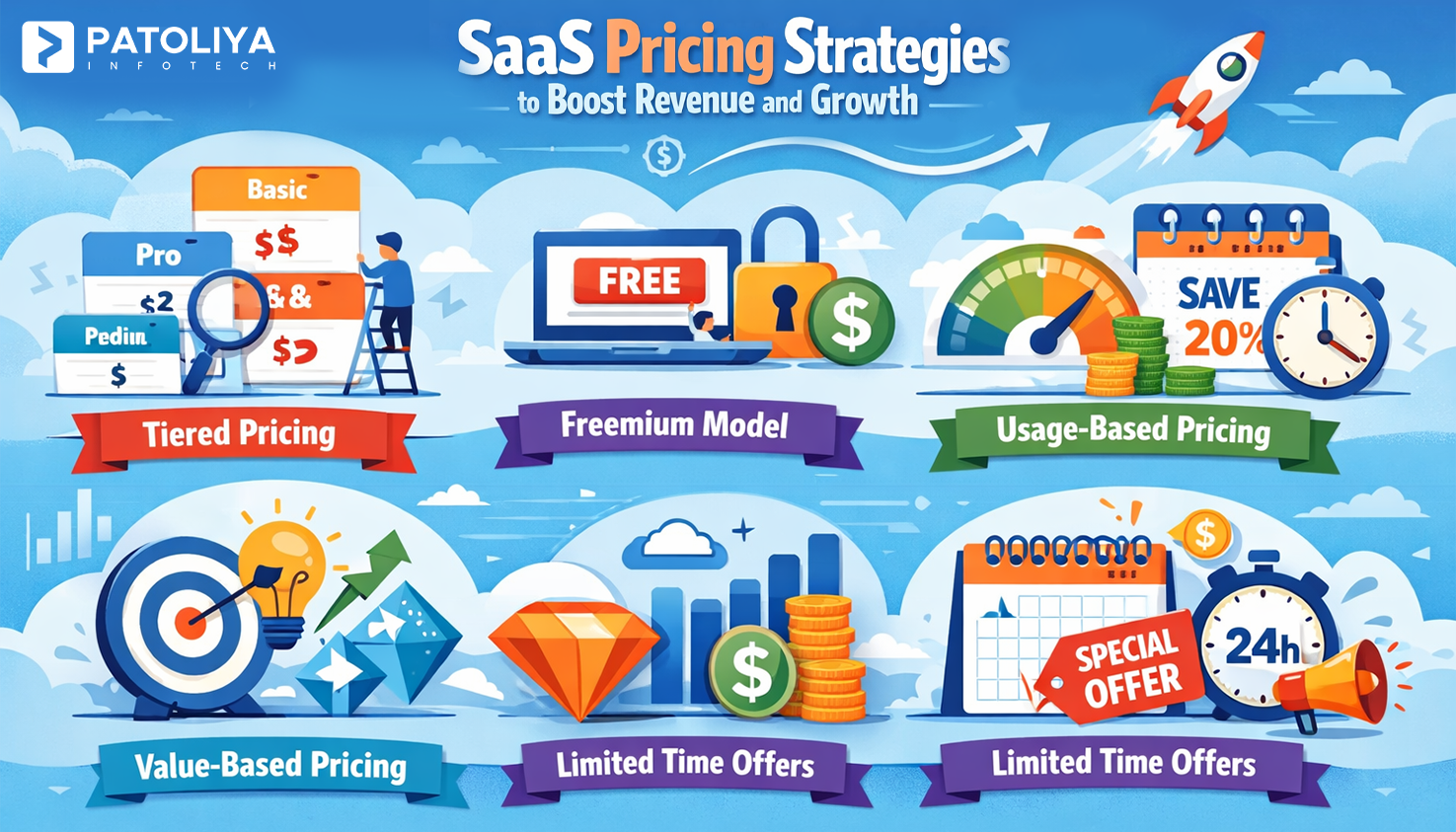
Table of Contents
SaaS pricing is not a number on a webpage. It is the strategic foundation that determines how fast your company grows, how long customers stay, and how investors value your business. The right SaaS pricing strategy signals product value, attracts the right customers, and fuels predictable recurring revenue. Get it wrong, and even the best product struggles to scale. Many SaaS founders also collaborate with a SaaS product development partner to ensure pricing models, billing systems, and product architecture scale together as the platform grows.
In 2026, SaaS pricing has grown more dynamic than ever. AI-driven tools are reshaping how value is delivered and measured, usage based pricing is becoming the default model for API platforms and developer tools, and product led growth companies are reimagining how SaaS pricing models guide users from free to paid. This guide covers every major model, advanced strategies, and a practical optimization framework to help you build SaaS that converts, retains, and scales.
What Is SaaS Pricing and Why It Defines Business Growth
A well-structured SaaS pricing strategy creates recurring, forecastable income. The subscription pricing model, the most widely adopted framework in SaaS, allows finance teams to project monthly and annual recurring revenue with precision. This recurring structure reflects the software as a service model, where applications are delivered through cloud infrastructure rather than traditional software licensing.
When the SaaS billing model aligns with how customers derive value from your product, renewals become the default behavior rather than a sales challenge. Companies with clearly structured SaaS pricing models consistently report stronger revenue predictability than those with undefined pricing logic.
Impact on customer lifetime value and churn
Customer lifetime value in SaaS is directly tied to pricing structure. The customer lifetime value concept helps companies estimate the long-term revenue generated from each customer relationship. When customers feel they are paying a fair price relative to outcomes delivered, they stay longer and expand usage. Misaligned SaaS billing model creates friction at renewal and accelerates churn. A tiered pricing structure allows customers to grow into higher plans instead of churning when needs evolve, directly improving net revenue retention.
Core SaaS Pricing Models With Real World Examples
Subscription pricing model with flat rate example
The flat rate subscription pricing model charges every customer the same fixed monthly or annual fee regardless of usage or team size. Basecamp is a well-known example, offering all features for a single flat price. This model simplifies billing and reduces decision fatigue. However, it leaves revenue on the table from power users and may underprice enterprise buyers while overcharging smaller teams.
Tiered SaaS pricing models with product segmentation example
A tiered pricing structure groups features and limits into defined plans, typically Starter, Professional, and Enterprise. HubSpot is a strong example of tiered SaaS pricing models, separating CRM, marketing, and reporting capabilities across tiers to serve different buyer segments.
Tiered SaaS pricing strategy work well when your product has clear feature value differences that map to distinct customer profiles. The key risk is creating too many tiers, which overwhelms prospects and stalls conversion.

Per user pricing model and scaling impact
The per user pricing model charges based on the number of active seats. Salesforce and Slack have built large revenue engines on per user SaaS billing model. This model aligns cost with team growth and is easy to budget. However, it can discourage broad adoption since customers may limit seats to control costs rather than rolling the product out company-wide.
Usage based pricing and AI driven SaaS example
Usage-based SaaS subscription pricing models charge customers based on actual consumption, such as API calls, compute hours, or AI credits. Stripe charges per transaction, Twilio charges per message, and OpenAI charges per token.
Usage-based pricing is especially suited to AI-driven SaaS platforms where value delivery fluctuates by workload. It lowers the barrier to entry and ensures customers never pay for value they did not receive.
Advanced SaaS Pricing Models Used by High Growth Companies
Freemium model SaaS and product led growth
The freemium model SaaS approach offers a permanently free tier with limited functionality to drive top-of-funnel acquisition. Notion, Figma, and Zoom built product led growth engines on the freemium model SaaS, converting free users to paid plans through in-product value triggers. A SaaS monetization strategy built on freemium requires disciplined feature gating and clear upgrade paths to convert free users efficiently.
Value based pricing software with customer outcome alignment
Value based pricing software sets price based on measurable outcomes delivered to customers rather than cost or competitor rates. A platform that saves a company 20 hours per week can price based on that productivity value rather than feature count.
Veeva Systems uses a value-based SaaS subscription pricing model to charge pharmaceutical clients based on compliance risk reduction and revenue impact. This approach requires willingness-to-pay research but delivers the strongest margin expansion in any SaaS pricing strategy.
Hybrid SaaS pricing strategy combining tiers and usage
A hybrid SaaS pricing strategy combines a base subscription fee with usage-based overages. Datadog charges a platform fee plus consumption billing for logs and metrics. This hybrid SaaS strategy provides revenue predictability through the base tier while capturing upside as customers scale. It is rapidly becoming the dominant SaaS for infrastructure, analytics, and AI platforms in 2026.
How to Choose the Right SaaS Pricing Strategy for Your Product
Mapping pricing to ideal customer profile
Your ideal customer profile should drive every SaaS pricing decision. SMB-focused products benefit from self-serve, low-friction SaaS pricing strategy or models. Enterprise SaaS billing model requires negotiated contracts, custom tiers, and dedicated onboarding.
Mismatching your SaaS strategy to the wrong segment results in either uncaptured revenue from enterprise buyers or pricing out the SMB customers who form your growth base.
Aligning SaaS pricing with product complexity and value delivery
A simple, single-use SaaS tool suits flat rate or per user pricing. A multi-module platform delivering compounding value warrants a tiered pricing structure with expansion paths. If your product delivers value through outputs, usage-based pricing feels fairest to customers. Building SaaS platforms with flexible pricing logic often requires specialized custom software development services to integrate metering systems, subscription billing, and analytics infrastructure. If it delivers value through constant access and availability, the subscription pricing model works better.
Competitive positioning without price wars
Competing purely on price is a race to zero margins. Pricing psychology in SaaS plays a significant role here. Anchor pricing, charm pricing, and decoy tiers all influence perceived value without requiring lower prices. Position your SaaS pricing strategy around outcomes, not feature lists, to justify premium positioning confidently and avoid commoditization.
Data Driven SaaS Pricing Optimization Framework

Using average revenue per user and expansion revenue
Average revenue per user is a foundational SaaS billing model health metric. Tracking it alongside expansion revenue reveals whether your tiered pricing structure is working.
If average revenue per user is flat but usage is growing, your SaaS pricing models may be leaving significant money on the table. Expansion revenue from upsells and cross-sells should represent 20 to 30 percent of new MRR in a mature SaaS monetization strategy.
A B testing SaaS pricing pages for conversion lift
A/B testing pricing pages is one of the highest-leverage growth activities available. Test plan naming, price anchoring, feature emphasis, billing toggle placement, and CTA copy.
Pricing psychology in SaaS shows that positioning the middle tier as the recommended option can lift plan selection rates by 20 to 40 percent. Even small improvements at the SaaS pricing page level compound into significant SaaS revenue optimization outcomes over time.
Tracking pricing psychology signals in user behavior
Product telemetry reveals pricing psychology signals at scale. If users consistently hit feature limits before upgrading, your freemium model SaaS conversion triggers are working. If users upgrade and immediately exhaust the next tier, your tiered pricing structure needs adjustment.
Behavioral signals like time to upgrade, feature adoption sequences, and plan abandonment rates are the hidden inputs of a high-performing SaaS pricing strategy.
Common SaaS Pricing Mistakes That Reduce Revenue

Underpricing enterprise SaaS pricing plans
Enterprise SaaS pricing plans are chronically underpriced at early-stage companies. Founders anchored to SMB benchmarks apply the same rate card to enterprise deals worth ten times more value.
Enterprise buyers expect to pay more for compliance, SSO, dedicated support, and SLA guarantees. Underpricing enterprise SaaS billing model destroys margin and signals a lack of confidence in your product's value to the very buyers most willing to pay.
Overcomplicating tiered pricing structure
A tiered pricing structure with more than four tiers creates analysis paralysis. Prospects who cannot quickly identify the right plan will abandon the page. The optimal tiered pricing structure uses three tiers, each anchored to a clear customer segment.
Each plan should communicate one dominant value proposition rather than an exhaustive feature comparison. Simplicity in SaaS subscription pricing models is a direct conversion advantage
Ignoring usage data in usage based pricing
Usage based pricing without usage analytics is billing blindness. Companies using usage based pricing must instrument every billable event and surface consumption alerts proactively. Customers who receive unexpected invoices churn fast. Proactive usage communication builds trust and creates conditions for intelligent SaaS revenue optimization through well-timed, data-backed upsell conversations.
Why Patoliya Infotech Is Important for SaaS Pricing Strategy Success
Expertise in building scalable SaaS pricing models
Patoliya Infotech brings deep experience designing SaaS pricing models that scale with product growth. From structuring tiered SaaS subscription pricing models for multiple buyer segments to designing hybrid SaaS subscription pricing strategy frameworks, the team understands how these pricing decisions impact product, sales, and engineering systems.
Data driven SaaS monetization strategy implementation
Patoliya Infotech builds SaaS monetization strategy frameworks grounded in customer lifetime value analysis, average revenue per user benchmarking, and behavioral cohort data. Rather than applying generic templates, every SaaS billing model decision is mapped back to measurable business outcomes and ideal customer profile alignment.
Technical capability to integrate billing automation and analytics
Patoliya Infotech integrates billing platforms including Stripe, Chargebee, and Paddle with product analytics tools to create a real-time SaaS revenue optimization loop. This infrastructure enables accurate metering for usage based pricing, automated tier enforcement, and expansion revenue triggers based on actual usage signals rather than manual sales outreach.
Conclusion
SaaS pricing is the most powerful and most underutilized growth lever in most SaaS businesses. Whether you choose the subscription pricing model for predictability, usage based pricing for fairness, or a hybrid SaaS pricing strategy for scalability, the goal is the same: price in a way that reflects the value customers receive and grows with them. Test continuously, anchor every decision in customer lifetime value data, and treat your SaaS pricing strategy as a living system that evolves with your product and market. If you are building a SaaS platform or refining your pricing architecture, you can talk with our SaaS experts to explore scalable implementation strategies.
FAQs:
- What is the best SaaS pricing model for startups?
For startups, the freemium model in SaaS billing model drives user acquisition without a sales team. Pair it with simple tiered SaaS pricing models of two to three plans for clear upgrade paths. Early experimentation with usage based pricing helps identify the metrics customers value most.
- How often should SaaS pricing strategy be updated?
Review your SaaS pricing strategy at least annually. Update it when average revenue per user plateaus, churn spikes, or a major feature shifts delivered value. Market changes and ICP expansion are also valid triggers for revisiting your SaaS models.
- Is usage based pricing better than subscription pricing model?
Neither approach is universally better. The subscription pricing model provides predictability and simpler forecasting, while usage based pricing offers fairness and lower adoption barriers. The right choice depends on whether your product delivers constant or variable value.
- How do companies calculate value based pricing software?
Value based pricing software starts with quantifying outcomes like hours saved or revenue generated. Conduct willingness-to-pay research via interviews or conjoint analysis, map results to customer segments, and set price below the ceiling to create perceived value that drives retention.
- What metrics matter most for SaaS pricing optimization?
Key metrics include customer lifetime value, average revenue per user, net revenue retention, time to upgrade in freemium flows, and plan distribution across your tiered pricing structure. Together, they show if your SaaS pricing models capture full product value.
- Can SaaS pricing impact product led growth?
Yes. Transparent SaaS pricing models reduce evaluation friction and let users self-qualify without sales involvement. When SaaS Pricing maps features to outcomes at each tier, users know exactly when to upgrade. Freemium and usage based pricing turn limits into high-converting upgrade prompts.