Table of Contents
TLDR: Real estate app development in 2026 costs $25,000 for an MVP and scales to $400,000+ for enterprise platforms. Off-the-shelf tools cap your differentiation. If you need MLS control, branded UX, or scalable architecture, custom real estate app development is the sharper investment.
A single poor app experience can cost a real estate business a buyer, an agent, and a future referral. Slow property searches, outdated listings, or unreliable performance quickly affects trust and drive users to competing platforms.
In today's digital-first market, real estate app development directly impacts user experience, lead conversion, customer retention, and brand credibility. Building a successful platform requires more than adding features; it demands the right architecture, scalability, and product strategy.
This guide covers the essential features, development costs, technical architecture, and vendor selection considerations for a successful real estate app development project in 2026.
Real estate app development is the process of designing, building, and deploying digital platforms that connect buyers, sellers, agents, and property data across mobile and web. A well-executed property listing app doesn't just display homes. It filters by commute time, surfaces price history, connects agents in real-time, and closes deals faster.
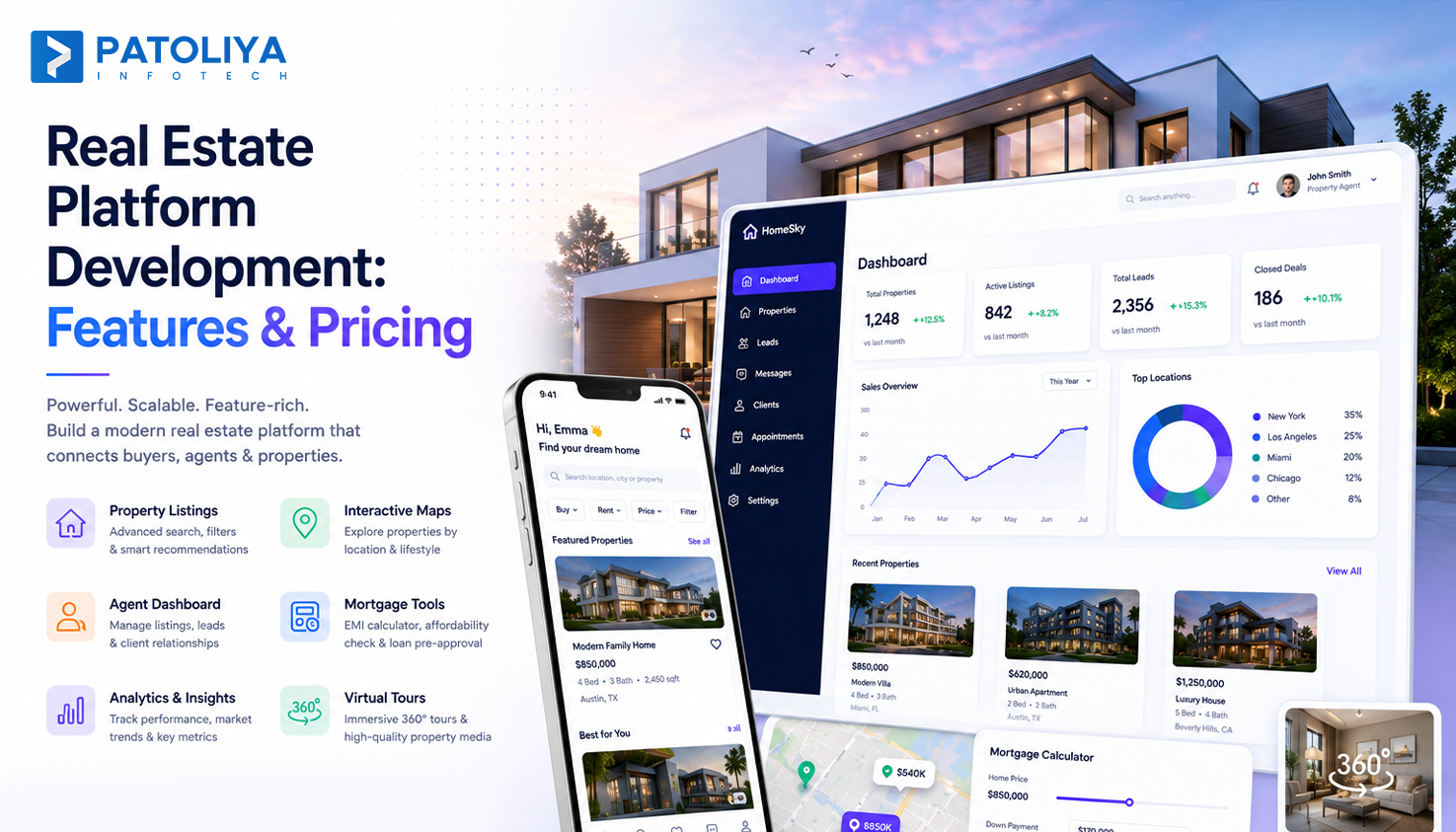
The scope of real estate app development has expanded significantly. Today's platforms integrate MLS API integration, AI-powered recommendations, map-based search UI, and mortgage calculator feature, all within a single user session.
What counts as a real estate app?
A real estate app can be a buyer-facing search tool, an agent CRM, a rental management system, or a full marketplace. The right scope for your real estate app development project depends on who your primary user is and what action you want them to complete inside the app.
The features that actually retain users aren't the flashiest ones, they're the fastest ones. Speed, filter accuracy, and reliable agent contact drive session depth in any property listing app.
Must-have features
Property listing app search filters let users sort by price, location, bedroom count, school district, and listing age. Without granular filters, users bounce. Map-based search UI keeps buyers oriented spatially, most users explore neighborhoods before they explore listings.
Agent-buyer chat reduces friction at the moment of highest intent. When a buyer is ready to ask a question, a 2-minute response window beats a 2-hour email chain every time.
Features that separate platforms
Virtual tour integration has moved from nice to have to a standard expectation post-2020. Listings with virtual tours get significantly higher engagement than photo-only listings.
A mortgage calculator feature embedded in listing pages reduces the number of steps between interest and action.
Real estate app development teams often underinvest in saved search alerts and comparison tools. These features drive repeat visits, the single clearest signal of platform stickiness in any property listing app.
The architecture decisions you make in week one show up as performance problems or scaling costs in year two. This is where most real estate app development projects get underestimated.
React Native handles cross-platform mobile without maintaining two separate codebases. Next.js covers the web layer with SSR for SEO performance, critical for any property listing app where organic search drives acquisition. Skipping SSR is a mistake that costs ranking visibility for months.
Node.js or Django manages the API layer. PostgreSQL with PostGIS handles geospatial queries essential for radius-based property searches. Elasticsearch powers fast, full-text search across thousands of listings.
MLS API integration connects the platform to live listing databases via RESO Web API. Without it, your build real estate platform effort produces a static directory, not a live marketplace.
AWS dominates real estate platform deployments in 2026. S3 handles media storage, CloudFront manages CDN delivery for listing images, and RDS supports PostgreSQL at scale.
To build real estate platform infrastructure that handles peak traffic open house weekends, new listing alerts horizontal autoscaling is non-negotiable from day one.
Most real estate app development projects don't fail because of bad code. They fail because of misaligned scope, underestimated data complexity, and vendor changes mid-build.
Scope without MLS clarity. Teams start real estate app development without confirming MLS board access. MLS boards have approval timelines, sometimes 6 to 12 weeks. Missing this delays launch regardless of how fast development moves.
UI decisions made without agent input. Agents use listing tools under time pressure, often on mobile, during client meetings. A property listing app built without agent usability testing ships a beautiful interface that professionals won't adopt.
Post-launch support gaps. A build real estate platform engagement that ends at App Store submission leaves you without support when MLS data feeds change, API versions deprecate, or App Store policy updates break functionality.
Custom real estate app development and white-label SaaS solve different problems. Choosing the wrong one wastes either money or market position.
When SaaS makes sense
White-label platforms like Placester or AgentFire work well for agents and small brokerages testing a market. Setup is fast, cost is low, and core features are ready out of the box. If you need a property listing app live in 30 days for a single market, SaaS is the right call.
When custom wins
The moment you need full MLS API integration control, custom data models, or a branded user experience competitors can't replicate, SaaS becomes a ceiling.
Custom real estate app development also matters for IP ownership. SaaS vendors own the platform. When you build real estate platform from scratch, you retain full IP ownership of the codebase, the data model, and the user relationships.
For enterprise teams and funded proptech startups, custom real estate app development consistently delivers better unit economics at scale. The higher upfront cost is recovered through better retention and direct monetization control.
Real estate app development costs follow scope, not market rates. The vendor's location affects hourly rate but feature complexity drives total cost more than geography.
| Tier | Scope | Cost Range |
| MVP | Core search, listings, contact | $25,000 to $60,000 |
| Mid-market | MLS integration, agent tools, mobile + web | $80,000 to $150,000 |
| Enterprise | AI features, CRM, multi-tenant, virtual tour integration | $180,000 to $400,000+ |
What actually drives cost
MLS API integration adds 3 to 6 weeks of development depending on the number of MLS boards involved. Map-based search UI with polygon drawing and saved zones adds front-end complexity.
A mortgage calculator feature with real-time rate feeds requires third-party API licensing.
Real estate app development timelines range from 10 to 14 weeks for an MVP to 32 to 52 weeks for an enterprise build real estate platform with AI and multi-tenant architecture.
The cheapest real estate app development quote is rarely the lowest total cost. Vendors who underscope MLS work or skip QA create expensive rework cycles that exceed the initial savings within the first year post-launch.
Real estate app development ROI is measurable but only if you define the right metrics before build starts. Vanity metrics like downloads mislead. The metrics that matter are session depth, saved search rate, agent contact conversion, and listing-to-inquiry ratio.
The platforms with the strongest ROI are those that treat the property listing app as a product.
A real estate app development project without a monetization model is a marketing expense. The revenue model should inform architecture decisions before a line of code is written.
Lead generation fees. Agents pay per qualified buyer lead. This works for high-traffic property listing app platforms with verified listings and strong SEO. Zillow's core model runs on this.
Subscription tiers. Agents or brokerages pay monthly for premium listing placement, analytics, or agent-buyer chat tools. Predictable revenue, easier to forecast.
Transaction fees. A percentage of closed deals, common in build real estate platform products that manage the full transaction workflow including escrow coordination.
Featured listing fees. Sellers or agents pay for promoted placement in search results or on the homepage. Works best at scale.
The model you choose determines which features to prioritize in real estate app development. A lead-gen model needs aggressive SEO and strong property search filters. A subscription model needs agent-facing dashboards and retention-driving analytics. Get this decision made before architecture, not after.
Real estate app development carries specific risks that general software projects don't. Most stem from regulatory complexity, data dependency, and the high expectations of professional users.
Apps operating in the US must follow MLS IDX rules for listing display and attribution. CCPA applies to California users. GDPR applies to EU-facing platforms. Apps handling mortgage data face RESPA and TILA requirements.
A property listing app that violates IDX rules loses MLS data access which means losing the core product. Engage a real estate attorney before launch.
Real estate app development platforms depend on MLS data feeds. Feed format changes, board policy updates, or membership lapses can break listing display overnight.
Build feed monitoring and fallback logic into your build real estate platform architecture from day one.
Changing vendors mid-build is one of the most expensive things that happens in real estate app development. Vet for proptech-specific experience, not just general app development volume.
A vendor with 3 completed build real estate platform projects delivers more value than one with 50 unrelated app builds.
Selecting the right partner for real estate app development is a process decision, not a pricing decision.
MLS integration experience. Ask for specific MLS boards they've integrated with and the timelines involved. Vague answers mean limited proptech depth.
Proptech portfolio. Request 2 to 3 live property listing app or build real estate platform references. Call the references. Ask specifically about post-launch support quality.
IP ownership terms. Confirm you own 100% of the codebase, data models, and third-party API configurations at project close. Some vendors retain licensing rights. That becomes a problem fast.
Post-launch SLA. Real estate app development doesn't end at launch. MLS data feed changes, OS updates, and App Store policy changes require ongoing developer access. A vendor without a formal SLA for post-launch support is a risk.
Communication cadence. Weekly status calls, shared project boards, and documented sprint reviews are non-negotiable for a real estate app development engagement above $50,000. Silence during build is always a warning sign.
These five vendors have documented proptech delivery experience across real estate app development, property listing app builds, and enterprise build real estate platform projects.
Full-cycle real estate app development with verified MLS API integration, React Native mobile, and Next.js web delivery. Strong post-launch SLA.
Key Features: End-to-end real estate app development, MLS board integration, custom property listing app architecture.
Best For: Funded proptech startups and enterprise brokerages needing full IP ownership.
Client Review: 4.9/5
Enterprise-grade real estate app development with AI feature integration and multi-market deployment capability.
Key Features: AI property recommendations, build real estate platform at scale, strong QA process.
Best For: Large brokerages and proptech platforms with complex data requirements.
Client Review: 4.7/5
Mid-market real estate app development with strong UI/UX specialization and mobile-first delivery.
Key Features: Property listing app design, agent-buyer chat modules, cross-platform mobile.
Best For: Regional platforms and agent networks needing fast MVP delivery.
Client Review: 4.6/5
Custom real estate app development with deep CRM integration experience and enterprise compliance support.
Key Features: CRM-connected build real estate platform, compliance auditing, mortgage calculator feature modules.
Best For: Enterprise teams with existing CRM infrastructure.
Client Review: 4.5/5
Hardware-adjacent real estate app development with IoT and smart building integration capability.
Key Features: IoT-connected property listing app, virtual tour integration, smart property management.
Best For: PropTech platforms integrating physical property systems.
Client Review: 4.6/5
Patoliya Infotech delivers real estate app development with a clear scope-to-launch process that eliminates the ambiguity that kills most build real estate platform projects.
Most real estate app development vendors hand off at launch. Patoliya builds the post-launch support structure into the project contract.
For teams that need a property listing app with map-based search UI, agent-buyer chat, and verified IDX compliance, Patoliya's proptech delivery record covers all three.
Book a scoping call with Patoliya Infotech and get a structured real estate app development estimate within 48 hours with feature breakdown, timeline, and stack recommendation included.
The gap between a property listing app that users return to and one they delete after one session comes down to architecture decisions made before build starts. Real estate app development done right means MLS integration from day one, performance-first infrastructure, and a vendor accountable beyond launch.
The market is mature. The tools are proven. What's left is execution. If you're ready to build a real estate platform that earns user trust and drives agent adoption, let's talk scope.